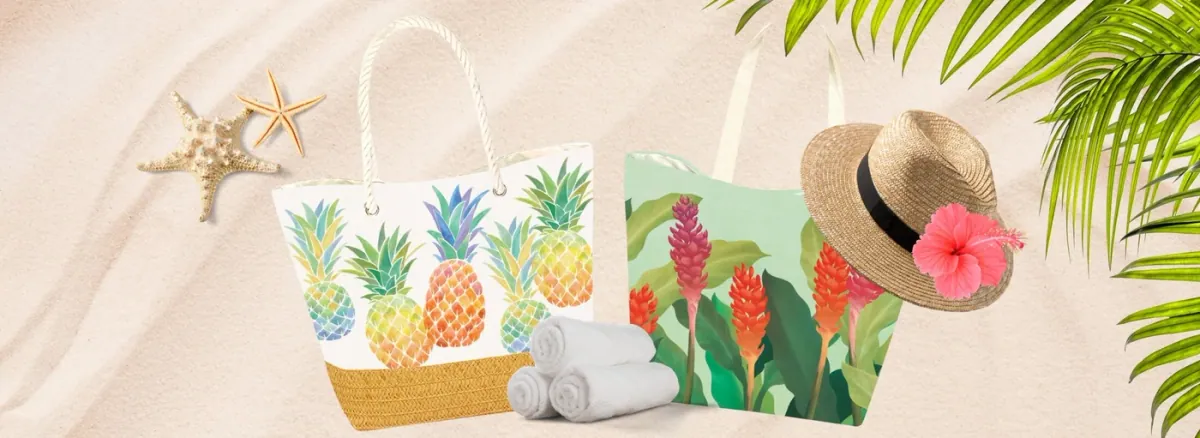
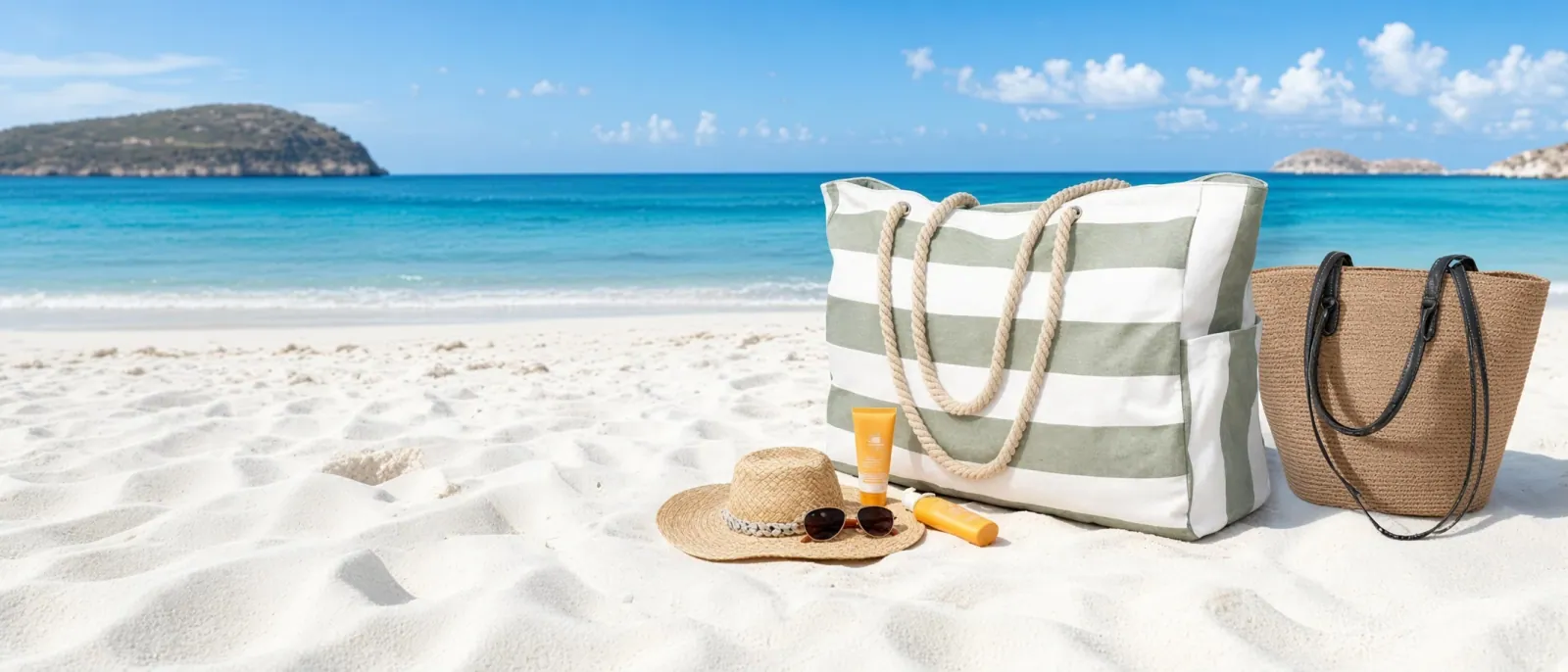
Two beach bags on white sand before a turquoise sea — a striped canvas tote with rope handles and a woven straw basket with leather handles, with a sun hat, sunglasses and sunscreen laid beside them
OEM / ODM · From 100 Pieces

Custom Beach Bag Manufacturer Sun, Salt and Sand — the Colour Holds 4–5

The seam and the handle root are where a beach bag gives out, and neither shows on a screen: the seam pulls water in along its stitch holes once the bag soaks, the root tears as wet webbing stretches under load. Both are proven on the sample — the cloth held 18 hours in seawater, the handle pulled wet, the seam closed by weld or tape rather than thread. What that sample signs off, the run repeats.

  • 40+hours UV exposure
  • 25kg wet-pull, handle root
  • 7-daysample window

Beach bag types

Which Cloth Becomes Which Bag

Canvas, jute, nylon, polyester, mesh, straw, EVA, woven and cotton — the cloths and weaves a beach bag is built from, doing a different job apiece. What is not here is still workable: the pattern is drafted from the sketch or the reference bag the same way.

  • A natural canvas beach tote with two webbing handles and an open top

    Canvas Beach Bags

    • A dense plain weave — the workhorse cloth of the category.
    • Stands open on the sand, holding a shape even when wet.
    • Takes a print cleanly, and softens with washing without sagging.
    • A dense plain weave — the workhorse cloth of the category.
    • Stands open on the sand, holding a shape even when wet.
    • Takes a print cleanly, and softens with washing without sagging.
  • A natural jute beach bag with a woven texture and a printed front panel

    Jute Beach Bags

    • A coarse natural fibre with a hand-made, matte look.
    • Strong for its weight, and renewable — a plant fibre.
    • Lined inside, so the raw weave does not pass sand.
    • A coarse natural fibre with a hand-made, matte look.
    • Strong for its weight, and renewable — a plant fibre.
    • Lined inside, so the raw weave does not pass sand.
  • A lightweight nylon beach tote with a bold stripe and two shoulder handles

    Nylon Beach Bags

    • The lightest body that still takes a full load.
    • Dries fast, and wipes clean of salt and sunscreen.
    • Strong enough for a packed bag, light enough to fold away.
    • The lightest body that still takes a full load.
    • Dries fast, and wipes clean of salt and sunscreen.
    • Strong enough for a packed bag, light enough to fold away.
  • A printed polyester beach bag with a blue-and-white stripe and rope handles

    Polyester Beach Bags

    • Takes an all-over sublimation print across the whole face.
    • A 600D weave that wipes clean of sand and salt.
    • Keeps a printed line sharp, run after run.
    • Takes an all-over sublimation print across the whole face.
    • A 600D weave that wipes clean of sand and salt.
    • Keeps a printed line sharp, run after run.
  • An orange mesh beach bag with an aqua adjustable webbing strap and a top zip

    Mesh Beach Bags

    • Sand falls straight through the weave.
    • Drains and dries with no wiping, so nothing stays damp.
    • A light open body over a solid base panel.
    • Sand falls straight through the weave.
    • Drains and dries with no wiping, so nothing stays damp.
    • A light open body over a solid base panel.
  • A hand-woven straw beach tote with red handles and a printed lining

    Straw & Raffia Bags

    • A hand-woven shell — the surface varies body to body.
    • Lined inside, because the open weave takes in sand.
    • Rope or leather handles, specified here; a seasonal build, ordered early.
    • A hand-woven shell — the surface varies body to body.
    • Lined inside, because the open weave takes in sand.
    • Rope or leather handles, specified here; a seasonal build, ordered early.
  • A molded EVA foam beach bag in sky blue with two arched top handles and a perforated face

    EVA Beach Bags

    • Molded as one rigid body, with no seam to leak.
    • Wipes dry and holds its shape, dry or wet — the poolside answer.
    • A print applies to the mold face; neoprene sits beside it for a soft body.
    • Molded as one rigid body, with no seam to leak.
    • Wipes dry and holds its shape, dry or wet — the poolside answer.
    • A print applies to the mold face; neoprene sits beside it for a soft body.
  • A woven striped beach tote in cream and taupe with tan leather handles

    Woven Totes

    • A knitted weave with a little give, not a flat cloth.
    • Soft-bodied, so it folds flat into a case or a drawer.
    • The casual counterpoint to the rigid cloths on this row.
    • A knitted weave with a little give, not a flat cloth.
    • Soft-bodied, so it folds flat into a case or a drawer.
    • The casual counterpoint to the rigid cloths on this row.
  • A soft cotton beach bag in a pale dye with a small front pocket

    Cotton Beach Bags

    • Lighter and softer than canvas, with a matte hand.
    • Takes dye and a soft-hand print better than a coated cloth.
    • A calm body for a quieter print — the low-key end of the range.
    • Lighter and softer than canvas, with a matte hand.
    • Takes dye and a soft-hand print better than a coated cloth.
    • A calm body for a quieter print — the low-key end of the range.

Salt, sun and sand

Where a Cloth Gives and Where It Holds

Long sun, salt water, sand that never fully leaves, and a handle pulled while the webbing is wet — whichever of these a run has to beat decides which beach-bag cloth is right. All nine are graded against the same four; open one to read why a grade is set.

HoldsBuilt for it as standardWith a specNeeds a spec or a liningFalls shortDesign around it
Nine beach-bag cloths rated against sun, seawater, sand and a wet load — a qualitative chooser, not a test result. Point at a cloth to read why its four grades are set.
ClothSun holdSeawater holdSand releaseWet-load seam
With a specWith a specHoldsHolds
With a specFalls shortFalls shortHolds
HoldsHoldsHoldsHolds
HoldsHoldsHoldsWith a spec
With a specFalls shortFalls shortWith a spec
HoldsHoldsHoldsHolds
With a specWith a specFalls shortWith a spec
Falls shortWith a specHoldsWith a spec

WhyCanvas

  • Sun holdDyed cotton fades unless the lot is lightfast-tested.
  • Seawater holdSalt wicks in and stains; the yarn lot is colour-fast checked.
  • Sand releaseA tight weave shakes out clean.
  • Wet-load seamSewn seams take a wet pull; box-X at the root.

WhyJute

  • Sun holdNatural jute dries unevenly and darkens.
  • Seawater holdRaw fibre wicks salt water and smells if it stays damp.
  • Sand releaseAn open weave passes sand through to the lining.
  • Wet-load seamA strong fibre on the seam; a lined body carries it.

WhyNylon

  • Sun holdSolution-dyed nylon holds its colour.
  • Seawater holdSalt rinses off and the dye stays.
  • Sand releaseA tight weave wipes and shakes clean.
  • Wet-load seamSewn seams on a cloth that is light and strong.

WhyPolyester

  • Sun holdThe steadiest of the plain weaves under UV.
  • Seawater holdColour holds in salt water.
  • Sand releaseWipes clean of salt and sand.
  • Wet-load seamTakes a sewn seam or a welded edge.

WhyMesh

  • Sun holdPVC or nylon mesh keeps its colour.
  • Seawater holdNothing holds the salt — it drains straight out.
  • Sand releaseSand falls through the weave.
  • Wet-load seamA cut mesh edge frays; it is bound or taped.

WhyStraw / raffia

  • Sun holdFades and dries brittle under long sun.
  • Seawater holdSalt water softens and stains the weave.
  • Sand releaseAn open weave takes sand in unless lined.
  • Wet-load seamHand-woven, so the lining seam carries the load.

WhyEVA

  • Sun holdMolded foam holds colour and shape.
  • Seawater holdWipes dry — nothing to soak.
  • Sand releaseSand rinses off the solid skin.
  • Wet-load seamMolded as one body, so there is no seam to fail.

WhyWoven totes

  • Sun holdA soft yarn dye fades under long sun unless the fibre is UV-treated.
  • Seawater holdThe open knit drains salt, but the fibre dries slowly.
  • Sand releaseSand lodges in the knitted loops.
  • Wet-load seamA soft body, so the handle root takes a backing patch.

WhyCotton

  • Sun holdUndyed cotton yellows fastest of the nine.
  • Seawater holdDye needs a colour-fast lot to survive salt.
  • Sand releaseA soft weave shakes out.
  • Wet-load seamA light cloth needs the handle root reinforced.

The handle root

A Wet Handle Fails At the Root

Most beach-bag handles are specified on a dry pull. A wet one tells a different story — and the difference decides how the root is built.

The root, not the strap

  • A handle strap almost never breaks along its own length.
  • It fails where the strap meets the panel, the one point the whole pull concentrates onto.
  • There, a short line of stitches holds cloth gone wet and softer than the day it was sampled.

Why wet changes the figure

  • Webbing takes on water and stretches under load.
  • A stitch that read tight on a dry sample elongates on a wet, loaded bag.
  • So the root is set on a wet pull — 25 kg, measured wet — not the dry figure a spec sheet quotes.

What spreads the pull

  • The webbing is carried onto a backing patch inside the panel.
  • The root is box-X stitched, not a straight run, with a bar-tack below the X.
  • No handle loop is sewn straight to a panel face on any beach build this floor runs.

Salt and sun

Colour Held Against Seawater and UV

A beach bag loses its colour two ways — salt water lifts the dye, and long sun fades it. Both are measured on the same grey scale a buyer can name: grade 5 is no visible change, grade 1 is severe. A beach build ships only if it lands at the release gate or better, on both.

Grey Scale
5
4–5gate
4
3
2
1
Colour retained
Immersed in seawater, 18 hours
4–5
Under UV light, 40+ hours
4

What lifts a dye

Salt water, more than fresh. Two cloths can read identical in the swatch book and separate the day one soaks in brine, so a dye’s hold on salt is judged as its own test, apart from any dry rub.

What fades it

Ultraviolet, hour after hour. A seasonal beach bag sits in direct sun all summer, so the fleet colours — the reds, the deep blues — are the ones tested hardest.

What the fix is

The lot, not the finish. Colour is held at the yarn, by choosing a lot that passes wet — not masked at the end of the line by a surface treatment.

Bag details

What Is Settled After the Cloth

The cloth and the seam are the front of the page; what is left is the beach bag those call for. The interior it is lined in, the sizes it is sold in, the method that fixes the mark and the closure the hand meets — all settled in the tech pack, not on the bench.

  • A cream canvas beach tote opened from above to show its pale lining, a zipped inner pocket and the small hardware at the rim

    The interior

    The Inside Is What the Bag Is Judged On

    The outside of a beach bag is a print and a shape; the inside is what is lived with. The lining, the pockets and the closure are settled on the sample, not left to the line.

    • A single deep compartment, lined in peach-skin for a smooth interior that protects what it holds.
    • A magnetic snap, so the bag opens one-handed with sand or sunscreen on the hands.
    • A zipped inner pocket for keys, phone and cards, kept off the open floor of the bag.
    • Lining and closure are pinned to the signed sample, so a unit repeats the fit.
  • A beach tote shown front and side with dimension lines marking its width, height and base

    Sizes

    The Size Block Is Cut to the Range You Sell

    The size block is what a beach line is sold on, so the four spans below are the usual grades — one cut to its own carton, its own load and its own price point.

    • Small, 35 × 35 × 13 cm — a boutique or gift build, sized for a compact carry.
    • Medium, 40 × 30 × 15 cm — the everyday size, holding a towel, a bottle and the day’s essentials.
    • Large, 50 × 40 × 20 cm — a full-day body, for a family load of gear and picnic kit.
    • Extra large, 60 × 45 × 25 cm — for chairs and umbrellas, the hospitality and event size.
  • A group of cream and jute totes each carrying a different printed or stitched mark on its front panel

    Logo & branding

    The Mark Follows the Cloth It Lands On

    The method that looks right on a screen can grey out or lift a season later. A marking route is chosen for the surface it is fixed to, not for how it reads in a mock-up.

    • Embroidery, which sits into canvas and jute rather than on them, for a raised, tactile mark.
    • Screen printing, for large, flat, bold graphics on a solid panel.
    • Heat transfer, for detail and full-colour work a screen cannot hold, on a coated or woven face.
    • Woven labels, stitched in, for a subtle mark that carries the brand inside the bag.
    • Patch and metal badges, for a mark that outlasts the cloth it is fixed to.
  • A close view of a metal snap closure stitched onto the panel of a beach tote, with the woven top edge above it

    Closure & handles

    The Closure and the Handle Are One Decision

    The two points the hand meets most often — the closure that opens the bag and the handle that carries it — are specified together, because they share the same panel.

    • A magnetic snap for quick, one-handed entry, with sand or water on the hands.
    • A zip option on the models that carry valuables, for a closure that stays shut in transit.
    • Handles in rope, webbing or PU-leather, matched to the body and to how the bag is carried.

01 / 04

Swipe to turn the page

OEM · ODM

Bring the Design — or Take Ours

Who owns the pattern is the first decision — the buyer's own drawing, or a proven body reshaped for the line. Whichever path, the same floor builds the beach bag and the same lot holds the colour.

OEM

The buyer’s pattern, built to the drawing.

You send
A tech pack or a reference bag, the artwork files and the target cost.
What ships
Built to the pack — the cloth, the tolerances, the marking placement and the packaging named in the drawing, not chosen on the floor.

ODM

A proven beach body, reshaped for the range.

You send
A direction — a look, a size band or a price point — and the marking files.
What ships
A developed structure you brand, fastest route to a first run when the pattern is not the differentiator.
  1. 01

    Brief

    • The cloth, the size, the marking and the quantity.
    • What the shore or the brand demands of the bag.
    • The path settled: a drawing, or a proven body.
  2. 02

    Lock the cloth and the mark

    • The yarn lot signed off before a sample is cut.
    • The marking method and its placement fixed.
    • So the sample is the bag, not an approximation.
  3. 03

    Sample

    • One piece, in the agreed cloth and marking.
    • Seven days, held against seawater, sun and a wet pull.
    • Size, colour and print approved before a quantity.
  4. 04

    Bulk run

    • Cut from the lot the sample was approved from.
    • A reorder matches the first run, hardware to hardware.
    • From the 100-piece floor — a season test or a gifting drop.
  5. 05

    Packing and shipment

    • Retail packing and the carton marks applied per unit.
    • The export paperwork prepared alongside the run.
    • So the carton is received without a recheck on arrival.

Beach brief to quote

Send the Cloth. Back a Sea-Rated Build.

Name the beach-bag type, the marking and the quantity. Back comes the build, the cost and a physical sample.

Buyer accounts

What the Buyers Said After a Season in the Sun

From the original beach runs — a coastal label building a summer line and a promotions distributor sourcing for its own clients — and what the beach bag had to survive.

Jessica ThompsonCreative Director, Coastal Chic

A coastal label needs a tote that comes back from the beach the colour it left. On the first beach run the deep blues read a shade lighter by August, and the lining seam had wicked through at the base.

The build was re-cut around that seam. The lining is welded, not stitched, so salt water has no needle line to follow in, and the handle root went onto a backing patch signed off against a 25 kg wet pull.

Colour was settled at the yarn lot, not the finish. The cloth is soaked 18 hours in artificial sea water and graded before it is cut, so nothing ships below 4–5 on the grey scale. The next summer's order repeated the same lot and came back the colour it was signed off.

Michael DavisMarketing Manager, Sunny Days Promotions

A promotional beach bag is used hard and shown off — hotel pools, boat trips, a full summer outdoors. A print that cracks in the sun, or a handle that pulls free while the bag is wet, is a bad advertisement with a client's name on it.

The marking came first: one of the five routes matched to the cloth, not picked off a list, because a method that reads well in a mock-up can grey out a season later. The handle root took the second spec, box-X stitched over a backing patch so a wet webbing cannot tear along the stitch line.

A hundred pieces tested the design at a fraction of a bulk commitment, and the reorder came back on the same build and the same colour.
Beach bag questions

Frequently Asked Questions About Custom Beach Bag Manufacturer

The questions that come up on most beach-bag enquiries. Where a figure already appears in a section above, the answer points at it, never repeats it a second time down the page.

Which beach bags actually need a welded seam, and which are fine sewn?

It turns on one question: does anything the bag carries have to stay on the dry side of a soaking? A canvas tote that holds sunscreen and a towel is fine sewn — the seam never meets standing water, and a stitched linen looks better than a welded edge. A waterproof beach bag meant to hold wet swimwear, or a pool bag that sits on a wet deck, wants the liner and its seam welded or taped, because a stitched seam is watertight on the day it is made and wicks through its own needle line within a season. Most runs end up mixed: sewn bodies, one welded compartment.

Will the colour survive a full summer of sun and salt water?

If the cloth is chosen for it, yes — and the page above states the result, not a promise. The two things that kill a colour are salt, which lifts the dye, and ultraviolet, which fades it, and both are graded on the grey scale before a lot is cut. A beach build ships only at the release gate or better on both. The failure to design out is a cloth dyed for laundering: it reads fine in a wash and still bleeds the first time it soaks in the sea. That is why the lot is tested, not the finish — a sprayed-on coating wears through in the first season.

How do I pick a cloth for a pool bag against one for a dry beach?

By what the bag will meet most, not by what it looks like on a screen. A pool bag meets standing water and chlorinated decks, so a molded EVA body or a welded TPU one, both of which wipe dry and have no seam to leak, is the natural answer — jute and cotton are the wrong pick there, because they hold water and stay heavy. A dry-sand bag, a market tote or a beach-and-beyond carry-all, is the opposite: canvas or straw gives it a body that stands open and a face a print sits on, and a lining is enough to keep the sand out. The chooser matrix above rates all nine against sun, seawater, sand and a wet load.

Can a straw or raffia beach bag be built to a brand spec?

Bodies can, and the lining is what makes it a brand bag instead of a market bag. A hand-woven straw shell is ordered to a shape, a handle type and a lining, and the weave itself is a hand process, so the surface varies slightly from body to body — that is the look, not a defect. What carries the brand is inside: a fabric lining stitched to a woven shell holds the shape, keeps sand from passing through the weave, and gives the labels and the pocket layout somewhere to sit. Rope or leather handles are specified here too. A straw bag is a seasonal build, so it is ordered early, ahead of the summer window.

Is neoprene available, and how does it differ from the molded EVA bags?

Both are closed-cell and both shrug off water, and the difference is how they feel and how they are built. A neoprene beach tote is a soft, stretchy, thick-walled body — the same material a wetsuit is cut from — so it holds a shape without being rigid and takes a heat-pressed logo patch cleanly; it is the body for a boutique or fashion line, not a utilitarian one. A molded EVA bag is a single rigid molding, so it has no seam to fail and a print can be applied to the mold face. A bulk run of either is quoted on the sheet thickness and the tooling, and both are available as a private label build.

How do I stop sand working through the bag, into the lining?

It is the weave first. A tight plain weave — canvas, polyester or a coated nylon — shakes and wipes clean, because the grains stay on the surface, and the matrix above grades them on exactly this. An open weave passes sand straight through: mesh is built to drain it, and a straw or knitted body takes grains into the loops, so both want a lining between the sand and the load. Depth is the other half — a shallow, flat body lets sand gather across everything it holds, where a base with a little height lets it settle into one corner. A lined open body is the usual compromise when the look wants an open weave.

Why does the handle pull out of the panel on a wet beach bag?

Because that is where the whole load concentrates, and on a beach bag the cloth is wet right there. A strap almost never fails along its own length — it tears where it meets the panel, into the line of stitches holding it, and wet webbing stretches, so the stitch that read tight on a dry sample gives first. The answer is structural, not a heavier strap: the webbing is carried onto a backing patch inside the panel, the root is box-X stitched with a bar-tack below the X, and no handle loop is sewn straight to a panel face on a beach build. The pull it is set against is the wet figure the handle-root section above states, not a dry spec-sheet number.

Start a beach run

Name the Shore.
The Bag Is Built Around It.

Send the cloth, the marking and the season you are building for. Back comes the sea-rated build, the cost and a physical sample at a hundred pieces.

Get a Quote