Titles, descriptions and categories are all searched.
↑↓ NavigateEnter OpenEsc Close
OEM & ODM · One Pattern Set
Custom Golf Bag Manufacturer Three Molded Parts — and the Plastic Is Never What Fails.
The ring, the base plate and the stand bracket follow a tool rather than a pattern, so a late approval on any of them costs a new tool instead of a new cut. Send a tech pack and a quote comes back within 48 hours with tooling on its own line and a sample at seven days, the geometry proven before a panel is cut. Tooling you pay for stays yours, so a reorder opens at unit price.
A bag’s shape follows how the clubs get to the first tee. What this floor runs most often sits below, and a shape that is not listed is still workable from a sketch or a reference bag.
A tall single-column body whose pockets stack down the front face instead of wrapping the sides
It sits on a wide molded base and carries no legs — the bag is built to ride a cart, not to stand on its own
One strap on the back panel, positioned for lifting the bag on and off a cart, not for carrying it a course
Golf Cart Bags
A tall single-column body whose pockets stack down the front face instead of wrapping the sides
It sits on a wide molded base and carries no legs — the bag is built to ride a cart, not to stand on its own
One strap on the back panel, positioned for lifting the bag on and off a cart, not for carrying it a course
Two legs on a pivot bracket, so the bag stands on the ground as a tripod and never leans on something
A handle sits at the top of the spine, directly over the pivot, which is also where the bag is lifted from
The body is cut to a slimmer section than a cart bag, because it has to hang from a shoulder for eighteen holes
Golf Stand Bags
Two legs on a pivot bracket, so the bag stands on the ground as a tripod and never leans on something
A handle sits at the top of the spine, directly over the pivot, which is also where the bag is lifted from
The body is cut to a slimmer section than a cart bag, because it has to hang from a shoulder for eighteen holes
A soft-sided case wrapped around the bag and not a replacement for it, with padding the whole length of the club heads
A full-length opening runs the case, so a loaded stand bag slides in and out without the clubs coming out first
The base and the pull points take the handling, which is why both carry extra reinforcement on a travel build
Golf Travel Bags
A soft-sided case wrapped around the bag and not a replacement for it, with padding the whole length of the club heads
A full-length opening runs the case, so a loaded stand bag slides in and out without the clubs coming out first
The base and the pull points take the handling, which is why both carry extra reinforcement on a travel build
A flat zipped case with vented panels, the only thing that keeps a pair of worn shoes from holding their moisture
The perforation is a functional panel, not a pattern — it is the bag’s only air path when it is zipped shut
The zip runs three sides so the case lays flat, and the grab handle sits on the spine for pulling it out of a pocket
Golf Shoe Bags
A flat zipped case with vented panels, the only thing that keeps a pair of worn shoes from holding their moisture
The perforation is a functional panel, not a pattern — it is the bag’s only air path when it is zipped shut
The zip runs three sides so the case lays flat, and the grab handle sits on the spine for pulling it out of a pocket
The narrowest body in the range — a half-set carry with a single-column mouth and no divider structure
The main zip runs the full length of the bag, so it opens along its side, not across the top
It carries a partial-length liner and one side pocket, which is the whole storage the shape allows
Golf Pencil Bags
The narrowest body in the range — a half-set carry with a single-column mouth and no divider structure
The main zip runs the full length of the bag, so it opens along its side, not across the top
It carries a partial-length liner and one side pocket, which is the whole storage the shape allows
The narrowest body in the range — a half-set carry with a single-column mouth and no divider structure
The main zip runs the full length of the bag, so it opens along its side, not across the top
It carries a partial-length liner and one side pocket, which is the whole storage the shape allows
A single-strap carry with no legs, cut short so the bag hangs beside the hip, not across the back
The body is built for a half set, and the mouth is open with no structure above the collar
One small pocket on the face and a handle at the top: everything the shape holds is reachable while it is being carried
Golf Sunday Bags
A single-strap carry with no legs, cut short so the bag hangs beside the hip, not across the back
The body is built for a half set, and the mouth is open with no structure above the collar
One small pocket on the face and a handle at the top: everything the shape holds is reachable while it is being carried
Molded structure
Half of a Golf Bag Is Molded, Not Sewn
A golf bag is not all cloth. Its top ring, its base and its stand bracket come out of a mould, and those three decide how the bag ages — which is why they are worth settling before the pattern is cut.
The Top Divider
The ring the clubs come out of
01
It keeps the clubs apart at the mouth and gives the shafts something to lean against.
An injection-moulded ring in polypropylene or HDPE, with full-length panels separating the columns.
The buyer’s. The divider count and the rim both change the tooling.
A hard rim is what a graphite shaft wears against, so the abrasion shows on the shafts first.
The Base
The panel a loaded golf bag stands on
02
It takes the weight of a full set and keeps the body flat enough that the bag stands.
A moulded plate joined to the sewn cylinder, or a reinforced sewn base with a stiffener where a lighter bag is wanted.
Mostly the factory’s. Standard on a cart build, optional on a stand build.
A base that pulls away fails at the join, not the plastic, where the load lands every time.
The Stand Bracket
Where the legs meet the bag
03
It carries the legs, pivots them out, and holds the bag as a tripod once they are down.
A moulded bracket fixed to a stiffened panel inside the bag, on a pivot pin with a spring return.
The factory’s, mostly. What the buyer settles is whether the bag stands at all.
The pivot is where a stand bag ages, and the panel behind it goes before the bracket does.
The specification menu
Everything Else Is Yours to Specify
The molded parts are the spine of the page; the rest is the bag around them. These are the decisions a golf bag buyer settles most often, and they belong in the tech pack, not on the bench.
Shell fabrics
Shells Chosen for What the Bag Has to Survive
A shell picked on unit cost is the one that fails in the second season, and a golf bag fails in public. The cloth follows the job the bag is being bought for.
Light and weather-resistant: high-density nylon, ripstop nylon and ballistic nylon, the three workhorse shells for a bag that travels.
Rugged and traditional: canvas and genuine leather, for a build where the surface is part of the product.
Waterproof: TPU and PU, for a bag that has to shed a wet round, not merely resist one.
Eco-named: recycled polyester, vegan leather and synthetic leather, for the brief that has to name a fibre source.
Colour & finish
Colour Held to a Reference, Not to a Memory
The complaint that outlives every other one is the second order not matching the first. Colour is fixed against something physical before production and held to afterwards.
Any colour a brief names, taken from a standard chart or a number the buyer supplies.
Colour is agreed against a physical reference, never against a description or a screen.
A repeat order is matched to the run it follows, never re-struck from the same formula.
Matte and gloss finishes, contrast piping and contrast stitching, for a build where the finish is doing the differentiating.
Logo & branding
How a Mark Goes Onto a Golf Bag
A mark that looks right on a sample and greys out or lifts a season later turns a branded bag into a plain one. The method is chosen for the surface it lands on.
Embroidery, which sits in the cloth and not on it, and is the method a woven panel takes best.
Silkscreen printing, for flat panels and solid marks where coverage matters more than relief.
Heat transfer, for detail and full-colour work that a screen cannot hold.
Embossed leather patches and metal badges, the two treatments that outlast the material they are fixed to.
Where the mark goes is open: the outside face, the pocket, an inner label, or the zipper pull.
Pockets
Pockets Specified by What Goes In Them
A pocket list is not a feature list. It is a set of decisions about what has to come out of the bag without opening it, and a pocket added later is a change order.
A padded strap across the shoulder, and a reinforced zip and heavy-duty buckle at every pull point.
An insulated cooler pocket, sized to the bottle and not to the panel it sits on.
A shoe compartment, with a vented panel and not a sealed one so worn shoes do not hold their moisture.
A waterproof pocket for a phone and a wallet, which is the pocket that decides whether the rest of the bag’s lining matters.
Packaging
The Box the Bag Arrives In Is Yours to Set
A golf bag is bulky enough that the packaging is a cost line and a brand surface at the same time. Both are settled at specification, not at dispatch.
Polybags, cartons and hangtags marked to artwork the buyer supplies.
Retail-ready packaging for a build heading onto a shelf and not into a warehouse.
Dust bags and care labels, carrying the brand on the inside of the product as well as the outside.
A presentation box or a gift carton, for a build going out as a corporate or club gift and not into storage.
01 / 05
Swipe to turn the page
Spec to quote
Send the Build. It Comes Back Tooled and Costed.
Send the divider count, the size of the set and where the golf bag has to go. Back comes the top ring, the base, the bracket, the marking method and a tooling line quoted separately — a fixed cost stated on its own, not buried in the unit price.
The plant that cuts the golf bag is the one that answers for it afterwards, and these terms hold after the invoice, not only during the quote.
A replacement
Where a bag arrives wrong, the fault is the plant’s and not the buyer’s, so the bag is made again rather than argued about.
A free repair
Where a bag fails in use and the cause is how it was built and not how it was carried, the repair is on the plant.
A full refund
Where neither a replacement nor a repair settles it, the order is refunded, never merely credited.
A reply within 24 hours
A request is tracked from the moment it arrives, so the answer comes with the status attached, not with a promise to look into it.
2015Manufacturing since
50,000 m²Production floor
500+On the floor
500,000Units a month
The order path
The Tech Pack Becomes a Priced Bag
A golf bag brief travels the same path every time, and knowing the path is what stops a quote being revised twice. Every step below names what changes hands at it and whose move it is.
01
The tech pack
You
Dimensions, the divider count, the shell, hardware, the mark and the pocket list.
A plastic part is better with a drawing than with a description.
A brief missing half of it gets quoted twice, never refused.
02
Design for manufacture
The plant
The geometry goes to the tool shop before any money is discussed.
Back comes whether the ring can be cut as drawn and where a wall is thin.
Most first-time briefs change here, and changing here is free.
03
The line-item quote
The plant
Unit price at the quantity, with the tooling line broken out, never folded in.
Sample cost is stated on its own, so the two can be weighed apart.
A quote carrying one number is a quote nobody can audit.
04
The sample
The plant
The ring against the clubs it will hold, the shell against the swatch.
The mark against the artwork, and the closure worked, not just looked at.
Nothing goes to bulk until the sample has been signed off.
05
The production run
The plant
Production runs to the approved sample and to nothing else at all.
Inspection happens in process and then again before the goods ship.
Packed to the carton marks agreed at quote, which set the freight charge.
Environmental policy
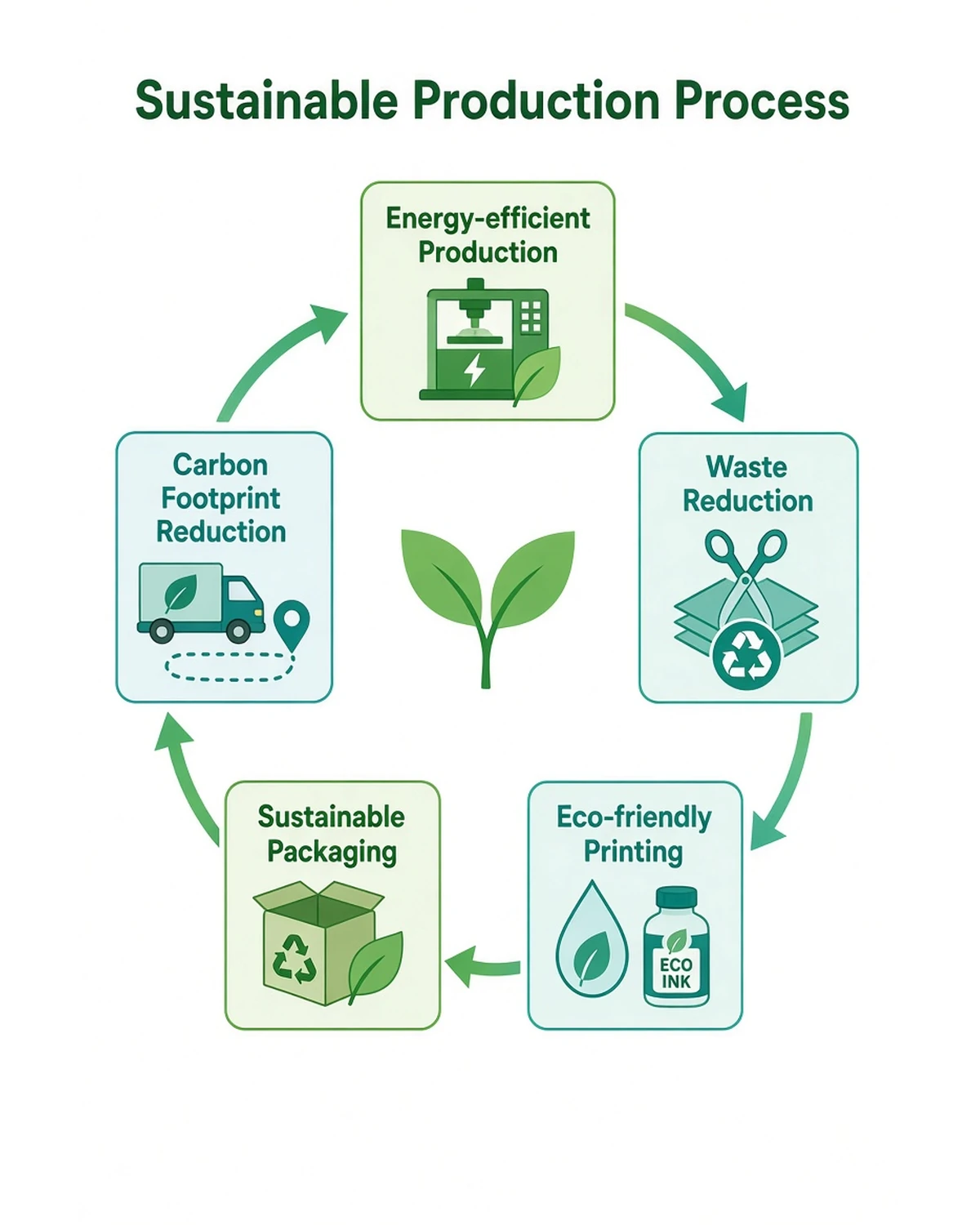
A Lighter Footprint Behind the Order
What the plant does about energy, waste, inks, packing and freight, so a run leaves a lighter mark than it otherwise would.
Energy-efficient production
Machines on the floor are specified for low draw, which takes carbon out of the whole shift the line runs, not just the finished bag.
Waste reduction
Cutting is nested to get the most panels out of a hide or a roll, and what is left over is collected and recycled, never binned.
Eco-friendly printing
Water-based inks and eco dyes carry the design and the logo without the solvent load, so a marked bag is not a dirtier one.
Sustainable packaging
Cartons and inner packing are recycled and biodegradable, so the last thing a buyer opens is held to the same standard as the bag.
Carbon footprint reduction
Consolidated loads and efficient routing cut the emissions attached to moving an order, which for an export run is where most of the footprint sits.
Buyer accounts
Live Orders, Start to Pallet
Live order threads, running the length of a build: the first enquiry, the sample, the shipment, the pallet.
Golf bag gallery
Bags in Play, Not on a Bench
First golf bag runs, samples and reorders — the same construction, photographed on the course.
Golf bag questions
Frequently Asked Questions About Custom Golf Bag Manufacturer
The questions that come up on most golf bag enquiries, and the ones where an answer anywhere else would be generic. Where a figure already appears in a section above, the answer points at it instead of repeating it.
Which parts of a golf bag are molded, and which parts are sewn?
The top divider ring, the base plate and the stand bracket come out of a tool, not off a bench. Everything else is cut and sewn. The split matters because the molded half is where a golf bag’s weight and its cost are concentrated, and because a change to any one of those three is a tooling question, not a pattern question — which is the difference between a revision and a new order.
Do I have to pay for a new mold, and who owns it afterwards?
Only if your bag needs geometry a standard part cannot give it. A ring, base or bracket already on a tool carries no tooling spend and the order opens at the hundred-piece floor. Where a part has to be cut, the tool is quoted as its own line instead of folded into the unit price, and whoever pays for it owns it — held here, and available for a reorder at the unit price alone.
How does a fourteen-way top change the tooling and the price?
It is the layout that costs most, for two reasons that stack. The ring itself is a bigger moulded part, because fourteen chambers is more geometry than four. And if the rim is over-moulded to protect graphite shafts, that soft edge has to follow a fourteen-chamber profile instead of a simple circle, which is a second shot on the tool. A plain moulded edge on the same count avoids the second shot.
What does a golf bag tech pack have to contain that another bag’s does not?
A golf bag pack carries what a tote or a duffle brief never does. The set the bag is built around, because that decides the divider count. The divider count itself, with the rim finish. A drawing of any plastic part, since a mould is cut from geometry and not from a description. And the collar diameter at the bag mouth, because that is what a stand bracket and a full-length interior are fixed to. The rest of the pack — dimensions, shell and denier, zip gauge, hardware callouts, the mark and its method, the pocket list — is the same as any other bag.
How does a stand mechanism actually hold up, and what wears first?
The pivot pin is what everyone watches, and the mounting panel is the piece that gives. Opening and closing works the bracket, and the bracket transfers that load into a stiffened panel inside the bag — cloth doing a job a moulded part exists to spread. A bag whose legs have gone slack usually has a panel letting go at the fixing, with the pin still sound. That is why the panel behind the bracket is specified alongside the bracket instead of being left to the interior.
Can a set of clubs be protected without a full-length interior?
Partly, and the honest answer is that the protection is different, not equivalent. Full-length panels hold every club in its own column for the depth of the bag, and that is the thing keeping shafts apart. A shorter collar separates them at the mouth only, so shafts can touch below it once the bag is loaded. What closes most of that gap is the rim: an over-moulded soft edge stops the abrasion that happens at the top, which is where a club is in and out of the bag most often.
Can stand, cart and staff bags be mixed in one order?
Yes, and it is usually cheaper than running them separately, because the bodies share a pattern set while the molded parts do not. The ring, the base and the bracket are what differ between the three, so a mixed order is one set of patterns and two or three tooling positions, never three separate productions. What it does mean is that every shape carries its own hundred-piece floor, since the minimum applies per construction, not per purchase order.
What happens if a golf run arrives with a defect?
It depends what was specified, and that is the reason the specification is written down. A ring that does not match the approved sample, a marking that is off the artwork, a bracket fixing that is loose — a pre-production sample is what settles all three, since nobody is arguing about opinion once a signed one exists. Inspection runs in process and again before shipment to ISO 2859-1 at AQL 2.5, under ISO 9001 and BSCI certification, with OEKO-TEX 100 and GRS available on the materials where the brief calls for them.
Start a golf bag run
Name the Divider. The Bag Is Built Around It.
Send the set your golf bag is built around and how the clubs travel. Back comes the ring, the base, the bracket, the marking method and a tooling line quoted on its own, with a physical sample at the hundred-piece floor.