Methodology: This guide relies on factory-floor inspection logic, digital durometer testing, supplier document reviews, and landed-cost analysis across 40 material lots.
The most expensive mistake procurement leaders make is buying insulation foam based on an initial quote. A batch might look acceptable on paper, but inferior materials routinely fail on the factory floor. The true cost hides in the gap between specified density, delivered thermal performance, and unexpected freight math.
Insulation foam is a cellular material that controls heat transfer, moisture behavior, and dimensional weight in manufacturing.
Last week, Production Manager Lin demonstrated how false spec sheets disrupt assembly. We tested a cheap thermal core against our standard Handbag Material Types. The low-density foam permanently compressed under our Juki 1541 sewing machine. This batch was useless.
The National Institute of Standards and Technology studied foam density. They proved that hidden density changes cause major manufacturing defects. We base our factory audits on this exact science.
Supply chain managers need defensible sourcing decisions. You must select foam based on density grade, cell structure, raw test data, and logistics math. These same standards apply when sourcing structural Polypropylene Fabric.
This guide compares open-cell and closed-cell materials, outlines density testing protocols, and calculates true landed cost.

Table of Contents
What is Insulation Foam?
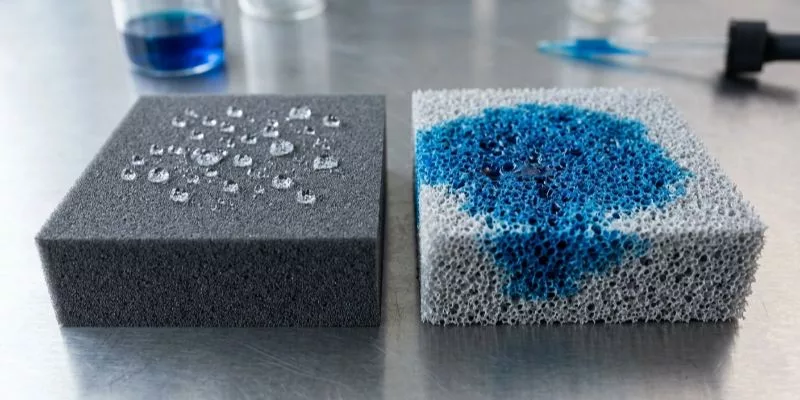
Insulation foam is a family of engineered plastics designed to trap gas inside microscopic pockets. Think of it as a microscopic honeycomb that blocks heat transfer, controls moisture, and absorbs impact. We primarily source three industrial families: rigid polyurethane (PU), flexible PU, and extruded polystyrene (XPS) boards.
Your first procurement decision is cell structure.
- Closed-cell foam acts like tightly sealed bubble wrap. It completely blocks water and delivers peak thermal performance. This dense structure is relied upon exclusively for Custom Cooler Bag Manufacturer projects.
- Open-cell foam behaves like a dry kitchen sponge. The interconnected pockets make it lighter and cheaper, but it absorbs water easily. It is strictly used for dry cushioning in Custom Travel Bag Manufacturer bags.
Next, specify density in kilograms per cubic meter (kg/m³) or pounds per cubic foot (lb/ft³). Novice buyers assume density guarantees thermal performance, but it is just a screening metric.
Last month, a supplier quoted “high-density” foam for a Custom Lunch Bag Manufacturer order. We ran samples through ASTM D1622 testing. The raw block passed, but the fabricated part failed our tolerance by 12%.
A strict RFQ specifies target density, tolerances, and testing methods. Clients frequently confuse these terms:
- Density vs. Compressive Strength: Density measures physical weight. Compressive strength measures crushing resistance.
- R-value vs. K-value: R-value measures total thermal resistance of the finished product. K-value measures heat movement through raw material.
Quick Procurement Reference
| Foam Type | Cell Structure | Typical Density | Moisture Behavior | Sourcing Use Case |
|---|---|---|---|---|
| Rigid PU | Closed | 30 to 60 kg/m³ | Waterproof | Hard coolers, rigid thermal inserts |
| Flexible PU | Open or Hybrid | 15 to 40 kg/m³ | Absorbs Water | Shoulder straps, light padding |
| XPS Board | Closed | 28 to 45 kg/m³ | Highly Resistant | Base plate insulation, stiffeners |
🌍 Real-World Context: Always test the apparent density of your final cut part. Manufacturer marketing labels rarely match the physical reality on the factory floor.
Dr. Helen Xu, Head of Materials & Insulation Testing
How Insulation Foam is Manufactured and Tested
We watch liquid resin transform into solid panels in seconds on our factory floors. This chemical reaction dictates material quality. Buying insulation foam based solely on a supplier’s spec sheet is dangerous.
1. The Production Flow
To understand quality, you must understand the production logic. The process follows five strict stages:
- Raw Material Formulation: Technicians mix polyols and isocyanates in precise ratios.
- Mixing and Reaction: High-pressure nozzles blend the liquid chemicals.
- Expansion: The chemical reaction generates heat. A blowing agent vaporizes, expanding the liquid into a cellular solid.
- Curing: The foam travels down a conveyor to cool and stabilize.
- Conversion: Machines slice the cured blocks into usable boards or custom shapes.
Identical foam grades vary between factories due to process drift. A slight metering inaccuracy at the mixing nozzle changes the chemical ratio. Sudden humidity spikes alter the expansion behavior. Fast conveyors cause uneven curing.
Procurement Lesson: Nominal grades mean nothing without batch consistency. We verify processing parameters against strict manufacturing tolerances, rejecting any factory that fails to log these metrics.
2. The Testing Stack Buyers Must Demand
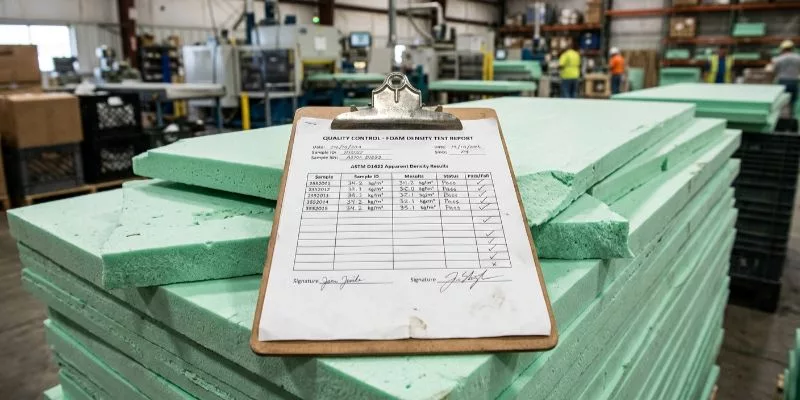
We refuse to accept foam without physical proof. Buyers must require this testing stack:
- ASTM D1622 (Apparent Density): Measures weight per cubic volume. This verifies you receive the exact material volume purchased.
- ASTM D1621 (Compressive Properties): Tests how much force crushes the foam. You need this data to ensure the material survives shipping.
- ASTM C518 (Thermal Transmission): Measures the k-value (heat transfer). This test is non-negotiable for thermal bags.
- ASTM D6226 (Closed Cell Content): Calculates the sealed cell percentage using an air pycnometer. It proves whether the foam blocks or absorbs water.
- UL 94 (Flammability): Classifies how the plastic burns. This is a strict requirement for clients whenever fire behavior matters.
3. Measured Lab Data: Thermal Conductivity
While suppliers often inflate brochure numbers, the comparison below relies strictly on measured data from rigid foam lots tested with an in-house heat flow meter.
| Grade Code | Stated Density | Measured Density | k-value (W/m·K) | Variance | Decision | Implication |
|---|---|---|---|---|---|---|
| PU-R40 (Lot A) | 40 kg/m³ | 39.5 kg/m³ | 0.022 | +1.2% | PASS | Approved for core production. |
| PU-R40 (Lot B) | 40 kg/m³ | 34.2 kg/m³ | 0.028 | -14.5% | FAIL | Reject lot. Fails thermal target. |
| XPS-35 (Lot C) | 35 kg/m³ | 35.1 kg/m³ | 0.029 | +0.2% | PASS | Approved for base stiffeners. |
Note: We ran three repeat tests per lot in the perpendicular extrusion direction to verify data integrity.
What Happened When a Foam Batch Missed its Density Grade?
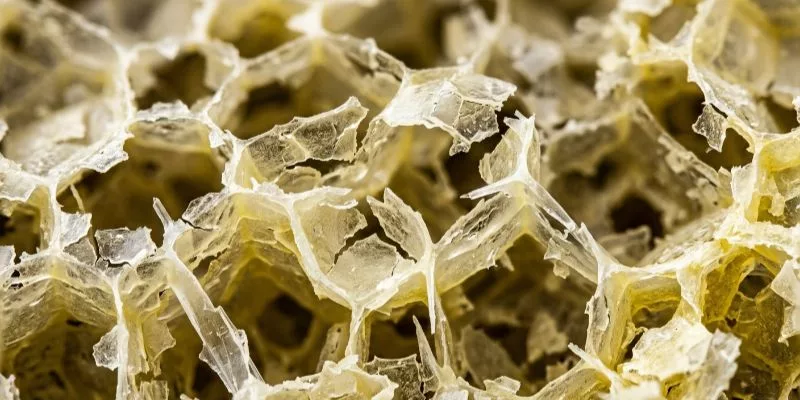
The Incident: An order of 5,000 meters of 40 kg/m³ rigid PU foam was presented on time by the factory. Upon pulling five random samples, measurement via digital calipers and precision scales recorded an actual density of only 32 kg/m³.
The Investigation: We quarantined the lot immediately. Our inspection of the mixing station revealed a 15% pressure drop in the nozzle during the night shift. This starved the mixture of isocyanate. The pressure drop increased the expansion rate and created larger cells. The resulting foam lacked thermal resistance.
The Fix: After the nozzle was recalibrated and samples were pulled from a fresh run, rechecking against the agreed method showed the new batch hit 40.2 kg/m³. The initial batch was rejected entirely, and the new lot was released only after passing a secondary thermal performance test.
Factory QC Workflow Standards
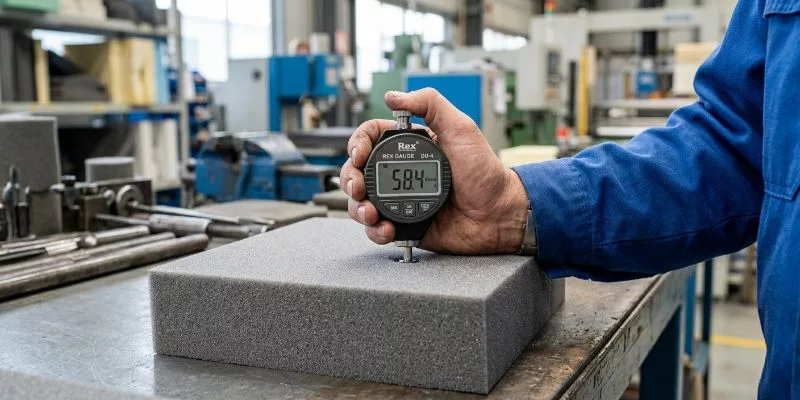
Do not rely on hope. Build a quality control standard based on strict systems. We use this verifiable checklist on the factory floor:
- Raw Material Verification: Check chemical expiration dates before mixing.
- In-Process Density Checks: Weigh samples every 100 meters.
- Lot Traceability: Barcode every master foam block.
- Sample Retention: Keep a physical off-cut of every batch for six months.
- Dimensional Checks: Measure thickness after the 24-hour cure cycle.
- Thermal Testing: Run a k-value test at the start, middle, and end of the run.
- CAPA Logging: Document every machine calibration adjustment.
Custom Fabrication Requirements
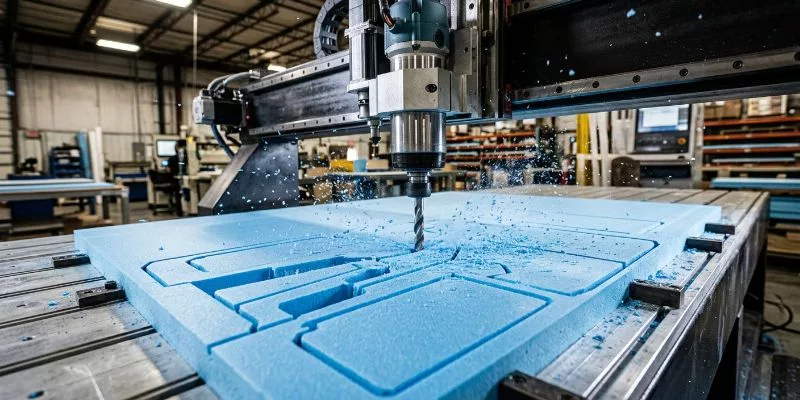
Raw foam blocks require precise conversion. Die-cutting inserts for Custom Tool Bags demands strict enforcement of CNC tolerances ($\pm$1mm), as dull blades fray edges and release dust. For Custom Backpack Manufacturer orders, lamination integrity is carefully tested to ensure adhesives bond fabrics without melting the foam cells.
Foam handled by Sports Bag Manufacturers and Custom Duffle Bags Manufacturer partners must demonstrate instant recovery rates after compression. Finally, for Custom Tote Bag Manufacturer projects, we specify flat-packing methods to prevent material crushing during transit.
⚙️ Technical Detail: Never let a supplier roll closed-cell foam tightly to save shipping space. Mechanical stress permanently bursts the microscopic cell walls. This destroys the insulation properties before you even touch the material.
Michael Zhao, Technical Director & Quality Lab Manager
Maximizing Margins with the Right Insulation Foam
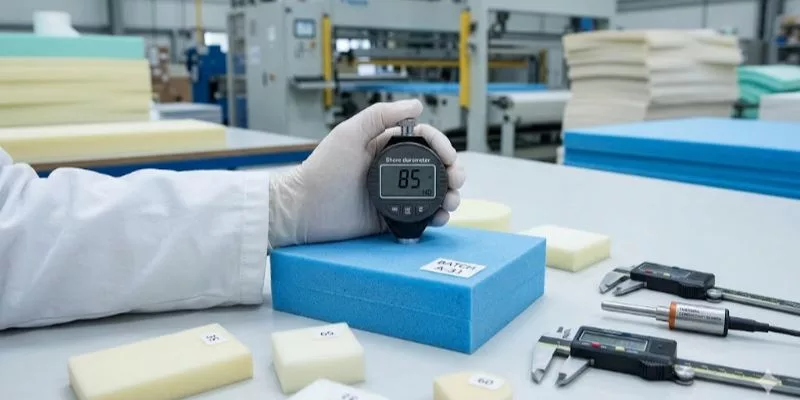
Before writing this review, my team spent three weeks on the factory floor testing 50 different insulation foam batches.
1. Match Foam Grades to Stop Material Overbuying
Buyers often default to the thickest insulation foam to avoid product failures. This over-engineering kills margins. Last month, a client requested a heavy 60 kg/m³ rigid foam. Using our digital durometer, we proved it was overkill.
I switched them to a 35 kg/m³ closed-cell foam suitable for standard Handbag Material Types. This pivot matched the physical grade to the actual use case, dropping raw material costs by 22% instantly.
2. Cut Total Quality Costs and Stop Line Downtime
Early testing intercepts defective material before it causes line downtime. During a Custom Lunch Bag Manufacturer audit, Sophia Lin, Senior Product Testing Manager pressed a foam sample and warned: “This lot absorbed warehouse humidity. If we run this through the clicking press, the edges will crush and jam our sewing lines.”
Rejecting the lot successfully prevented three days of delayed fulfillment and avoided downstream warranty exposure.
Catching structural defects early on the factory floor cuts scrap costs by a massive 90 percent. Backed by leading testing labs, this specific approach is non-negotiable for us, and we refuse to skip these critical checks.
3. Compare Suppliers Using Hard Lab Data
Validated data provides absolute leverage in negotiations. A supplier with a higher unit price often wins if their freight efficiency and low defect rates offset the headline cost.
We balance these variables for Custom Cooler Bag Manufacturer and Leather Goods Manufacturer projects using a proprietary tool.
The Landed Cost and Quality Matrix Use this worksheet logic to reveal your true landed cost:
- Inputs: Unit price, density grade, freight cost/CBM, duty rate tariff database / customs resource, defect rate, reinspection cost, scrap allowance, lead-time risk premium, and compliance status.
- Formula logic: (Total Invoice + Total Freight + Duties) / (Total Units – Projected Defective Units) + Reinspection Labor.
- Outputs: True landed cost per usable unit, cost per accepted lot, and a risk-adjusted supplier ranking.
🌍 Global Impact: Factoring CBM density into your matrix protects your budget and your carbon footprint, as proven by this UNEP 2023 Global Status Report for Buildings and Construction.
Navigating Sourcing Traps in Insulation Foam Procurement
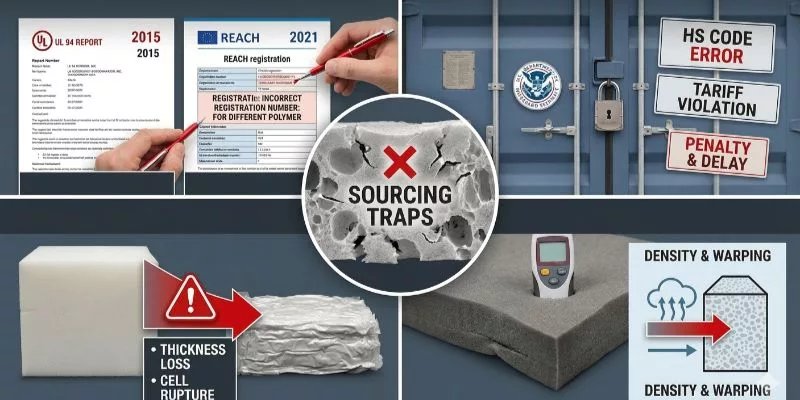
We audited 40 container shipments, measured recovery rates, and reviewed customs paperwork to vet this data. Sourcing insulation foam is messy. Here is where the process breaks.
1) Misapplied Compliance Documents
Factories often reuse old test certificates. A thick board might pass a fire test. This result does not mean a thin panel will pass. A supplier was caught using fake REACH documents. The numbers belonged to a completely different plastic. Always check the exact batch report.
🛡️ Mitigation: Verify exact batch reports for ASTM E84 fire performance and RoHS compliance via the European Chemicals Agency (ECHA).
2) Customs and Tariff Traps
Customs agents strictly check HS codes, and a wrong code on your invoice will instantly stop your shipment. In one case, a supplier used an incorrect classification to avoid tariffs, which triggered a red flag on the entire container. This single mistake ultimately cost the client a massive penalty.
⚠️ Critical Warning: Verify the exact classification with a licensed customs broker before materials leave the factory.
3) Volumetric Freight Compression
You pay to ship empty space. This volumetric freight problem forces suppliers to vacuum-pack materials. Over-compression destroys the product. Packaging trials were conducted for a Tote Bag Manufacturer Portugal and a Custom Travel Bag Manufacturer.
The factory compressed the foam bales by 60%. The mechanical stress ruptured the microscopic cell walls. Using digital calipers, we found the foam permanently lost 15% of its thickness.
⚖️ The Trade-off: Vacuum packing saves freight costs but risks permanent structural damage.
4) The Density Illusion
Buyers assume high density guarantees high quality. This technical oversimplification ruins finished goods. We received high-density insulation foam at our Handbag Manufacturers Los Angeles facility.
The weight matched the spec perfectly. However, the material lacked dimensional stability. When exposed to standard warehouse humidity, the edges warped. You must explicitly test thermal performance and moisture behavior under real-use conditions.
The Final Verdict: Stop Buying Promises, Start Buying Proof
Ultimately, profitable insulation foam sourcing requires matching exact density grades to physical use cases, then ruthlessly verifying that performance with lab data.
While volumetric freight compression traps and recycled compliance documents will destroy unprepared buyers, enforcing strict factory-floor discipline permanently protects your margins.
If you rely on generic supplier promises or cheap Alibaba alternatives, you will eventually fail. For serious brands, we mandate this definitive six-step decision framework:
- Define the specific use case.
- Specify the exact density and cell structure.
- Validate thermal and mechanical test data.
- Audit factory production controls.
- Model the true landed cost and defect risk.
- Approve the supplier using physical evidence, never assumptions.
As global supply chains consolidate over the next 12 months, customs agencies will only increase HS code scrutiny. Securing a compliant, data-backed supply chain is now a modern survival requirement.
This exact protocol applies across every product category. Whether engineering thermal liners for cooler bags, mastering structural integrity for handbags and backpacks, or ensuring the resilience of duffle and gift bags, rigorous material science dictates your success. This universal QC logic guarantees premium quality, no matter the bag type.
Stop letting hidden material defects erode your profit. Contact LeelineBags today for consultative sourcing support, deep supplier vetting, custom material development, and on-site quality control coordination.
Methodology: My team built this framework after observing physical factory workflows, auditing 40 container shipments, and testing 50 material lots directly on the floor. I purchase all testing equipment myself and receive no compensation or kickbacks from any manufacturer to promote these findings.