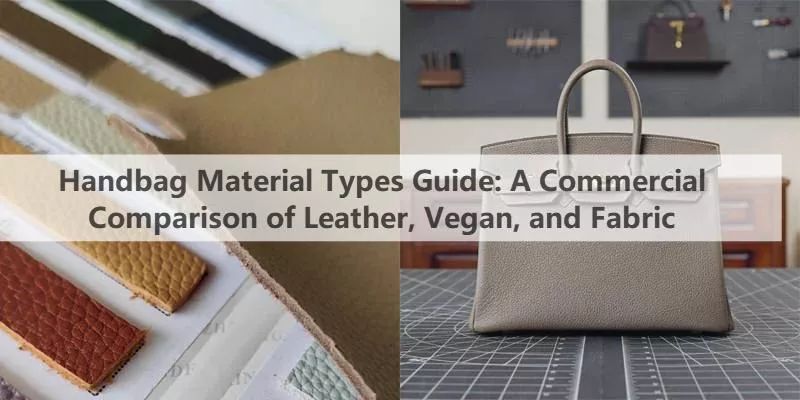
“High quality” is a dangerous phrase in manufacturing. It often lacks objective meaning. To avoid high return rates, you need measurable standards. This commercial review evaluates essential handbag material types, covering leather, bio-based synthetics, and technical fabrics. We judge materials by sourcing lead times and performance metrics like abrasion resistance. Use this data to specify quality. For physical examples, brands can request swatches via our Custom Handbag Manufacturer page.
Table of Contents
10 Handbag Material Types
1. Full-grain & top-grain leather: Macro diagnostics and specs

Grab a magnifying glass. The difference between luxury and landfill lies in the pores.
Full-grain leather retains the entire outer hide. Under macro inspection, look for irregular pore patterns and a dense, fibrous cross-section. This natural fiber structure ensures tensile strength and prevents stitch tearing.
Top-grain leather often looks suspiciously perfect. Tanneries sand off flaws, removing the strongest fibers. It appears uniform, but the required synthetic coating eventually cracks instead of developing a rich leather patina.
For structured bags, specify 1.4–2.0mm (3.5–5 oz) thickness in your tech pack. Avoid heavy finishes that hide weak, corrected grain.
🚀 Actionable Insight: Request unskived swatches. Fold the leather 90 degrees; if the surface coating wrinkles significantly or separates from the fiber base, reject the batch.
2. Genuine leather vs bonded leather: the most misunderstood labels in handbags

“Genuine leather” is a broad legal label, not a promise of quality. It covers everything from commercial splits to reconstituted materials.
Bonded leather is essentially leather particleboard. Factories glue shredded leather fibers with polyurethane binders onto a fiber backing. It mimics the look of smooth leather but lacks the strength of a natural hide.
Check the cross-section. Bonded material reveals a “sandwich” edge where a paper-like base meets a thin top film. While real leather develops a patina, bonded surfaces eventually peel and crack.
🧠 Expert Take: Ask manufacturers for the specific split structure. Perform a bend test; if the finish cracks or reveals a white mesh, position the product as short-lifespan fashion.
3. Patent leather & high-gloss finishes

Patent leather relies on a heavy polyurethane or acrylic coating applied over a leather base. This creates a mirror shine but drastically changes how the material performs. Unlike matte skins, the glossy layer highlights scuffs and scratches that you cannot repair or buff out.
Heat sensitivity is a major risk. In warm storage, the coating can become sticky or permanently absorb dyes from touching fabrics (known as dye migration). Furthermore, the finish often cracks under repeated flexing (measured by SATRA flexibility tests). Reserve this material for structured occasion bags rather than soft, daily carriers.
⚡ Power Move: Mandate protective film application immediately after stitching. Glossy surfaces show every handling mark from the factory line. Consult our Patent Leather sourcing guide for packaging specs to prevent transit damage.
4. Textured & pressed leathers (Saffiano, Togo, pebbled)

A flawless grain pattern often signals engineering, not nature. Natural pebbled grain comes from tumbling hides in drums, creating random, soft variances. In contrast, embossed leather uses heated plates to stamp permanent patterns.
This thermal compression defines famous styles like Saffiano leather and Togo leather. The process seals fibers, significantly increasing stiffness and surface durability. This makes pressed textures superior for high-wear items that need to camouflage scratches.
Sourcing checklist:
- Pattern Alignment: Demand visual continuity across seams.
- Coating: Limit thickness. Thick topcoats feel like plastic.
- Color: Embossing ensures exact batch matching.
🚀 Actionable Insight: Embossing hides natural surface defects. This increases the usable cutting area per hide, lowering your material cost per unit compared to natural full-grain.
5. Suede & nubuck: The ‘soft luxury’ that demands engineering-level care

Suede and nubuck offer a tactile depth that smooth leathers lack. The luxury comes from the nap, a surface of raised fibers created by sanding the hide. While this texture delivers stunning color saturation, the open structure instantly absorbs moisture and oils.
Performance depends entirely on placement. High-friction areas quickly suffer from burnishing, where constant rubbing flattens fibers into shiny, bald patches. Reserve Suede Leather for evening bags, linings, or recessed gussets where abrasion is minimal.
6. Exotic leathers: Rarity, compliance, and provenance

Exotic leathers (python, alligator, ostrich) signal luxury but function as a compliance test. Unlike standard hides, these materials require farm-level traceability to mitigate reputational risk.
The compliance trap
You cannot ship most reptile skins internationally without CITES documentation. International customs agents enforce these rules strictly; one missing permit leads to immediate inventory seizure and destruction.
Sourcing realities
- Defect sensitivity: The scale pattern is the focal point. Unlike cowhide, you cannot hide scars or asymmetry.
- Strategic usage: Limit exotics to trims or small panels to manage high costs and waste rates.
- Safer alternatives: Specify Fish Leather for unique scale textures without the regulatory red tape.
🚀 Actionable Insight: Audit your supplier’s CITES permits before paying the deposit. If they cannot produce valid export documentation immediately, walk away.
7. ‘Vegan leather’ (PU, PVC, microfiber): what it is, what it isn’t, and how it fails

“Vegan leather” is a marketing label, not a technical spec. It typically refers to Polyurethane (PU) or PVC coatings bonded to a fabric backing.
Standard PU fails via hydrolysis. Humidity breaks down the polymer chains, causing the surface to peel within two years. Microfiber leather is the high-performance tier. Its non-woven 3D structure mimics natural collagen for genuine durability.
Never equate “animal-free” with “eco-friendly.” Low-grade PVC often contains phthalates that trigger California Prop 65 warnings. For regulated markets, you must demand third-party REACH compliance reports to verify chemical safety and abrasion resistance.
8. Bio-based leather alternatives (Piñatex, mycelium, cactus)

“Bio-based” defines a material’s origin, not its biodegradability. Most market-ready options—like cactus or pineapple leather—are actually composite materials. Suppliers often mix plant powder into polyurethane (PU) binders or apply petrochemical coatings to ensure the fabric doesn’t rot or dissolve in rain.
This structure creates a durability gap. While industrial PU withstands 100,000+ Martindale abrasion cycles, many bio-hybrids show visible wear after just 20,000 cycles. Reserve these materials for limited-run “capsule” collections rather than high-friction daily drivers. You must verify the actual plant percentage using standards like ASTM D6866 to ensure you aren’t paying a premium for mostly synthetic material.
🧠 Expert Take: Ignore generic “eco-friendly” labels. Request the Technical Data Sheet (TDS) and check the “Bio-based Carbon Content” percentage. If a material claims to be “plant-based” but contains less than 30% bio-mass, you are paying a premium for plastic with a marketing story.
9. Canvas, cotton, and hemp: durable classics (and why weight/finish matters more than the name)

A “canvas tote” varies from cheap giveaway to luxury weekender based on weight. You must specify density in your tech pack using ounces (oz) or GSM (grams per square meter).
Avoid weights under 10oz. For premium structure and crisp screen printing, specify 16oz to 24oz canvas. Tighter weaves offer better durability and natural water resistance.
Finishes change performance. Waxed canvas adds weatherproofing and a rugged patina. Heat softens wax, so factories cannot iron these bags during final QC.
- Best for: Heavy-duty totes and weekenders.
- The Tradeoff: Untreated cotton stains immediately.
- Sustainability: “Organic” requires proof. Verify claims with GOTS certification or OCS standards.
10. Nylon vs polyester (and rPET): denier, abrasion, melting points, and waterproof ratings that actually mean something

Nylon outperforms polyester on abrasion resistance, making it ideal for technical gear, while polyester wins on cost and UV stability. Construction also dictates strength—ripstop or ballistic weaves add significant durability. To ensure quality, define these measurable specs:
- Denier: Density matters. 500D Nylon often exceeds 600D Polyester strength.
- Abrasion: Require Martindale or Wyzenbeek test reports to prove toughness.
- Waterproofing: Specify a Hydrostatic Head rating (e.g., >1,500mm ISO) rather than “waterproof” coatings.
- Heat: Polyester melts ~220°C. Monitor heat-press decoration to prevent shrinkage.
⚡ Power Move: rPET matches virgin performance but requires proof. Demand a transaction-specific Global Recycled Standard (GRS) certificate. If the factory cannot provide the paperwork, the sustainability claim is invalid.
Action Plan: Build Your Production-Ready Material Tech Pack

Use this workflow to convert design concepts into a factory-ready specification sheet. Stop guessing and specify every detail in your technical package. This reduces communication errors and prevents expensive bulk production mistakes.
Step 1: Translate style into measurable specs
Translate your aesthetic vision into hard numbers. First, choose your silhouette to determine the material class. Select stiff materials for structured briefcases or soft hands for slouchy totes. Next, define the weight using the correct industry metric. Use denier for synthetics, GSM for woven fabrics, or ounces for leather.
Finally, set a target for abrasion resistance. This prevents premature wear and customer returns. Require a formal test report based on ISO 12947 (Martindale) or ASTM D4157 (Wyzenbeek) standards.
Step 2: Define waterproofing standards
“Waterproof” is a vague marketing term. You must define the Hydrostatic Head in millimeters. For functional rain protection, require a result greater than 1,500mm. Verify this performance with AATCC 127 or ISO 811 test methods.
Remember that fabric is only part of the equation. Water follows the path of least resistance. Explicitly instruct your factory to seal seams and use waterproof zippers. Apply seam sealing tape to all needle holes to ensure the bag remains dry during use.
Step 3: Secure your compliance workflow
Safety is mandatory for US and EU markets. Non-compliance risks customs seizures and lawsuits. Request third-party test reports from accredited labs like SGS or Intertek.
Test all coated materials for REACH SVHC and phthalates. Ensure trims and inks comply with California Proposition 65 regulations. Demand material declarations for all industrial adhesives used in production to guarantee they are free from banned substances.
Step 4: Verify sustainability claims
Credibility requires a paper trail. Never accept verbal promises regarding eco-friendly materials. Demand the Global Recycled Standard (GRS) certificate for recycled plastics (rPET). Ask for GOTS certification for organic cotton.
Always request the Scope Certificate for the factory and the specific Transaction Certificate for your batch. These documents prove the chain of custody and validate your marketing claims.
Step 5: Finalize your BOM checklist
Your Bill of Materials (BOM) must list every single component. Include precise specifications for the Handbag Linings, internal reinforcement materials, and hardware plating quality. Define the base metal for hardware to avoid rust issues later. Specify zipper sizes and counts clearly to avoid assembly delays.
Need help sourcing reliable partners? Review our Custom Handbag Manufacturer services. If you are ready to test materials, contact us today to request a sourcing consultation and sample kit.
Frequently Asked Questions for Handbag Material Types
Q1. How can I tell full-grain leather from bonded leather without lab tests?
Inspect the raw edge of the material first. Bonded leather often reveals a “sandwich” structure where a thin surface layer is glued onto a fibrous backing. Full-grain leather shows a dense, uniform fiber structure throughout the cross-section. Next, perform a bend test. Fold the strap inward. Bonded finishes often peel or crack under stress, while natural leather wrinkles organically without separating.
Q2. Is vegan leather more eco-friendly than genuine leather?
Not automatically. Most “vegan” options are simply Polyurethane (PU) or PVC, which are petrochemical plastics. These materials do not biodegrade and often have a shorter lifespan than hide, leading to faster disposal. To ensure true sustainability, ask your supplier for the bio-based carbon content percentage or look for plant-based composites tested under ASTM D6866 standards.
Q3. Nylon vs polyester for everyday bags—what’s the practical difference?
The choice comes down to abrasion versus UV stability. Nylon is softer but significantly stronger against friction, making it the superior choice for backpacks and tactical gear. Polyester holds dye better and resists UV fading, but it pills faster under heavy rubbing. For high-traffic products, request an ASTM D4157 abrasion test report to compare the specific durability of the swatches.
Q4. What makes a bag material truly waterproof (not just ‘water-resistant’)?
Water-resistant coatings (DWR) wash off over time. True waterproofing requires a physical barrier defined by a Hydrostatic Head rating. Look for a rating above 1,500mm on the spec sheet. Furthermore, the construction matters more than the fabric. If the tech pack does not specify sealed seams and waterproof zippers, water will leak through the needle holes regardless of the fabric quality.
Q5. What lining should I choose for a premium handbag?
Your lining determines the bag’s lifespan. Avoid cheap, thin polyester that tears near the pockets. Choose a heavy cotton drill or a high-density nylon for superior tear strength and stain resistance. A quality lining adds structure and tactile value. For a deeper breakdown of options, read our guide on Handbag Linings. Ready to see the difference? Contact us to review our Bill of Materials (BOM) sample kit.