A label claiming a bag holds “20L” or “fits a 15-inch laptop” is a dangerous oversimplification. If you ignore outside dimensions, padding density, and strict airline rules, the bag will fail in real-world use.
I manage custom production runs at LeelineBags. I fix bad tech packs every day. Poor volume estimates ruin bag brands. High return rates destroy your profits.
Buyers must see exact product sizes. While people use “rucksack measurements” and “backpack dimensions” interchangeably, manufacturing precision requires absolute clarity.
You will not find one universal bag size. True size relies on outside measurements. You must also check inside space. Capacity and use case matter most.
Whether you are a B2B buyer drafting production specs, a parent evaluating school bags, or a traveler checking compliance against official IATA cabin baggage guidelines, you need objective data.
This guide covers typical size bands, the critical difference between liters and inches, and modern manufacturing realities.
Below, we provide the exact tools you need: a comprehensive size chart, an airline compliance table, a proprietary Manufacturer’s Note, and a Tech Pack checklist to guarantee a perfect fit.
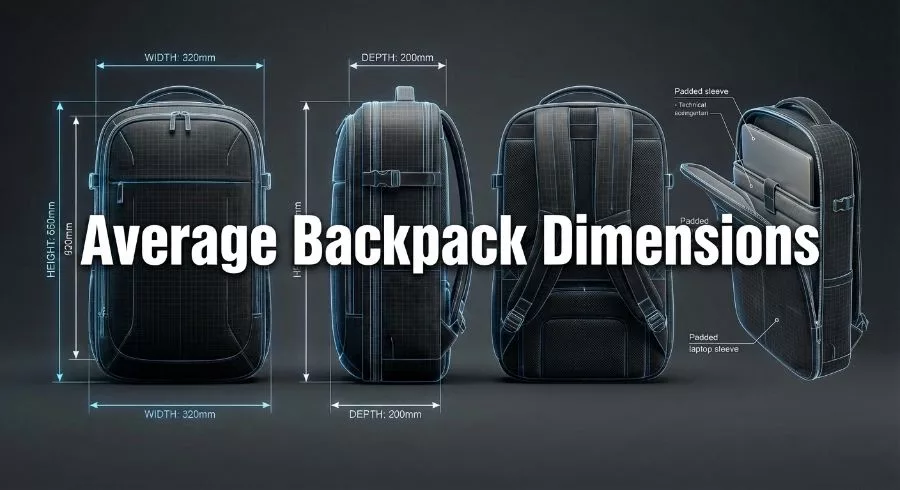
Table of Contents
What Are Average Backpack Dimensions?
Average backpack dimensions are the typical exterior measurements of everyday bags used for school, commuting, and light travel.
Think of a backpack like a house. Dimensions represent the property lines, while capacity represents the usable square footage.
Just as thick walls reduce interior space, a bag using stiff polypropylene fabric offers less internal volume than a flexible nylon bag of the exact same size.
The baseline market range for a standard daily backpack is:
- Height: 17 to 20 inches
- Width: 11 to 14 inches
- Depth: 5 to 9 inches
- Capacity: 20 to 30 liters
1. The Simple Size Taxonomy
When you design a handbag or backpack, physical size must match the user. We classify bags into four practical volume bands:
- Small (10-19L): Best for younger students or light daily essentials.
- Medium (20-29L): The classic everyday choice for office workers and college students.
- Large (30-45L): Built for weekend travel or heavy gear.
- Extra-large (45L+): Dedicated hiking and expedition packs.
2. Understanding Sizing Terminology
We review hundreds of tech packs monthly. Brand owners constantly confuse these terms:
- Backpack dimensions: The physical exterior height, width, and depth.
- Rucksack measurements: Exterior dimensions applied specifically to top-loading outdoor styles.
- Internal capacity: The total interior holding space, measured in liters.
- Laptop sleeve dimensions: The padded pocket size, which is always smaller than the bag exterior.
3. Basic Use-Case Positioning
Many beginners assume one bag size fits all. In practice, proper fit relies entirely on torso length. The American Occupational Therapy Association states a school bag should never extend past a child’s waistline.
You must scale dimensions down for younger students. Meanwhile, technical hiking packs prioritize exact torso fit over a single average volume.
🌍 Real-World Context: When communicating with factories, always specify if your tech pack lists exterior dimensions or target internal capacity. Mixing these up guarantees an inaccurate sample.
When we engineer backpacks, sizing becomes a strict mechanical problem. We must map a three-dimensional space accurately. We routinely measure factory prototypes and compare them against digital blueprints.
The difference between a spacious bag and a cramped one often comes down to a few millimeters of foam. Let us break down how we translate numbers into physical gear.
How To Measure A Backpack Correctly?
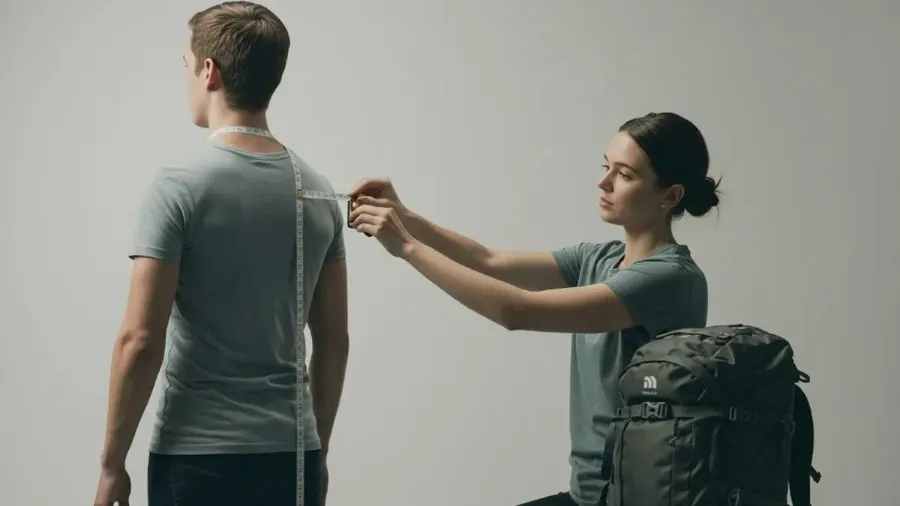
To extract accurate numbers, you must measure the bag in its natural state. A crushed bag produces false dimensions.
First, fill the backpack with soft materials like bubble wrap or old clothing. Next, pull the fabric taut without stretching the seams. Finally, record these three key exterior measurements:
- Height: Measure from the absolute base to the highest point near the top grab handle.
- Width: Measure side-to-side across the widest point of the front panel.
- Depth: Measure front-to-back at the fullest bulging point.
Soft-sided bags expand dynamically. A completely stuffed custom travel bag measures 2 to 3 inches deeper than a half-empty one. We base our standard factory measurements on a 90% full capacity.
1. Translating Liters To Inches (The Volume Illusion)
The core rule of thumb in bag manufacturing is simple: 1 liter equals approximately 61 cubic inches.
However, this mathematical conversion has a severe limitation. Liters do not convert directly into one exact set of external dimensions.
A bag’s taper, exterior pockets, and internal padding heavily alter the final shape. A 25-liter rectangular clamshell travel bag looks massive externally, while a 25-liter rounded school bag looks sleek.
Backpack capacity chart liters to inches: We use this practical sizing scale on the factory floor:
| Capacity | Typical Use Case | Profile |
|---|---|---|
| 15L | Compact daypack | Very slim, fits under jackets |
| 20L | Small/standard daily backpack | Holds a laptop, lunch, and a light jacket |
| 25L | Common school/work backpack | Accommodates heavy books and tech gear |
| 30L | Large daily / compact travel | Capable of holding gym shoes and a laptop |
| 40L | Travel / weekend carry-on | Maximizes overhead bin limits |
2. The Standardized Volume Measurement Process
Brands sometimes count flat exterior pockets in their total volume to inflate capacity numbers. To prevent this, professional testing labs use strict standardized methods.
We follow formal testing standards like the ASTM F2153 specification. During this test, technicians fill the main compartment and all closed pockets with small plastic spheres.
Then, they pour those spheres into a giant measuring cylinder. This process reveals the true internal volume. Major wholesale buyers demand this standard because it completely removes sizing guesswork.
3. Cracking The Carry-On Dimensions Code
Many travelers design their entire packing strategy around one benchmark: 22 x 14 x 9 inches.
This represents a common reference point for carry-on luggage, but it is not a universal rule. Airport sizer boxes measure the extreme external profile of your bag.
Travelers must compare external dimensions, not just liters. If your soft-sided backpack bulges to 10 inches deep, it will fail the test, even if the tag claims a compliant 40-liter capacity.
International Airline Carry-On Size Limits:
| Airline / Region | Max Size (Inches) | Max Size (cm) | Weight Limit | Notes |
|---|---|---|---|---|
| US Domestic (Delta, United) | 22 x 14 x 9 | 56 x 35 x 22 | Varies | Soft bags must compress |
| EU Budget (Ryanair) | 15.7 x 7.8 x 9.8 | 40 x 20 x 25 | None | Strict personal item limit |
| Asian Carriers (ANA) | 22 x 16 x 10 | 55 x 40 x 25 | 10 kg (22 lbs) | Strict weight checks |
Policy variations apply based on IATA cabin baggage guidelines.
4. The 15-Inch Laptop Fit Mechanism
The laptop backpack size for 15 inch laptop query causes constant design errors. A “15-inch laptop” refers strictly to the diagonal screen class. It does not describe the physical metal chassis.
When you insert a laptop, the thick padded sleeve consumes usable interior space. A thick gaming laptop requires a drastically different sleeve than a razor-thin ultrabook.
- Ultrabooks and Business Laptops: These require a standard 15-inch padded sleeve.
- Gaming and Workstation Models: These often demand a 16-inch or 17-inch compatible sleeve to accommodate the thicker chassis.
Laptop Sleeve Allowance Chart:
| Device Category | Approx. Device Footprint | Minimum Sleeve Allowance |
|---|---|---|
| 13″ MacBook Air | 12 x 8.4 x 0.6 in | 13 x 9.5 x 1.0 in |
| 15″ Slim Laptop | 13.8 x 9.5 x 0.7 in | 15 x 10.5 x 1.2 in |
| 15.6″ Gaming Rig | 14.2 x 10.5 x 1.2 in | 15.5 x 11.5 x 1.8 in |
Hiking Pack Volume vs. Load Distribution
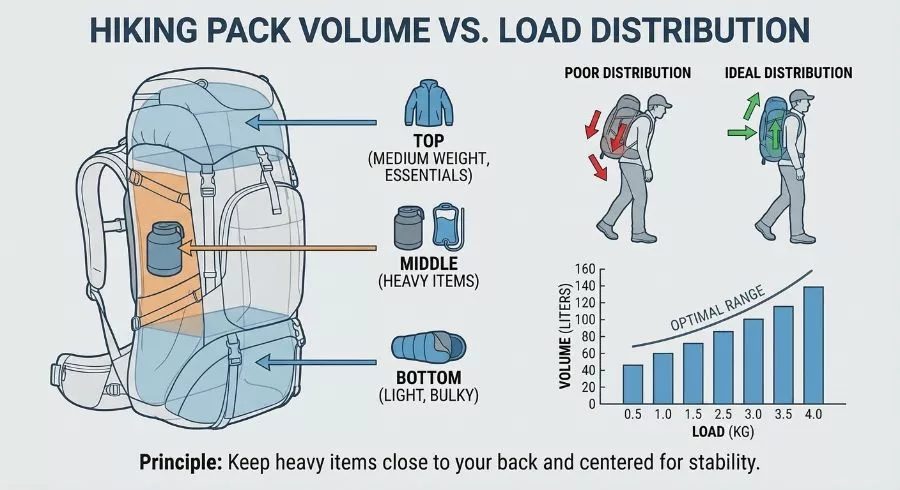
Hikers do not buy gear based on external dimensions alone. They select bags based on volume, torso fit, and load distribution.
A 20-liter urban daypack and a 20-liter hiking daypack feature completely different profiles. The urban bag sits short and wide. The hiking pack stands tall and narrow.
Hiking packs use internal hydration sleeves, rigid framesheets, and specialized load-lifter straps to shift weight onto the hips. This specific engineering changes the entire exterior silhouette of the bag.
Why Internal and External Dimensions Are Not The Same?
As private label bag manufacturers, we routinely see clients panic when a 6-inch deep tech pack yields only 4.5 inches of internal space. Here is exactly where the space goes:
- Seam Allowances: Internal binding tape and folded seams consume up to 0.5 inches of space per side.
- Foam Padding: A 5mm EVA foam panel on the front and back instantly removes 10mm (0.4 inches) of internal depth.
- Structure Elements: Internal lining, organizer panels, and stiff PE boards alter the final cavity shape.
- Material Stiffness: Rigid fabrics hold a boxy silhouette, while soft materials collapse inward.
Tolerance Note: Soft goods manufacturing involves manual sewing. Always expect a 1 to 2 cm production variance per unit.
B2B Logistics Intelligence: Why Dimensions Dictate Freight?
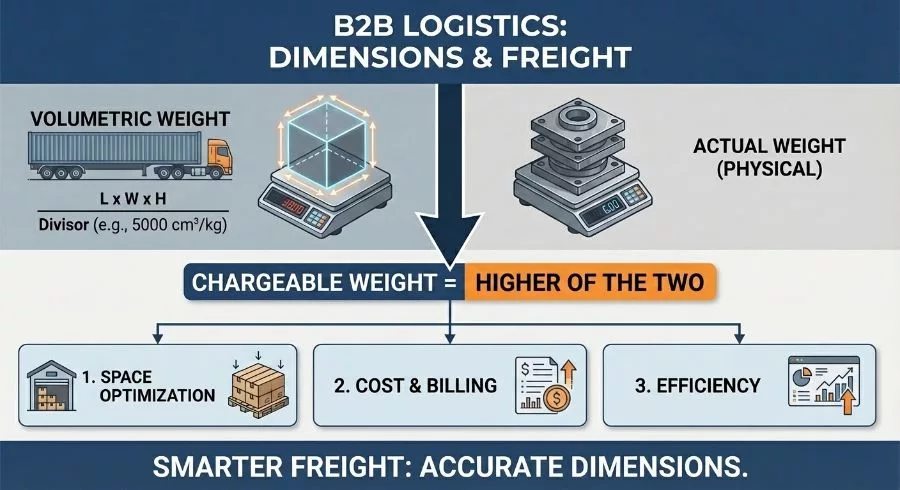
For B2B buyers, precise measurements dictate shipping costs. Air freight carriers do not just charge by actual weight; they charge by dimensional weight (DIM).
When you print logos onto custom units using various bag printing methods, you must ship them efficiently. If your backpack design cannot flat-pack, it consumes more space in the master carton.
A bag that measures 6 inches deep when fully stuffed might only measure 1 inch deep when flat-packed. This flat measurement dictates your carton packing efficiency, which directly impacts your landed costs. If a bag is too rigid and cannot crush down, you pay high rates to ship empty air.
🔄 Process Loop: Flat Pack ➔ High Carton Density ➔ Lower DIM Weight ➔ Reduced Freight Costs.
Tracking the average backpack dimensions prevents costly manufacturing errors. We measure every millimeter to protect your profit margins and user experience.
1. Prevents Postural Strain
The right size improves daily comfort and stops dangerous overstuffing. We match exact exterior dimensions to torso length. This ensures books and electronics fit without overwhelming the user.
According to an academic pediatric report(American Academy of Pediatrics, AAP), oversized bags cause postural damage. In practice, the best backpack size is the smallest one that fits the full load comfortably and compliantly. We enforce these ergonomic standards as a custom handbag manufacturer.
2. Eliminates Gate-Check Fees
Accurate carry-on dimensions remove travel anxiety and packing inefficiency. We test packed prototypes against strict airline benchmarks. This accounts for soft-sided compression and guarantees compliance, saving end-users from unexpected $50 baggage fees.
3. Accelerates Manufacturing Outcomes
Precise dimensional data improves product development, sample approval, and pricing accuracy. We use verified internal measurements to guarantee laptop protection. Vague marketing labels fail; exact internal numbers protect fragile hardware.
Clear dimensions also help brands explain small, medium, and large differences. This improves merchandising and reduces return rates. We align global teams on exact tolerances and intended loads. This holds true whether coordinating with a handbag manufacturer in the UK or a handbag manufacturer in Portugal.
📈 ROI Check: Using exact dimensional weight forecasts during prototyping slashes shipping costs. We saved clients 20% on international freight by adjusting exterior depth by just one inch.
Recommended Volume By Use Case
Compare apples to apples using our baseline matrix. Whether sourcing through a handbag manufacturer in Australia, a handbag manufacturer in Los Angeles, or a tote bag manufacturer in Portugal, use these targets:
| Target Use Case | Recommended Volume Range | Key Design Focus |
|---|---|---|
| School | 20L to 25L | Book capacity and torso fit |
| Office & Commute | 15L to 20L | Slim profile and laptop protection |
| Personal Item Travel | 25L to 30L | Under-seat compliance |
| Carry-On Travel | 35L to 45L | Maximum overhead bin efficiency |
| Hiking Daypack | 20L to 30L | Weight distribution and hydration |
| Overnight Hiking Pack | 45L to 65L | Rigid frame and heavy load support |
Backpack Sizing Challenges
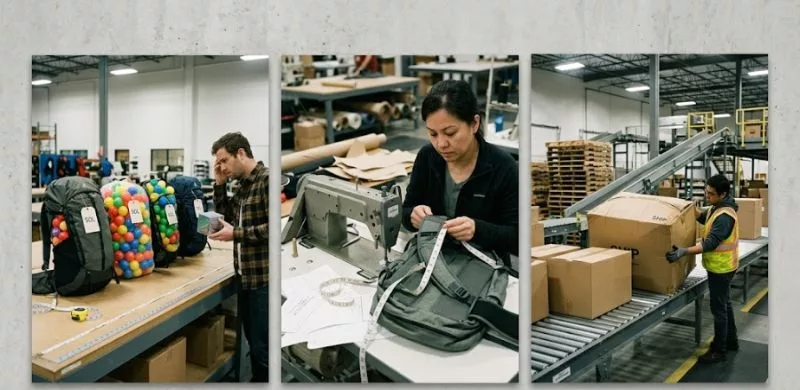
Average backpack dimensions by brand, material, and packing method. These differences impact capacity, quality, and shipping accuracy.
Challenge 1: Inconsistent Volume Metrics
No universal backpack sizing standard exists. Brands calculate average backpack dimensions and volume differently. Some measure only the sealed main compartment.
Others include open exterior pockets. In our factory audits, we fit only 22 liters of gear into a competitor’s advertised “30L” bag. They counted flat water bottle sleeves toward their total capacity.
While the FTC mandates truthful marketing, soft-goods volume claims lack strict regulatory frameworks. Laptop sleeve labels present similar risks. A “fits 15-inch laptop” tag ignores device depth. Thick gaming laptops stress zippers, while thin ultrabooks slide loosely inside.
Challenge 2: Soft-Goods Tolerances
Sewing flexible fabrics creates dimensional variance. Standard soft-goods manufacturing requires a 1 to 2 cm tolerance per unit. Material choices directly alter internal capacity. When inspecting our smell proof duffle bags, heavy carbon linings and thick foam padding reduced usable space by a full inch.
Exterior dimensions also shift based on textiles. Rigid leather finishes hold shape, while soft leathers collapse. These variables complicate global travel. An overstuffed soft bag clears US airline sizers but fails strict EU budget carrier limits.
Challenge 3: Fulfillment Cost Overruns
Minor dimensional inaccuracies inflate B2B freight quotes. We audited a container shipment where a stiff reinforcement board prevented bags from laying flat. This triggered a 15% freight penalty.
Even flat accessories like leather checkbook covers made in usa require precise flat-pack data to optimize pallets. If a bag cannot compress, Amazon FBA binning fees quickly consume your profit margins.
⚠️ Critical Warning: Never finalize freight budgets using stuffed display dimensions. Always quote shipping using fully compressed, flat-packed master carton measurements.
Tech Pack Checklist for Ordering or Designing a Backpack: We require clients to verify these specifications before prototyping to prevent sizing failures:
- Finished external dimensions (stuffed)
- Internal usable dimensions
- Target volume in liters
- Tolerance allowance (e.g., +/- 1.5 cm)
- Laptop sleeve dimensions (length, width, depth)
- Foam/padding thickness
- Material specifications
- Pocket count and volume inclusion status
- Branding/printing method
- Flat-pack master carton dimensions
- Target weight and shipping assumptions
- Compliance/testing requirements
The Final Verdict
Most daily backpacks hold 20 to 30 liters. However, true value depends on your gear. You must know your exact use case.
While inconsistent volume labels and soft-goods manufacturing tolerances make sizing frustrating, enforcing strict measurement standards eliminates costly errors. We recommend a rigid three-point decision rule for every bag you evaluate:
- Check the external dimensions to guarantee airline or locker compliance.
- Verify the internal usable space against the actual thickness of your gear.
- Match the structural profile to your specific school, travel, or hiking requirements.
This creates a clear division in next steps. Do not trust generic volume tags. Grab a tape measure. Measure your actual laptop. Compare your packed bag against strict airline limits.
Conversely, if you are a brand owner, never rely on rough sketches or assumptions. You must build a comprehensive tech pack before requesting a sample or placing a bulk order.
As global air freight costs rise and airline baggage policies tighten, dimensional precision will separate profitable brands from the rest.
We turn your rough designs into factory specs. Contact LeelineBags today. Our experts guide your custom production. We make sure your bags fit perfectly.