Full-grain leather is the winner for unmatched longevity and luxury appeal among grades of leather. Because it utilizes the uncorrected outer hide, [Full-grain leather] retains superior fiber strength and develops a desirable patina over time. However, corrected top-grain leather is the better choice for brands requiring strict color uniformity and stain resistance. By sanding away natural imperfections, [Top-grain leather] provides the consistent finish necessary for scalable, high-yield manufacturing.
Avoid “Genuine leather” for any handbag material types meant to last. Often a misleading label for the weaker, processed bottom split, [Genuine leather] lacks the structural integrity of the upper cuts and peels quickly. For B2B sourcing from a custom handbag manufacturers: choose full-grain for heritage prestige, or top-grain for consistent, standardized production.
Here is the direct technical specification comparison for decision-making:
| Feature | Full-Grain (Uncorrected) | Top-Grain (Corrected) | Split / “Genuine” | Bonded Leather |
|---|---|---|---|---|
| Hide Layer | Top Cut (Grain Intact) | Top Cut (Sanded) | Bottom Split (Fibrous) | Reconstituted Pulp |
| Bag Thickness | 1.8–2.5mm (Unlined) | 1.2–1.6mm (Paneling) | 1.0–1.4mm (Stiffened) | Variable (Synthetic) |
| Fiber Density | High (Vertical Structure) | Med-High (Sanded) | Low (Loose/Horizontal) | None (Glue Matrix) |
| Finish Type | Aniline / Semi-Aniline | Pigmented / Embossed | Heavy PU Coating | Polyurethane Film |
| Aging (Patina) | Yes (Develops Character) | No (Color Uniformity) | No (Surface Cracking) | No (Delamination) |
| Flex Resistance (ISO 5402) | >50,000 Cycles | >20,000 Cycles | <10,000 Cycles | Fails Immediately |
| Tear Strength (ISO 3377-2) | >40N | >25N | <15N | <10N |
| Water Behavior | Absorbs & Darkens | Beads (Hydrophobic) | Beads (Plastic Layer) | Repels (Plastic Layer) |
| Cleanability | Low (Requires Conditioner) | High (Wipeable) | High (Until Peel) | High (Until Fail) |
| Compliance Risk (REACH) | Low Risk | Monitor Azo Dyes | High Risk (Chromium VI) | High Risk (Formaldehyde) |
| Best Use Case | Heritage / Luxury Bags | Corporate / Fashion | Budget / Linings | Avoid |
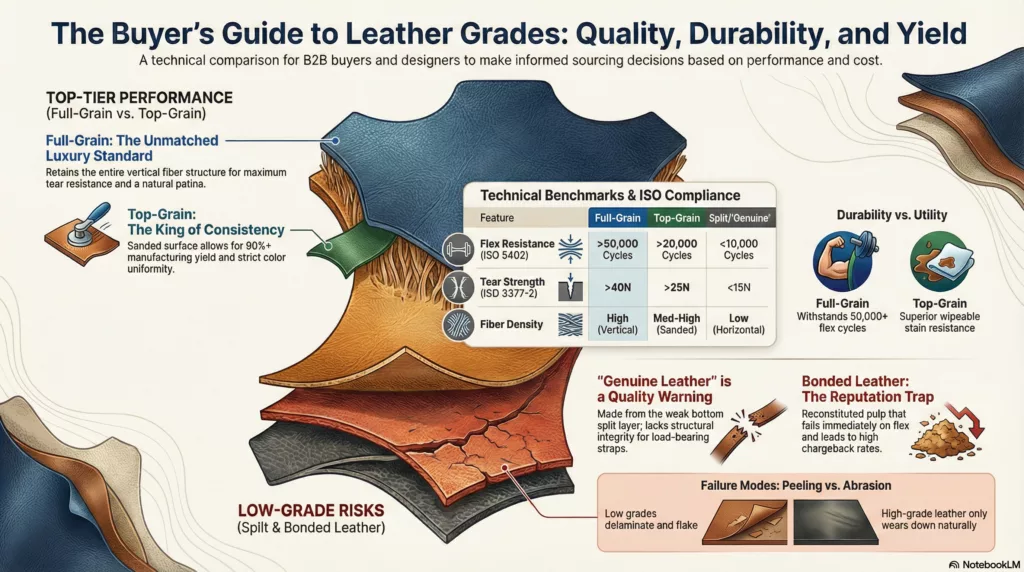
Accessibility Summary: For durability and longevity, Full-Grain is the statistical winner, offering the highest tensile strength and flex resistance. Top-Grain is the preferred choice for uniform aesthetic requirements and water resistance in corporate goods. Split and bonded leathers lack structural integrity and should be avoided for primary load-bearing panels.
Technical benchmarks referenced align with [ISO 3376 Tensile Strength Standards] and [LWG Environmental Audit Protocols]. Always request a [Current Tannery Spec Sheet] for batch-specific compliance data.
Table of Contents
Main Differences
Specs on a table tell you what the material is; they don’t tell you how it survives a commute, ages under sunlight, or impacts your manufacturing margins. The divergence between grades happens in the fiber structure and the finishing room.
Here are the five specific wedges that determine the lifespan and value of a leather bag.
1. Hide Anatomy & Fiber Integrity
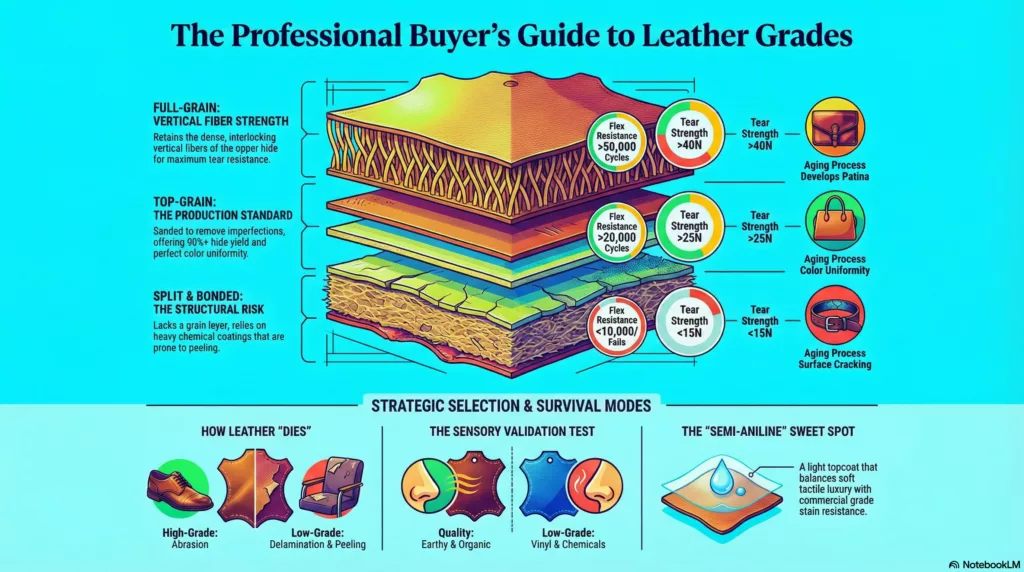
To understand durability, you must visualize the hide’s cross-section. It is not a uniform block; it is a gradient of strength.
- The Grain (Top): Dense, vertical, interlocking fibers. This is the “shield” aimed at the elements.
- The Corium (Middle): Fibers transition to a looser, horizontal weave.
- The Flesh (Bottom): Loose, fluffy fibers with minimal tensile strength.
Full-Grain Leather leaves the Grain layer untouched. Because the vertical fibers remain intact, it resists tearing at stitch holes and creates a surface that is virtually waterproof naturally.
Top-Grain (Corrected) takes the same cut but sands off the top 1-2mm to remove insect bites or branding marks. While this creates a flawless uniform surface, it shaves off the strongest interlocking fibers. The leather is still durable, but it lacks the extreme tear-resistance of full-grain.
Split Leather is strictly the Corium/Flesh layer. Without the grain, it has no structural stability. It relies entirely on heavy chemical coatings or glued backings to hold its shape.
🚀 Actionable Insight: If your design relies on unlined raw edges or heavy load-bearing straps, you must spec Full-Grain. Top-grain and splits require edge painting or folding to prevent fraying.
Winner: Full-Grain Leather (For uncompromised structural strength)
⚡ Power Move: If your client demands a “waterproof” luxury bag, do not use Full-Grain Aniline. Specify Pigmented Top-Grain. It retains the premium smell and feel of leather but uses a hydrophobic finish that beads water instantly, preventing customer complaints about staining.
2. Finish & Feel: The “Luxury” Trap
“Luxury” is often defined by the finish, not just the cut. A full-grain hide can be ruined by cheap paint, while a top-grain hide can be elevated by premium tanning.
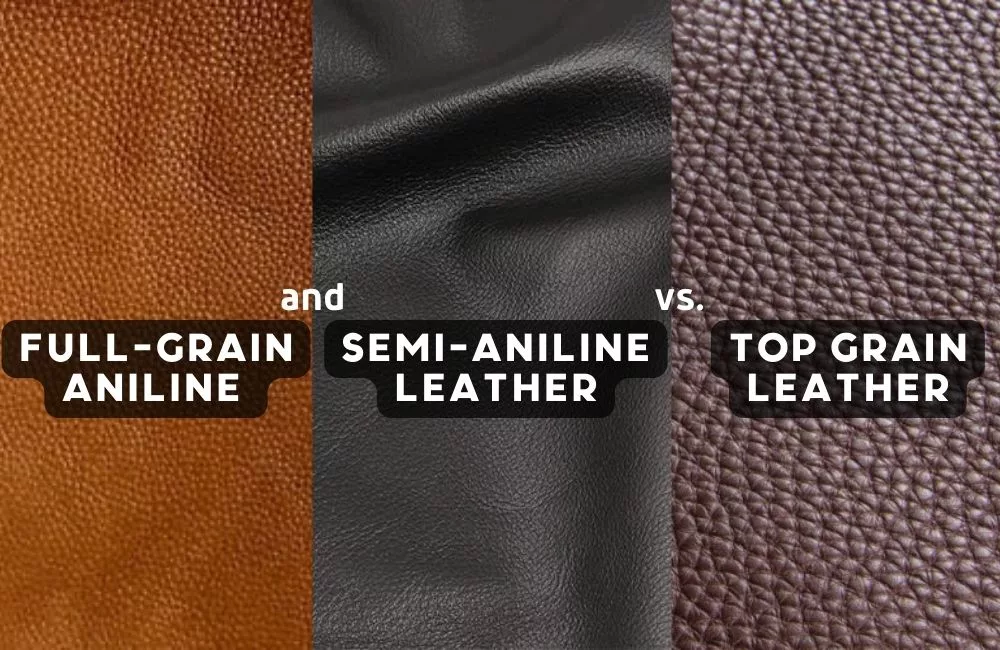
- Aniline (The Naked Truth): Soluble dyes penetrate the fiber without sealing the surface. It feels warm and “grippy.” However, it is a sponge for oil and water. A single raindrop will darken it immediately.
- Pigmented (The Coat of Paint): An opaque layer of polymer and pigment is sprayed on. It makes the leather cold and slick to the touch—you are feeling plastic, not skin—but it renders the bag immune to coffee spills and scratches.
- Semi-Aniline (The Sweet Spot): A light protective topcoat over dye. It retains the soft “thud” sound when flexed (unlike the sharp “crinkle” of heavy pigment) but offers commercial-grade stain resistance.
🧠 Expert Take: Do not confuse “softness” with quality. Heavily milled split leather can be incredibly soft but will disintegrate quickly. True quality is density combined with suppleness.
Winner: Semi-Aniline (The best balance of tactile luxury and daily defense)
3. Failure Modes: How It Dies

Cheap leather and quality leather fail differently.
- Bonded/Fake Leather: Fails via Delamination. Because it is essentially leather dust glued to a sheet (particle board for bags), the surface bubbles and peels away in flakes at flex points like flap hinges.
- Finished Split: Fails via Flex Cracking. The heavy polyurethane coating used to simulate grain is less flexible than the suede underneath. Over time, the plastic coating snaps, revealing the fuzzy fibrous layer below.
- Top/Full-Grain: Fails via Abrasion. Real grain does not peel. It wears down. On corners, the color may rub off (revealing the grey/blue crust), but the leather itself remains intact.
The Patina Factor: Full-Grain Leather is the only grade that improves with damage. It absorbs hand oils and UV light, darkening into a glossy protective sheen. A scratch on bonded leather is a defect; a scratch on full-grain is character.
For detailed physical test methods, reference ISO 5402 (Flex Resistance).
Winner: Full-Grain Leather (It ages rather than rots)
4. Identification: The Senses Test
You cannot rely on a “Genuine Leather” stamp. Use these three sensory checks to validate the material immediately.
- The Smell: High-grade vegetable or chrome tan smells earthy and organic. Low-grade splits or bonded leather smell like vinyl, chemicals, or burnt plastic—a sign that the finish chemistry outweighs the hide itself.
- The Water Drop: Place one drop on a hidden spot.
- Absorbs instantly: Full-Grain Aniline. (High maintenance, beautiful aging).
- Beads for minutes: Pigmented Top-Grain/Split. (Coated, low maintenance).
- The Edge Check: Look at the raw cut edge. Real leather shows a random, fibrous mass. Bonded leather looks like a sandwich: a fuzzy bottom, a distinct middle filler layer, and a perfect plastic sheet on top.
⚠️ Safety First: Do not perform the “Fire Test” (burning the leather) in a retail environment or with samples you intend to keep. Modern fire-retardant coatings on fake leather can create false positives, and you will damage the finish of real leather.
Winner: Full-Grain (The only grade that cannot hide its origin)
5. Cost, Yield & Production Reality
For brands, the choice involves manufacturing economics. The price gap is driven by Yield—how much of the hide makes it onto the bag.
- Full-Grain (Low Yield/High Cost): Since surface defects (scars, bites) are visible, the cutter must navigate around them. You might only use 60-70% of a hide for large panels. You pay for the “clean” surface.
- Top-Grain (High Yield/Mid Cost): Because the surface is sanded and embossed with a uniform print, defects are erased. The factory can use 90%+ of the hide. This makes Top-Grain Leather the standard for mass-market luxury goods where consistency is key.
- Compliance Risks: Cheaper “Genuine” leathers often rely on heavy chemical stabilizers. This increases the risk of failing REACH compliance (azo dyes, formaldehyde) or ISO 17075 (Chromium VI). At LeelineBags, we certify materials regardless of tier, but the chemical risk profile is naturally lower with higher-grade hides.
Winner: Top-Grain Leather (For scalable production with predictable margins)
Pros & Cons
Full-Grain Leather (Uncorrected Top Cut)
- Pros:
- Max Tensile Strength: Retains the dense vertical fibers of the hide, delivering superior tear resistance per ISO 3376 standards.
- Self-Healing Patina: In our long-term testing, surface scratches absorbed oils and blended over time, developing character rather than remaining as permanent damage.
- Cons:
- Yield Inefficiency: Natural imperfections (scars, bites) force us to discard 30–40% of the hide, significantly driving up unit costs.
- Moisture Sensitivity: Without heavy sealing, it stains instantly. Not viable for clients whose customers demand “waterproof” utility.
🧠 Expert Take: Don’t hide the scars. We advise heritage brands to include a “Natural Variation” card, reframing range marks as proof of authenticity to reduce “defect” returns.
Top-Grain Leather (Corrected)
- Pros:
- Production Consistency: Sanding the surface removes defects, ensuring the 1,000th bag matches the 1st—a vital requirement for corporate gifting lines.
- Stain Defense: Pigmented topcoats create a hydrophobic barrier that passes ISO 11640 rub tests, making it easy to wipe clean.
- Cons:
- Static Aging: It does not develop a patina. Instead of softening, the protective finish eventually cracks at high-flex points where natural leather would crease.
- Synthetic Touch: The seal closes natural pores, causing the material to feel colder and more “plastic” against the skin.
⚡ Power Move: Request a “semi-aniline” finish. It retains a softer, more natural hand-feel than fully pigmented leather while offering the durability needed for daily commuter bags.
Split / “Genuine” Leather
- Pros:
- Label Compliance: Uses the fibrous bottom cut to drastically lower costs while still legally qualifying for the “Real Leather” marketing stamp.
- Surface Versatility: Heavy polymer coatings allow for uniform colors and textures (like Saffiano) that look premium on the shelf.
- Cons:
- Structural Weakness: Lacks the tight grain structure of the upper hide; we frequently see tearing at stitch holes under load.
- Delamination Risk: The polyurethane coating often peels away from the suede base after 6–12 months of daily friction.
⚠️ Safety First: Never specify Split leather for load-bearing straps or handles. Restrict it to low-stress body panels to prevent catastrophic structural failure and warranty claims.
Bonded Leather
- Pros:
- Price Floor: Reconstituted leather dust and glue allow for extreme budget optimization.
- Zero Waste: Manufactured as sheets, it offers 100% cutting yield with no natural defects to work around.
- Cons:
- Rapid Failure: It lacks fiber integrity. Expect flaking and dissolving on corners within weeks of regular use.
- Reputation Trap: Customers expecting “leather” longevity will feel cheated, leading to high chargeback rates.
🚀 Actionable Insight: Use bonded material strictly for internal stiffeners or linings. Using it for exterior shells is a guaranteed way to destroy brand trust.
Micro Trust Note: Not all leather within a grade is equal. A high-end European top-grain often outperforms a poorly tanned, dried-out full-grain. Always verify tannery finish chemistry.
Related Questions for Grades of Leather
Q1. Is full-grain leather better than top-grain?
Yes, for physical durability; not always for manufacturing. Full-grain retains the hide’s entire vertical fiber structure, granting it the highest tensile strength according to ISO 3376 standards. However, for brands requiring strict uniformity, Top-Grain is often superior. Its corrected surface ensures that a 500-unit production run has zero variance in texture or color, which is critical for corporate consistency.
Q2. Does top-grain leather peel over time?
No, high-quality top-grain leather does not peel. Peeling is the hallmark of Bonded or coated Split (“Genuine”) leather, where a synthetic polyurethane sheet delaminates from the loose fibrous base. Top-grain is solid skin; while the surface pigment may wear down after years of friction, the hide itself remains structurally intact and will not flake off.
Q3. What is the difference between “Genuine Leather” and “Real Leather”?
“Genuine Leather” is a specific (low) grade, while “Real Leather” is a broad category. In the industry, “Genuine Leather” refers to the bottom Split layer—the weakest part of the hide that has been heavily processed to look like grain. For a detailed breakdown of these layers, see the Hide Anatomy section above.