
Vague requirements cause expensive defects.
In my experience, a generic instruction like “check stitching” is useless without defining the exact Stitches Per Inch (SPI). You need a specific quality control checklist that drives pass/fail decisions, informed by every stage of the handbag design process.
This guide provides a staged system (IQC, IPQC, FQC), defect classification logic, and AQL sample tables. We aligned these templates with ISO 9001:2015 protocols to replace theory with strict accountability.
1. Product Quality Standards & CTQs (ISO 9001:2015-Aligned)
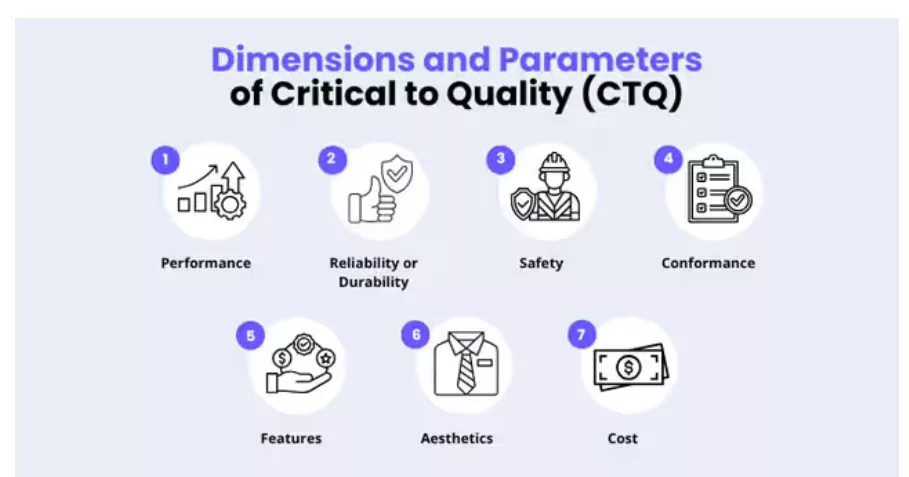
“Good quality” is subjective; Critical-to-Quality (CTQ) metrics are not. Your quality control checklist must define a minimum “Quality Pack” to serve as your ISO 9001:2015 operational control:
- Tech Pack & Tolerances: Define exact limits (e.g., ±0.5cm).
- Golden Sample: A signed physical prototype.
- Labeling & Testing: Packaging standards and material tests.
I’ve seen batches fail because clients asked for “strong stitching” instead of “bar tacking at stress points.” The factory used a weak backstitch—technically “strong” but functionally inadequate. Classify these defects by risk: Critical (safety), Major (returns), and Minor (cosmetic). Detailed specs also strengthen your position during manufacturing negotiation.
2. Incoming Quality Control (IQC) Checklist: Materials, Components, and Compliance Docs
You cannot sew your way out of bad fabric. If raw materials fail, the finished bag fails.
We start by verifying documentation: PO matches, packing lists, and Certificates of Analysis (COA). While we scan 100% of outer cartons for transit damage, we pull targeted samples from the bottom of pallets to catch hidden defects.
I specifically hunt for color shade shifts between dye lots. I also test the “hand feel” of PU coatings—tackiness often signals future peeling. For functional parts, we inspect luxury handbag hardware for plating scratches before they reach the assembly line.
3. In-Process Quality Control (IPQC) Checklist
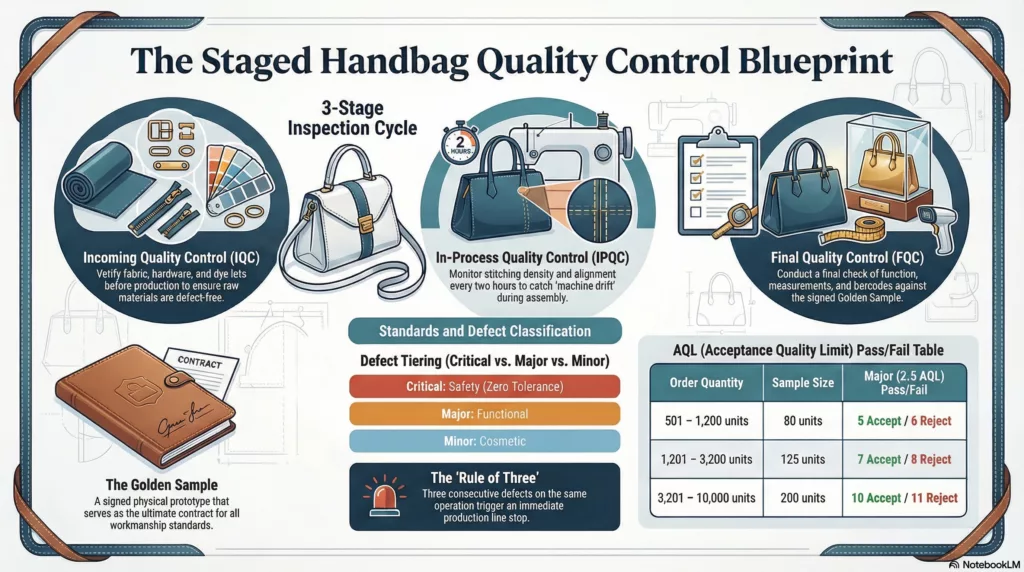
Waiting for final inspection is financial suicide. IPQC stops small process drifts from becoming thousands of defective units. I enforce three non-negotiable gates to catch these shifts:
- First-Article Approval: Production never starts until the first unit matches the Golden Sample. This is vital for a custom handbag manufacturer to secure precise sample sign-off before bulk cutting.
- Mid-Run Structural Check: Inspect stitching density and reinforcement areas every two hours. Machine tension often loosens as motors heat up—catch this drift before seams weaken.
- Pre-Final Assembly: Verify alignment and workmanship consistency before linings are sealed.

4. Final Quality Control (FQC) & Inspection Report
FQC is a financial trigger, not just a spot check. I hold final payment until the quality control checklist marks the batch as “PASS.”
Verify function, measurements, and barcodes against the signed Golden Sample. This documentation prevents handbag factory scams where suppliers swap approved samples for cheap bulk units.
Final Inspection Report Template:
- Header: PO #, Date, Location.
- Scope: AQL Level, Sample Size, Assortment.
- Defects: Critical/Major/Minor counts vs. limits.
- Evidence: Photos of defects, packaging, and labels.
- Action: PASS / FAIL / REWORK.
🛡️ LeelineBags’ Verdict: Ignore verbal assurances. If defects hit the AQL limit (e.g., 22 majors in 5,000 units), I require the factory to rework the entire batch at their expense before booking freight.
5. Defect Classification Table (Critical vs Major vs Minor)
Most QC disputes stem from definitions, not defects. A classification table turns subjective opinions into binary data.
Categorize every issue into three tiers:
- Critical (Safety): Zero tolerance. Examples: Broken needles, metal contamination, sharp edges.
- Major (Function): Likely returns. Examples: Open seams, zipper misalignment, heavy color bleeding.
- Minor (Cosmetic): Saleable within tolerance. Examples: Crooked logos (<2mm), slight scuffs.
These tiers dictate your acceptance rules. Build your defect library from actual warranty claims. If a customer returns a bag for a loose strap, classify that defect as “Major” for future runs.
6. Functional Testing: Catching Failures Visuals Miss
Visual inspections miss structural flaws. You need stress tests to catch failures before your customers do. If you lack agreed criteria, define provisional tolerances now to prevent disputes during the inspection.
I prioritize these functional checks for every quality control checklist:
- Load & Drop: Load the bag to capacity (e.g., 10kg) and drop it 10 times. Check handle stitching for “grinning” (gaps).
- Zipper Cycle: Open and close 20 times at speed. Any snag is a failure.
- Crocking: Rub fabric with wet white cotton. Any color transfer indicates poor dyeing.
- Coating Adhesion: Scratch coated surfaces to ensure no peeling occurs.
We once rejected a batch because the PU coating peeled under a simple fingernail scratch test. The factory argued it was minor, but we knew humidity would worsen it. We forced a remanufacture using higher-grade material.
🚀 Actionable Insight: Record video of these tests. A static photo cannot prove a zipper glides smoothly or a barcode scans instantly.
7. Factory Audit Checklist: Verify Capability Before You Rely on Inspections
Inspections catch bad products; audits catch bad businesses. We assess suppliers on nine pillars, prioritizing process control and traceability. Your audit score must dictate the QC plan—if a factory fails calibration checks, we automatically increase IPQC frequency and tighten AQL standards.
For sustainability, demand transaction certificates for your specific batch, not just a generic facility scope. This diligence clarifies who owns audit accountability and secures complex supply chains, including partners like handbag manufacturers in the UK.
We once audited a factory with perfect samples but zero traceability. They couldn’t link leather batches to finished bags. We walked away. If you can’t trace an error back to the material roll, you cannot prevent it from happening again.
⚡ Power Move: Make closing “Major” audit findings a contractual condition for releasing the deposit payment.
8. Real-World Saves: Why You Need a Quality Control Checklist
I once saved a shipment because a quality control checklist forced a “wet rub” test. Visuals lie; data doesn’t. Three defects we caught:
- Dye Transfer: The rub test revealed bleeding on red leather. We quarantined the lot and issued a CAPA immediately.
- Stitch Drift: IPQC caught straps drifting 2mm off-center. We recalibrated machine tension before the batch was ruined.
- Bad Hardware: Incoming QC flagged “sticky” zippers. We rejected the component lot before assembly.
Tools to Operationalize It Digital tools enforce accountability. I recommend Augmentir (guidance), QualityReports (forms), Alpha Software (no-code), OverInspect (reporting), or Clue (work orders).
Need help building a bag QC checklist + inspection plan? Contact us.
The Execution Plan: Set AQL Standards That Hold Factories Accountable
AQL (Acceptance Quality Limit) transforms “good quality” from an opinion into a contract. It defines exactly how many defects you accept before rejecting an entire shipment.
In my years managing bag production, I found that factories often argue that a few crooked stitches are “normal.” AQL stops that argument. It gives you a pass/fail mathematical standard based on the ISO 2859-1 protocol.
Step 1: Define Your Defect Classes
You must categorize potential errors before production begins. Factories need to know what kills an order.
- Critical Defects (0 allowed): Issues that hurt the user or violate regulations.
- Example: Broken needles left in lining, mold, or sharp hardware edges.
- Major Defects (2.5 AQL): Functional failures that make the bag unsellable.
- Example: Broken zippers, wrong Pantone colors, or snapped straps.
- Minor Defects (4.0 AQL): Cosmetic flaws that do not stop function.
- Example: Untrimmed threads under 5mm or slight scuffs on the base.
Step 2: Apply the Standard AQL Table
Use this simplified table derived from the official ANSI/ASQ Z1.4 standard. Do not guess your sample size.
| Order Quantity (Lot Size) | Code Letter | Sample Size (Inspect This Many) | Major (2.5) Accept / Reject | Minor (4.0) Accept / Reject |
|---|---|---|---|---|
| 281 – 500 | H | 50 | 3 / 4 | 5 / 6 |
| 501 – 1,200 | J | 80 | 5 / 6 | 7 / 8 |
| 1,201 – 3,200 | K | 125 | 7 / 8 | 10 / 11 |
| 3,201 – 10,000 | L | 200 | 10 / 11 | 14 / 15 |
How to Read This Table (Worked Example) You order 3,200 leather totes. Follow this sequence:
- Find 3,200 in the “Order Quantity” column.
- Identify Code Letter K.
- Pull 125 bags at random from different boxes.
- Count the defects.
- If you find 7 Major defects, the batch passes.
- If you find 8 Major defects, the batch FAILS. You reject the entire order.
Step 3: Insert “The Teeth” into Your Contract
A failed inspection means nothing if the factory refuses to fix it. We lock specific remedies into the Purchase Order during manufacturing negotiation.
Add these three rules to your contract:
- Rework Window: The supplier must repair or replace all defective units within 10 days at their own expense.
- Chargeback Protocol: If the defect rate exceeds the AQL limit, the supplier pays for a third-party re-inspection (typically $300 USD). Deduct this from the final payment.
- Partial Shipment Ban: You refuse to accept the “good half” of the order until the “bad half” is fixed. This prevents them from shipping the good units and abandoning the rest.
Step 4: Roll Out the Operations
You need a system to enforce these rules on the factory floor.
- Version Control: Date every checklist (e.g., QC_Checklist_v3_May2024). Old versions cause confusion.
- Calibration Checks: Verify tools before inspecting. If you check leather thickness, ensure the factory uses a calibrated digital caliper, not an old plastic ruler.
- Corrective Action (CAPA): If a batch fails, demand a “Corrective and Preventive Action” report. The factory must explain how they will prevent this specific defect in the next run.
- Sign the Golden Sample: Keep one perfect unit signed by the factory manager. Use this to settle disputes about color or texture.
Step 5: Add Critical Appendices
Modern buyers need more than just stitch checks. Add these modules to your checklist:
- Amazon FBA Prep: Verify barcode scannability and polybag suffocation warnings. Amazon will reject inventory if labels peel off textured fabrics.
- Sustainability Verification: Match the transaction certificate number to your specific batch. This prevents handbag factory scams where suppliers use regular cotton but charge for organic.
Want LeelineBags to build and run this QC plan for your bag line? Contact us.
Frequently Asked Questions About Quality Control Checklist
1. What is the difference between Quality Assurance (QA) and Quality Control (QC)?
Think of Quality Assurance (QA) as the rulebook and Quality Control (QC) as the scoreboard. QA is proactive. It involves setting up your processes, training staff, and creating the Standard Operating Procedure (SOP). You do this before production starts to prevent errors. QC is reactive. It happens during or after production. You use QC to identify defects that slipped through the system. If you only rely on QC, you will just find bad bags. If you use QA, you prevent them from being made in the first place.
2. Which AQL standard should I choose for my bag order?
There is no single “best” number. You must choose based on your risk tolerance. For most consumer bags, I use Level II, AQL 2.5 for Major defects and 4.0 for Minor defects. This is the industry standard. However, if you sell high-end luxury leather goods, 2.5 is too loose. I recommend tightening the standard to AQL 1.0 or 1.5. Your customers pay for perfection, so your inspection must be stricter. For cheap promotional giveaways, you might accept AQL 4.0 to keep costs low. Match the AQL to your warranty exposure.
3. What must be included in a Final Inspection Report?
A report is useless if it does not prove the goods are ready. Your inspector must include:
Sample Size: The exact number of units checked.
Defect Breakdown: A count of Critical, Major, and Minor issues.
Photos: High-resolution images of defects, packaging, and shipping marks.
Result: A clear PASS, FAIL, or PENDING decision.
I also require a side-by-side photo of the production unit next to the signed Golden Sample. This proves the factory followed the approved design. If a report lacks photos, do not approve the shipment.
4. Is a Final Inspection (FQC) enough to guarantee quality?
No. Relying only on Final Inspection is dangerous. If you find a structural defect at the end, it is often too late to fix it. You cannot change the lining once the bag is sewn shut. This is why Incoming Quality Control (IQC) and In-Process Quality Control (IPQC) are vital. IQC catches bad fabric before you cut it. IPQC catches stitching errors before the bag is finished. These early checks prevent irreversible mistakes and save you from arguing over a pile of scrap metal and leather.