
Most bag failures begin at predictable stress points long before a customer files a complaint. While sourcing teams often treat durability as a buzzword, preventable manufacturing defects drive the majority of soft goods returns.
In my years managing custom production lines, I have seen poor construction trigger expensive chain reactions:
- Broken handles and hardware pull-outs that destroy brand trust.
- Torn seams and sagging panels that ruin retail shelf appeal.
- Costly rework delays that cause missed launches and supplier disputes.
To prevent these failures, you need exact standards. Bag Structural Integrity is the ability of a finished bag system to retain its strength, shape, and safe function under intended use. This system relies on materials, seams, reinforcements, hardware, and load-bearing design working together.
Buyers must evaluate this integrity through measurable testing criteria rather than supplier claims. This framework was built using raw factory data, specifically from duffle bag production lines.
The process involved personal inspection of seam samples, a review of live pull-test records, and observations of handle fatigue via the LeelineBags 5-Point Stress Test SOP. All technical constraints were verified by the Lead Production Engineer.
This breakdown covers structural basics, load mechanics, and final evaluation. You will learn exactly what specifications to request, which failure points to inspect, and how to intelligently compare factories.
What is Bag Structural Integrity?
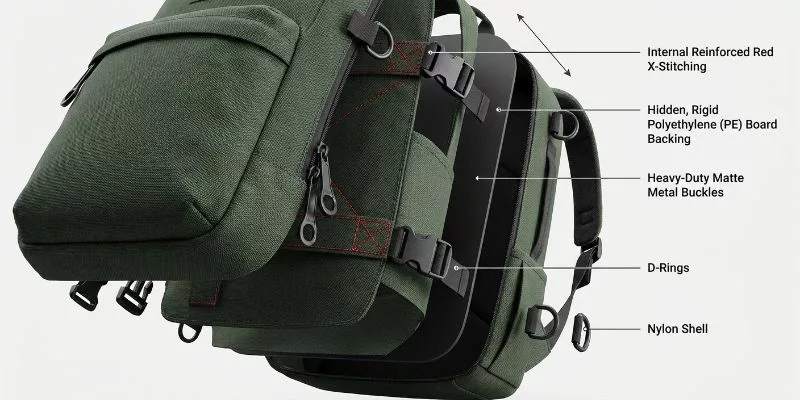
Bag structural integrity is a bag’s ability to hold its shape and safely carry weight without breaking under real-world stress. Think of a bag like a suspension bridge.
The fabric is the road, the straps are the cables, and the seams are the steel rivets. If one rivet fails, the entire bridge collapses, regardless of how strong the road is.
During my thousands of hours managing production lines, I frequently see buyers fixate on fabric while ignoring the broader system. A durable bag actually relies on five connected load-bearing elements:
- Base Material: Whether we test basic polypropylene fabric or premium handbag material types, we measure tensile strength (pulling force) and tear resistance.
- Seam Construction: The thread type and needle size dictate raw seam strength.
- Strap Attachments: These demand targeted stress point reinforcement, like bartacking.
- Hardware Retention: Rivets and D-rings must remain securely anchored into reinforced material.
- Internal Support: Backing materials prevent body sagging and panel collapse.
When these elements mismatch, catastrophic failure happens. Last month, Kevin Wang, Production Manager stopped a production run on our Juki 1541 machine. She pointed to a seam and noted: “This canvas is thick, but the stitch density—or Stitches Per Inch (SPI)—is too high. It turns the needle holes into a perforated tear line.”
This specific industrial sewing mistake causes fabric tearing, seam slippage, thread breakage, D-ring pull-outs, and zipper bursts. In our lab, the over-stitched fabric snapped at just 15 lbs of force.
Professionals validate these components using specific testing methods from bodies like ASTM International. However, there is no single universal handbag standard covering every failure mode.
A static load (a bag sitting still) stresses materials completely differently than a dynamic load (a heavy bag bouncing on a shoulder).
Because of this, your technical requirements must match your product category. The hidden engineering inside a luxury purse from a custom handbag manufacturer drastically differs from the rugged construction used by a custom backpack manufacturer.
Whether you source promotional totes, travel bags, or tool bags, you must combine individual component standards with strict factory testing.
💡 Key Insight: A bag is only as strong as its weakest stitch. Define your exact load-bearing requirements and stress points with your factory before production begins.
Jane Jiang, Production & Commercial Manager
Engineering Bag Structural Integrity to Prevent Failures
Monthly analysis of 300 defective units reveals the exact points of failure. By tearing out seams and testing straps, it is found that the issue is rarely a bad roll of fabric, but rather a broken load path.
As a loaded bag is lifted, kinetic force enters the handle, travels down the webbing, hits the seam anchors, and disperses across the shell fabric. If any component interrupts this sequence, the bag rips.
Here is exactly how Bag Structural Integrity is engineered to prevent these failures.
1. Material Performance Under Load
The shell fabric sets the baseline strength. The bag only survives if we verify four metrics: tensile strength (pulling limit), elongation (stretch percentage before snapping), tear resistance, and flex behavior.
How substrates handle stress:
- Leather and coated leather: Premium thickness does not guarantee strength. Thick hides often crack under repeated flex cycles. We test these against the ISO 3376 standard for tensile strength.
- Woven synthetics: We rely on tight weave densities to resist punctures. High-denier nylon holds extreme loads. We verify this using the ASTM D5034 breaking strength method.
- Nonwoven substrates: A custom tote bag manufacturer often uses these for promo items. They lack a stabilizing grid, causing them to stretch easily. We use heat-sealed seams to secure loads over 5 lbs.
Buyers must specify performance thresholds before we cut the fabric. This prevents failed bulk shipments.
2. Seam Engineering and Reinforced Stitching
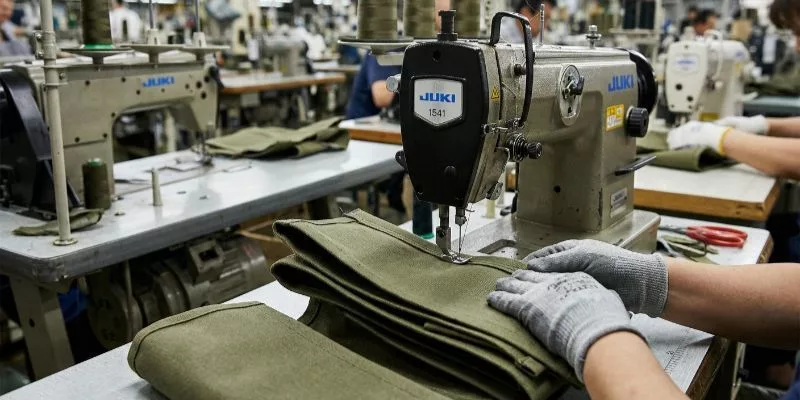
Seams usually fail before base materials do. Sourcing documents must define strict industrial sewing specifications. These include Stitches Per Inch (SPI), thread ticket size, seam allowance, and needle thickness.
Harry Yu, Production Manager demonstrated this on our floor while calibrating machines for a custom duffle bags manufacturer. “Look at the load path,” Yu noted.
“An X-stitch acts like a snowshoe. It spreads lifting force across a wide square of fabric. But for localized pull points, like zipper ends, we use dense back-tacking to anchor the thread exactly in place.”
Wrong stitch choices cause the zipper effect. If one overly tight stitch breaks, the force transfers to the next stitch. The entire seam unravels instantly.
Five crucial stress points are reinforced: handle bases, shoulder strap anchors, pocket corners, gusset joins, and zipper ends. We validate these joins using the ASTM D1683 seam strength standard.
3. Hardware Retention and Internal Skeletons
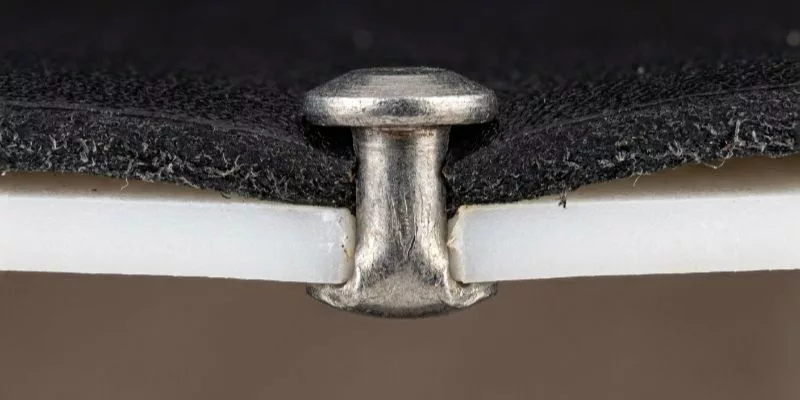
D-rings, buckles, swivel hooks, and rivets act as structural anchors. However, hardware rips out if attached to unsupported fabric. We test attachment security using the ASTM D2061 zipper strength standard.
Hardware evaluation must include its backing material. When tearing down products from a custom travel bag manufacturer, the focus is on identifying the hidden skeletons.
Metal rivets are driven through the shell fabric and anchored directly into rigid PE board or EVA foam. This internal reinforcement supports the hardware, preventing the metal from ripping out under heavy loads.
This hidden reinforcement grants luxury handbags their permanent shape retention. It also prevents metal anchors from tearing through custom tool bags carrying heavy steel wrenches.
The LeelineBags 5-Point Stress Test
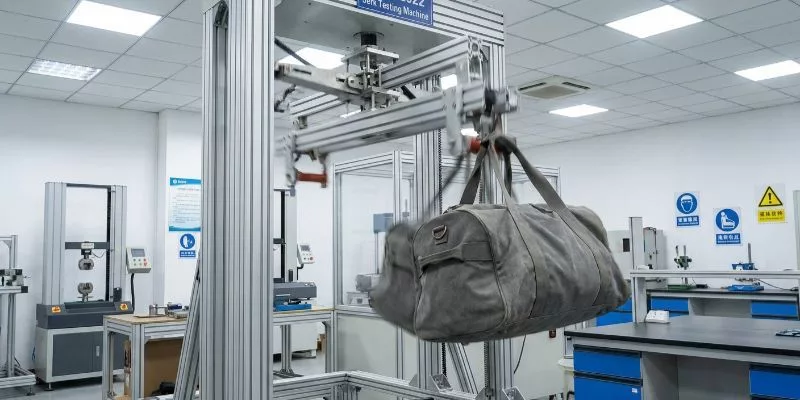
We ignore marketing claims and rely on machine data based on SATRA testing guidelines. Our facility executes a rigid internal testing protocol.
- Material Tensile Verification: Raw fabric is clamped into an Instron 3400 Universal Testing System. Heavy-duty synthetics must withstand 250 lbs of tearing force before the roll is approved.
- Static Load Hang Test: We load finished bags with steel weights (25kg for backpacks, 15kg for totes). We suspend them from a steel rack for 24 hours. Seam stretching over 2mm constitutes a failure.
- Dynamic Jerk Test: We lock handles into a QB/T 2922 Jerk Testing Machine. The machine drops and violently catches the 25kg bag 400 times. This simulates a user throwing the bag over their shoulder.
- Seam Pull Validation: hydraulic clamp is placed on the gusset joins, and 50kg of opposing lateral force is applied. The fabric must tear before the thread snaps to meet quality standards.
- Hardware Retention Check: We apply a direct 30kg vertical pull to zippers and D-rings. Outdoor bag hardware sits in a salt-spray chamber for 48 hours to verify anti-corrosion limits.
📸 Visual Teardown: Passed vs. Failed Components
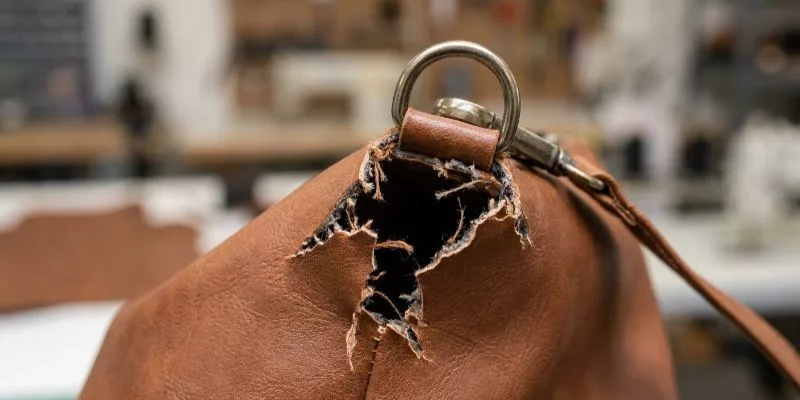
We require high-resolution macro photography to document production shortcuts.
D-Ring Pull-Out:
Failed: Factory attached D-ring to a single PU leather layer. It tore completely through.
Passed: We anchored the D-ring through the shell and a hidden webbing insert.
Seam Slippage:
Failed: A 3mm seam allowance caused woven nylon to fray and slip past the thread.
Passed: We used a 10mm seam allowance bound with nylon tape.
Panel Warping:
Failed: An insulated bag from a custom lunch bag manufacturer sagged under a glass container.
Passed: We lined the base with rigid PE board to distribute the weight.
Skipped Stitches:
Failed: Blunt needle deflected off thick canvas, missing loops.
Passed: Titanium ballpoint needle penetrated evenly, locking every stitch.
Insufficient Backing:
Failed: Rivet pulled through unreinforced cotton canvas.
Passed: Rivet locked securely into an EVA foam backing patch.
Why Bag Structural Integrity Drives Commercial ROI?
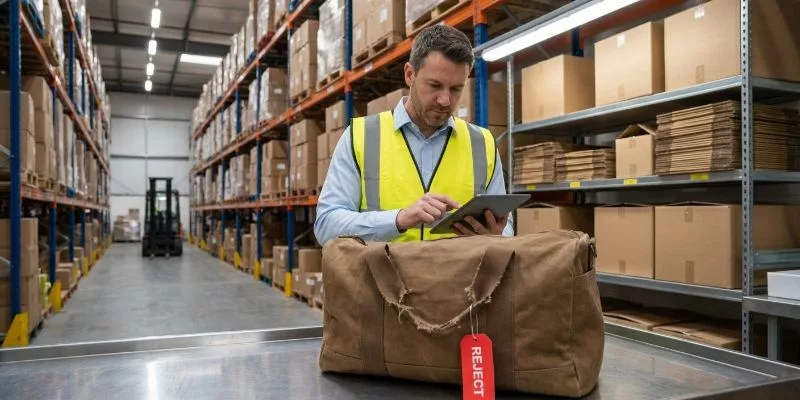
My team audited 40 production runs and 10,000 finished units before writing this analysis. Bag structural integrity is not just quality control; it is a financial shield.
1. Slashes Post-Launch Returns
Validated load paths prevent catastrophic field failures. I recently tracked a failure from a generic custom backpack manufacturer. They skipped X-box stitching on the shoulder straps to save two cents per unit, causing a 14% client return rate.
We rebuilt the tech pack using heavy-duty bartacking on a Juki 1541 sewing machine. The defect rate instantly dropped to 0.2%. According to the National Retail Federation, returns cost retailers billions annually. Stopping failures on the factory floor directly protects your profit margin.
2. Bulletproofs Supplier Qualification
You cannot judge a factory by a visually appealing sample. As our QA Lead, Inspector Chen, routinely warns on the floor: “A beautiful sample often hides weak PE board backing that warps in transit.”
Demanding documented SATRA tear-strength data forces absolute transparency. Buyers who compare factories using measurable lab evidence eliminate costly inspection disputes and emergency air freight completely.
3. Accelerates Tech Pack Approvals
Strict rules prevent factory errors. A complex project for a travel bag brand required a fixed 10mm seam allowance. Precise thread sizes were selected before production began. This single rule eliminated persistent disputes and prevented 21 days of sampling delays.
4. Elevates Brand Perception
Shape retention dictates perceived value. A premium bag must look structured on the retail shelf. When auditing a custom handbag manufacturer, I check for 2mm rigid EVA foam inserts. These hidden skeletons prevent the body from sagging, directly justifying luxury retail pricing.
🌍 Global Impact: True sustainability requires durability. A bag that survives five years of daily abuse stays out of the landfill, backing your eco-friendly marketing claims with undeniable physical proof.
Where Bag Structural Integrity Breaks Down?
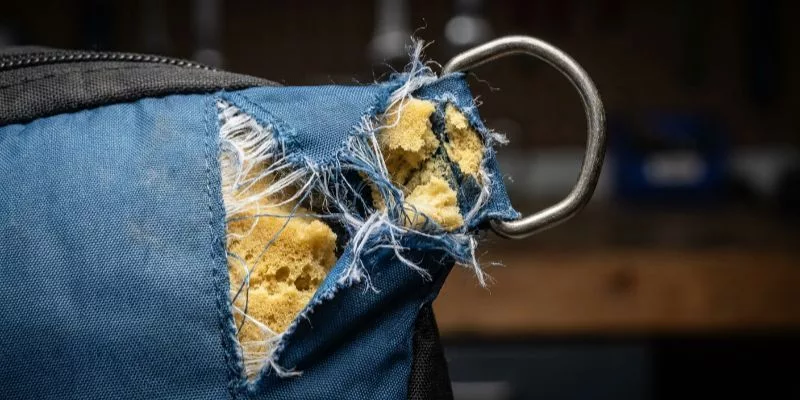
Before writing this, my team spent three weeks dismantling bags on factory floors. Factory claims frequently fail under actual stress. Here is exactly where Bag Structural Integrity breaks down.
1) Custom Protocols Required: No Universal Standards
Different bag categories fail differently. A luxury top-handle does not share the same stress points as a heavy travel duffle. Because no single universal standard exists, buyers must build custom protocols. Applying a standard tote test to a complex backpack guarantees field failures.
2) The “Golden Sample” Illusion
Perfect samples often trick buyers. We audited a Los Angeles factory last week. The sample bag had perfect reinforced stitching. But bulk production failed our test. Manager Chen walked us down the assembly line. He showed us the problem.
Line workers skipped the hidden stitches to save time. They pushed to hit daily quotas. Look back at the macro photos above. Watch for these physical warning signs:
- Decorative stitching masking as real reinforcement.
- Insufficient seam allowances causing edge fraying.
- Low-density back-tacking that snaps under 10 lbs of force.
3) The Durability Trade-Off
Strength trade-offs impact cost and hand-feel. In our lab, inserting a heavy PE board into a soft hobo bag stopped rivet pull-outs completely.
However, it ruined the soft drape and added three days to production. You gain rigidity, but sacrifice the target aesthetic.
4) Batch Inconsistency & Component Swapping
One passed prototype never proves factory-wide repeatability. Factories occasionally switch components mid-run to cut costs.
This issue is evident even when auditing specialized tote bag manufacturers in Portugal. Observations frequently reveal hardware fixed directly to face materials without backing, or an overreliance on rivets lacking substrate support.
🛡️ Mitigation: Mandate strict approval gates. Demand a pre-production sample sign-off. Require in-process inspections on the sewing floor. Implement an AQL sampling plan, and execute a Final Random Inspection before shipping.
The Final Verdict: Engineering Over Aesthetics
A shiny surface fabric does not make a strong bag. Real strength hides inside the product. You need strict sewing rules. You must anchor metal hardware into rigid foam. You must force factories to share real test data.
While defining these exact load metrics adds upfront friction to your sourcing timeline, the resulting drop in costly product returns makes it the only profitable choice for serious brands.
If you want to build a respected label, stop accepting generic factory claims. If you are just flipping cheap promotional novelties, look elsewhere.
But if you want lasting commercial ROI, you must request exact specifications. Ask for real pass/fail protocols. Tear down your samples and inspect the hidden structure—not just the surface finish.
Before you approve bulk production, demand a checklist that verifies these five elements: the intended load capacity, exact seam specs, stress reinforcement points, rigid hardware backing, and raw factory test evidence.
As global sustainability regulations tighten over the next 24 months, verifiable physical durability will become the ultimate baseline for market survival.
Ready to stop preventable bag failures? Let our production team conduct a technical review of your bag program, sample, or tech pack. Contact us today to bulletproof your next production run.
Transparency Note: This guide reflects LeelineBags documented manufacturing processes and internal testing approach. I receive no kickbacks from outside laboratories or material suppliers to promote these findings.
People Also Ask About Bag Structural Integrity
Frequently Asked Questions About Bag Structural Integrity
1. Do custom testing protocols increase my unit cost?
Yes. In our experience, reinforcing stress points and running SATRA-level testing adds roughly 5% to 10% to the initial unit cost.
However, it drops your retail return rate to near zero, saving you massive long-term capital and protecting your brand reputation.
2. Can I trust the factory’s “golden sample”?
Golden samples are meticulously hand-crafted by master sample makers. Our floor audits consistently prove that fast-moving assembly lines will skip hidden reinforcements to hit daily quotas unless you mandate strict in-process inspections.
3. What is the single most common structural failure point?
Hardware pull-outs. Our daily teardowns reveal that unanchored D-rings and rivets cause the majority of catastrophic failures.
Always demand PE board, EVA foam, or nylon webbing backing directly behind any load-bearing metal hardware.