
How To Design Handbags For Manufacturing can elevate your brand and help you stand out in the market. By designing handbags from a customized handbag manufacturer perspective you ensure your designs are stylish, functional, and market-ready.
When designing handbags start by brainstorming ideas in line with current trends and your target audience. Highlight the unique features, styles, and purposes of your handbags. They should stand out in a crowded market. It sets the foundation and guides the next steps. This includes sketching and selecting materials.
Get ahead by studying the latest fashion trends. Then, turn your ideas into technical drawings and compile a Bill of Materials (BOM). Follow these steps to streamline your manufacturing process and improve your final product. Ready to make your design a reality? Read this guide to design handbags!
How To Design Handbags For Manufacturing?
Step 1: Concept and Design
In the first stage of handbag design for production focus on concept creation and design. Work with your product team to find trends and preferences that suit your brand. Conduct market research. Focus on creating survey for enterprise companies and large retail buyers to refine ideas through structured feedback and focus groups.
Use fashion magazines, blogs, and store visits for trend and customer insights. Define the purpose and target audience for the handbag. This will help it meet customer needs. Outline its use, features, and intended user.
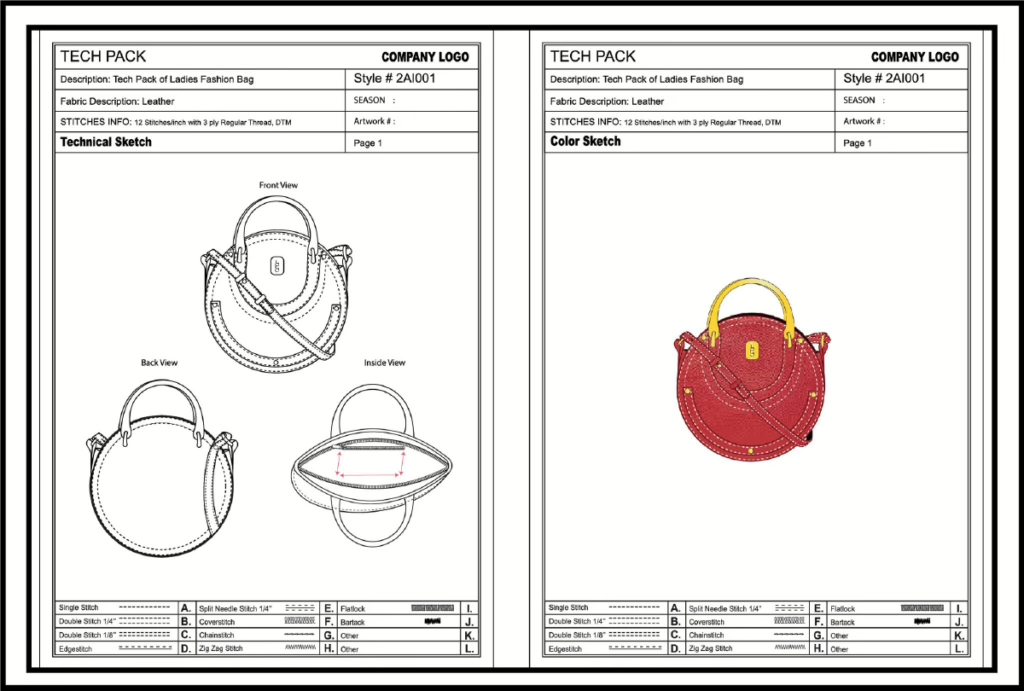
Choose materials that are durable and functional, especially for everyday personalized bags. Use sketches, CAD software, and virtual models to test the handbag’s functionality, look, and comfort. A full Technical Pack with all design details is crucial for consistent manufacturing. Add to this by creating a Paper Model to physically test the design.
Step 2: Start with Sketches and Digital Design Tools
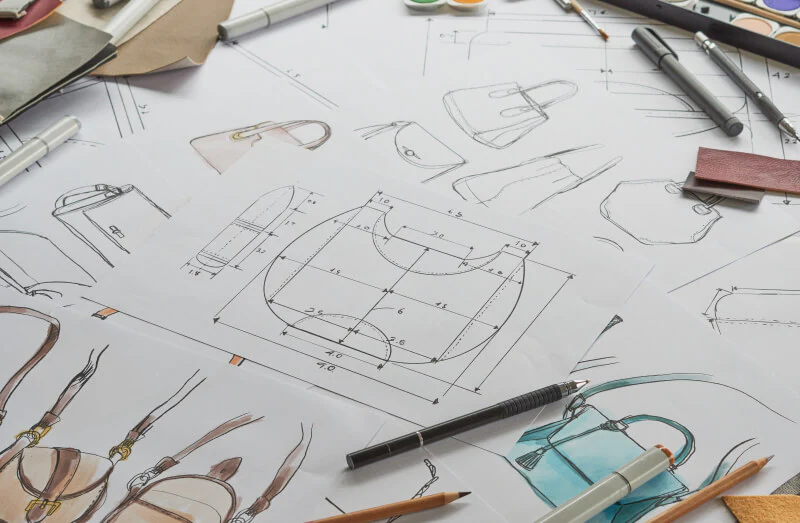
When designing handbags for production initial sketches are key. Start with pencil and paper to test different shapes, sizes, and details. This process helps you refine your ideas before moving to digital tools. These early sketches lead to technical sketches or fashion flats. They show your designs from different angles.
Digital Design Tools:
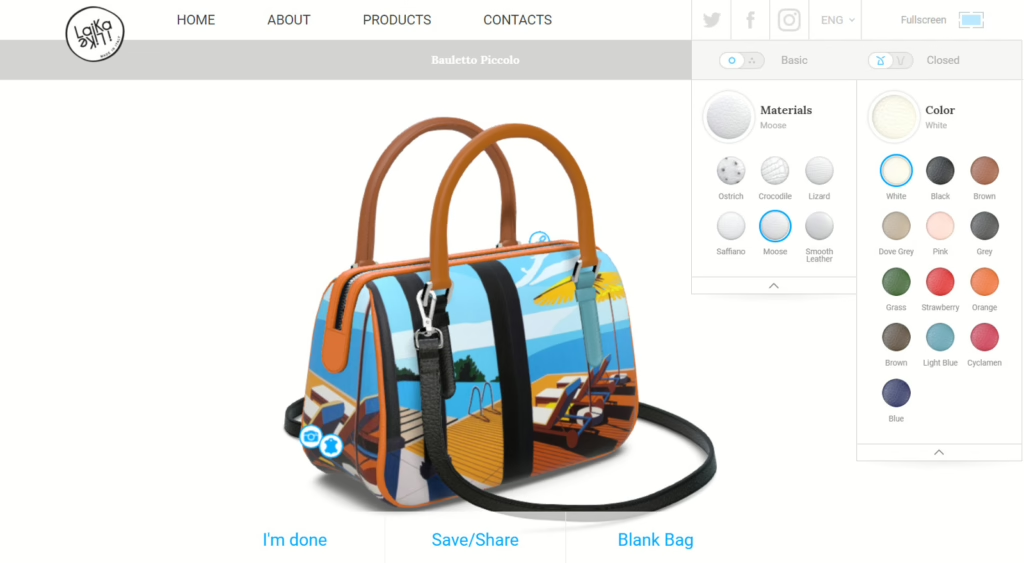
Use digital tools like Adobe Illustrator. It’s great for scalable vector files. Illustrator’s “Recolor Artwork” feature allows you to try different color options and increase design flexibility. Adobe Photoshop is perfect for adding photographic elements and fabric textures. Use “Pattern Preview” to check for seamless designs. Procreate is a dynamic drawing app with many brushes and color tools.
CAD Software and 3D Modeling:
CAD software like Optitex offers 2D/3D visuals. This cuts the need for physical samples and speeds up the time to market. Use CLO Virtual Fashion to simulate fabric behaviors. It has a library of design templates. For projects that require precise component fits 3D modeling software like Rhino is useful to get detailed virtual samples without physical prototypes.
Step 3: 2D Patterns and Bag Dies
2D patterns and bag dies are key to designing handbags for production.
- Draw the design: Start with simple 2D geometric shapes for the front, back, flaps, sides, and other parts. Use paper or vector tools like Illustrator.
- Add dimensions and details: Include measurements, seam allowances, and stitch lines. Seam allowances are usually 5 mm (1/4”) to 1.5 cm (5/8”).
- More Pieces: Create separate pattern pieces for pockets and gussets. Use tracing paper or digital tools for precision.
- Label each piece clearly with its details. Mark key points like grainline and darts.
- Use Precision Tools: Use the 2D patterns to create bag dies from strong materials, like metal or plastic. This ensures consistent quality.
- Pre-Cutting Nesting: Use software like Romans CAD 2D BAG for pattern nesting. It will maximize material use.
- Material Calculation: Software can calculate material usage and cost.
- Mock-Up and Prototype: Build a mock-up to test and refine the design before production. It must meet your standards for function and appearance.
Step 4: Find and Partner with the Right Manufacturer
In How to Design Handbags for Manufacturing, partnering with a manufacturer experienced in leather goods is essential. This ensures your handbag designs are translated into high-quality products that meet both aesthetic and functional standards for production.
- Research and Shortlisting: Check feedback and previous work to make sure they meet your standards.
- Leather Expertise: Look for experience with full-grain, top-grain, and genuine leather.
- Technical Consultation: Work together to match your design with technical consultation.
- Efficient Production: Skilled partners make the process faster and easier.
- Cost Savings: Save money by taking advantage of scale.
- Brand consistency: Keep design and quality consistent to build your brand.
This way your handbags meet both your design and quality standards and strengthen your brand in the market.
Expert Tips:
“In How to Design Handbags for Manufacturing, it is vital to collaborate with a manufacturer experienced in your specific materials and production techniques. This ensures seamless production, high-quality results, and efficient scaling from design to final product.”
—Ricky Cheng, CEO of HOYUEN HANDBAG FACTORY
Step 5: Source Components and Hardware
To design handbags for production find the right components and hardware accessories. Choose trusted suppliers like LeelineBags, and Luxury Leather Italy for high-quality materials like Italian-made hooks, locks, and chains. Match components to the handbag style; custom clasps and hooks for extra flair. Get the essential hardware. Use durable materials like brass or Zamak for the metal studs and branding logos. Focus on sustainability and customization to keep your brand identity and eco-friendly commitment.
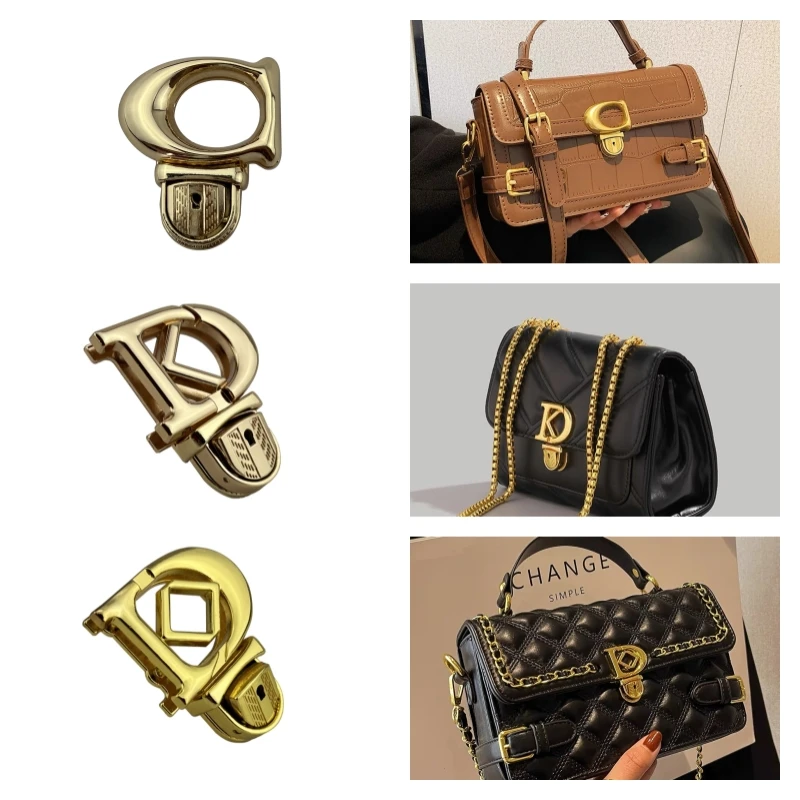
Step 6: Create and Refine Prototypes
In handbag design, making and refining product test handbags turns your sketches into real products. First, use your sketches and digital models to make physical samples. Use the right materials and put the bag together; focus on quality and practicality.
Technical Consultation: Talk with the manufacturer. Ensure your handbag matches your vision. It should have the right design, function, and look. Teamwork helps everyone to understand the product needs clearly.
Material Sourcing and Component Selection: Once you have the design finalized, source high-quality and eco-friendly materials. Use leather and fabric linings from trusted suppliers. Choose zippers and straps from them, too. This will make the bag more durable and stylish.
Pattern and Die Development: Create a 2D pattern and die. These are essential for assembly and provide the details for each component.
Sampling and Testing: A prototype costs between £150 and £350, depending on the complexity. It usually takes 3-5 weeks to get it. Use this time to test the handbag’s materials and finishes. Adjust them to meet quality standards before mass production.
Step 7: Manufacture the handbags
In this stage of handbag design for production manual, die and CNC cutting are key. Manual cutting is best for small batches, especially for leather bags. For larger jobs, use die-cutting for uniform patterns. Use CNC cutting for complex designs.
Assembly
- Use specialized machines for stitching parts, and saddle stitching.
- Add straps, handles, and zippers for style and function.
- Use durable fabric linings to improve interior looks.
Quality Control
- Check seam strength, smooth zippers, and perfect materials.
- Package properly to protect and present well; add swing tags or accessories.
Step 8: Final Quality Checks and Packaging
In the last step of How To Design Handbags For Manufacturing do a thorough quality check. Each handbag must meet industry standards to gain customer trust. Follow ISO 9001 for quality management. Inspectors will check for defects, like weak seams and faulty zippers. They will also verify that the fabrics and hardware are correct.
Test zippers and clasps, and check the measurements. Package the handbags with care instructions and brand tags. This will avoid damage during transit. This way you ensure high-quality handbags and customer safety.
Expert Tips:
“Final stage of How to Design Handbags for Manufacturing, Conduct thorough quality checks to ensure each handbag meets industry standards, such as ISO 9001. Inspectors will meticulously examine the handbags for defects, including weak seams and faulty zippers, while verifying that all fabrics and hardware meet the required specifications.”
—Eric Flores, Footwear, Handbags and fashion accessories sourcing professional
End
Designing handbags for production has several steps: concepts, prototypes, material selection, and production. Working with the manufacturer is key to getting the design right and quality. See our guide, “How to Design Handbags for Manufacturing.” It has more info.
For custom bag inquiries or Chinese handbags brands for your brand, contact us at info@leelinebags.com or leelinebags.com.
Frequently Asked Questions About How To Design Handbags For Manufacturing
1. What to consider when designing a handbag for production?
When designing a handbag consider material, function, target market, and manufacturing capabilities. Make sure the design aligns with production feasibility and cost.
2. How do I make my handbag design producible at scale?
To make it scalable focus on creating detailed tech packs with precise measurements, material specs, and construction details. Collaborate with manufacturers early in the design process to address potential production issues.
3. What role do materials play in design and production?
The material choice affects durability, cost, and aesthetics. Choosing materials that fit your brand’s vision and are available and easy to work with in production is key to manufacturing success.
4. How do I incorporate customization into handbag design without compromising manufacturing?
Customization can be done through design elements like color, hardware, and branding but standardize key components where possible to streamline production and efficiency.
5. Why is prototyping important in handbag manufacturing?
Prototyping allows you to test the design, material, and function of the handbag before full production. It helps you identify issues and make adjustments to ensure quality and producibility.