
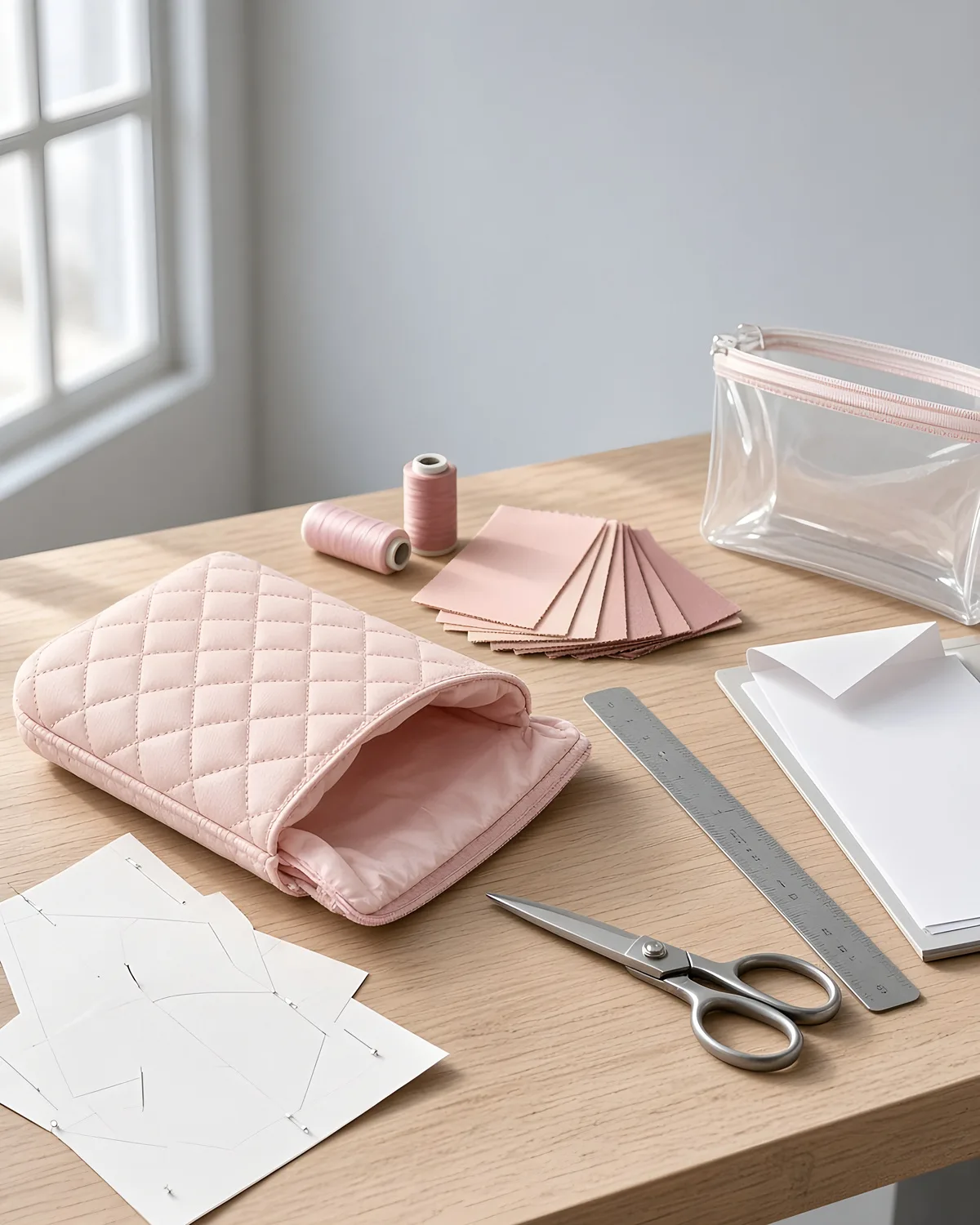
Second lot returns off-shade
- A second lot comes back a shade off.
- PU delaminates at the fold a season in.
- One dye lot reserved, held to ΔE ≤ 1.5 against the signed sample.
- Peel test on the laminate lot.
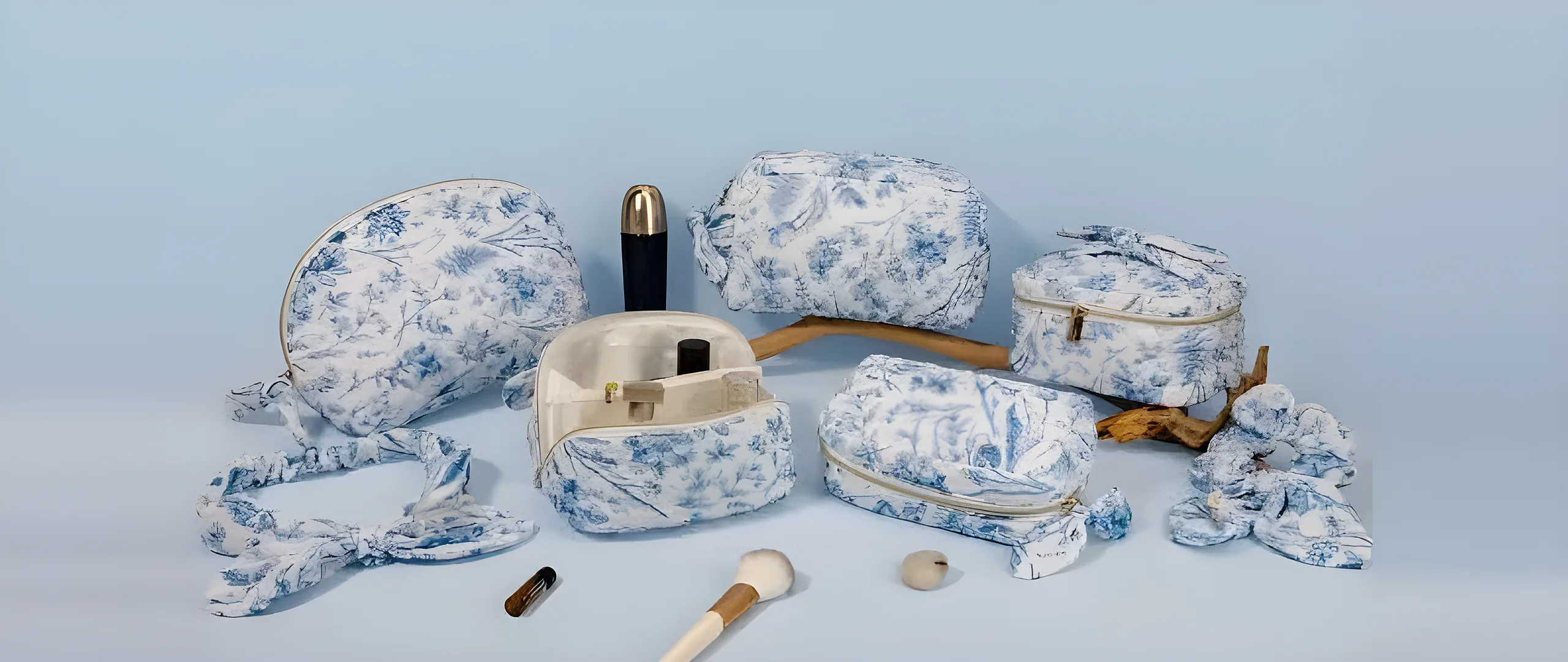
The hard part of a beauty bag order is not the first shipment — it is the third reorder still reading as the same product on the shelf. Shade, market compliance and the freight route are locked before the first pattern is cut, so a launch lands on its shelf date instead of the next available cut.

Where it breaks
These are the ways a run ships and still fails — a lining, a second lot, a customs screen or a freight choice made too late. Any one of them is a failure a beauty buyer meets, with the move on this floor that stops it.

Evidence
These are published category figures, not a client roster — benchmarks from the wider market, never a Leeline client result. They are here because a beauty bag programme is judged on the metrics below, and the run is built to move them.
beauty shoppers have sent an order back over its packaging
Health-and-beauty shoppers who returned, exchanged or refunded an online order because of how it was packed — the failure an inner build is there to prevent.
lift in add-to-basket with a coordinated gift-with-purchase
Beauty campaigns that paired a gift with the order moved add-to-basket by 77% and conversion by 1.1 points — an effect a shell shared across a promo range can repeat.
forecast beauty subscription-box market by 2035
The category market grows at 16.3% a year, reaching US$8.9B by 2035 — recurring boxes turn on a fresh pouch by cycle, which a shared base shell makes affordable.
of shoppers will pay more for sustainable packaging
A 2025 German survey of 2,031 buyers found roughly 54% accept a premium of about 8% for recycled or recyclable packaging — the demand behind a certified-recycled range.
typical gross margin on a private-label cosmetic bag
Against 20–40% on resold stock — the bag is a high-margin, low-freight add-on SKU, which is why a branded pouch earns its place on its own.
the liquid limit a clear travel pouch has to respect
A container over the limit is held at the checkpoint no matter how the pouch is made; the clear film is sized to it — the scene below covers the full rule.
Who is buying
A bag programme is shaped by the buyer’s own bottom line, not by the pouch. Founder, co-packer, retail buyer and amenity team carry constraints different in kind, and the run is shaped to meet them.
The founder
The co-packer
The retail buyer
The agency
The amenity buyer
The hotel buyer

Own floor, one programme
Cutting, printing and QC all sit in one building — a small market test scales into a seasonal reorder without changing supplier.
Where it is used
A pouch is judged in the place it is used, and the place sets the rule. Subscription boxes, salon benches, security checkpoints and holiday shelves put a different demand on one shape of bag.

A recurring box with a changing pouch, on a cadence the subscriber expects to land on time.

A planogram under store lighting, picked up and set down by shoppers, sometimes bundled into a gift set.

Daily handling by staff, contact with sanitising alcohol and bleach, and a pouch that is opened and closed dozens of times a shift.

A buyer whose customer reads the label and expects a material claim to be backed by a document.

A clear pouch handed to a passenger, screened at security, and packed into a cabin kit or a travel-size set.

A holiday or Mother’s Day campaign with a hard date, a volume spike and a theme that cannot slip.
Compliance
A pouch that clears customs still has to satisfy the market’s substance rules and carry the paperwork a buyer’s compliance team will ask for. Documents are fixed at sampling; the file is in hand before the container sails.
| Document | What it proves | When it is needed |
|---|---|---|
| ISO 9001 certificate | A quality-management system audited at the factory, not a per-order promise. | On a buyer or retailer factory audit, and in a sourcing file. |
| BSCI social-compliance audit | A third-party social audit of the plant’s labour and safety standards. | For retail and import programmes that screen the supplier’s social record. |
| OEKO-TEX 100 test report | Restricted-substance screening on the textile components — azo dyes, formaldehyde and heavy metals held to the limit. | Where the pouch sits against skin or carries a beauty product. |
| GRS transaction certificate | Chain of custody for recycled content, lot by lot, behind a recycled claim. | Whenever a range markets recycled material and the claim has to be substantiated. |
| Final inspection report | Batch conformance at ISO 2859-1, general inspection level, AQL 2.5 on the packed lot. | On any shipment, with photos and the report before loading. |
| Material data for EU PPWR | The composition and recyclability data a European launch needs as Regulation (EU) 2025/40 phases in. | For an EU-bound range planning against the 2028 labelling and 2030 recycled-content timelines. |
A quality-management system audited at the factory, not a per-order promise.
Needed On a buyer or retailer factory audit, and in a sourcing file.
A third-party social audit of the plant’s labour and safety standards.
Needed For retail and import programmes that screen the supplier’s social record.
Restricted-substance screening on the textile components — azo dyes, formaldehyde and heavy metals held to the limit.
Needed Where the pouch sits against skin or carries a beauty product.
Chain of custody for recycled content, lot by lot, behind a recycled claim.
Needed Whenever a range markets recycled material and the claim has to be substantiated.
Batch conformance at ISO 2859-1, general inspection level, AQL 2.5 on the packed lot.
Needed On any shipment, with photos and the report before loading.
The composition and recyclability data a European launch needs as Regulation (EU) 2025/40 phases in.
Needed For an EU-bound range planning against the 2028 labelling and 2030 recycled-content timelines.
Route and date
Freight is a planning decision, not a step at packing. Destination and shelf date together pick the mode, fixed with the quote; the run lands when the calendar says it must. Windows below are indicative and confirmed per order.
US West Coast
Shortest ocean leg out of the southern ports — the natural default when a launch can wait for sea freight.
US East Coast
Longer ocean leg than the West Coast, so air gets chosen more often when the shelf date is tight.
EU and UK
Ocean to a Northern European gateway, with the packaging-compliance file travelling with the lot.
Gulf and Middle East
Ocean to a Gulf gateway, or by air where a festival or holiday date cannot wait for sea freight.
Buyer accounts
Buyers on what came before the first run — a segment constraint read at sampling, a compliance file assembled with the order, and a route chosen against the shelf date.
A first line opened at 100 pieces, on one base build recoloured across four SKUs — sized to test a market, not to bet the year on it.
Seven days brought a working sample with the print register set; the second colourway then came off that pattern, not a second tooling round.
One dye lot held the run: the restock sat on the shelf as a near-identical product, not a close match.
Sourcing sits between the packaging spec and the contract manufacturer, and the brief carried both — the shell, the shade target and the market’s restricted-substance list.
Sampling came back a week later, on the shade target, carrying the material composition and recyclability data the EU label file has to hold.
Freight was picked at quote stage against the shelf date, so landed cost and launch calendar moved together instead of being fixed at packing.
Solution questions
The questions that decide whether a programme is placed, not just what the pouch is made of.
A spec order reproduces a drawing. A programme wraps the bag around a buyer’s bottom line — segment constraint, destination compliance and freight route agreed before a pattern is cut. The pouch itself does not change; the run is planned against a shelf date and a reorder, not a single shipment.
Kitting is confirmed with the bag project: the contents, the packing instructions, who handles the product and where the finished unit is delivered are set at quote stage. Pouch and product then plan as one finished unit instead of a bag needing a second handler.
Regulation (EU) 2025/40 phases in harmonised labels in 2028 and recycled-content targets in 2030, and a European range needs material composition and recyclability data ahead of those dates. The file is prepared with the order and travels with the lot — the packaging obligation is the buyer’s, and the data to meet it is supplied, never a certificate claimed.
Yes. TSA’s 3-1-1 rule holds containers of 3.4 oz (100 ml) or less inside one clear quart bag per passenger. Film and sizing on a travel or amenity pouch follow that rule; one that misses it is turned away at security regardless of how well it is made.
A single dye lot is reserved for the run and held to ΔE ≤ 1.5 against the signed sample, the laminate peel-tested, and the signed-off sample kept as the golden reference for the bulk cut. A later order reuses that pattern, gusset and seam allowance — the shelf reads as one product line across its reorders.
A 100-piece test run proves the theme before the bulk order, cut from the approved pattern. For a promo window the test is the insurance: a theme that has to land on a fixed holiday date should not meet the spike order for the first time.
Destination and shelf date pick the mode at quote stage — FOB or DDP, ocean or air. Ocean is the low-cost default for volume that can plan ahead; air is booked where a campaign date will not move. Settling it with the quote is what keeps a correct run on its shelf date.
Start a beauty programme
Name the buyer, the market it sells in and the date it has to land. The reply opens with the segment constraint, the market's compliance file and the freight route already in it — before a pattern is cut.