Most sourcing guides list brands that won’t take your call. To find the best handbag manufacturers in the world, you need a procurement-first approach.
I selected these partners based on hard data: OEM capacity, ISO 9001 quality management standards, and sampling speed.
If you’re benchmarking manufacturers, this list validates their shop floor reality. These aren’t just names. They are verified supply chain partners ready for production.
Table of Contents
Global Handbag Manufacturers Comparison Table
| Manufacturer | Country / City | Positioning & Style | Materials / Sustainability Focus |
|---|---|---|---|
| 1. Italian Artisan | Italy (network; based in Italy) | High‑end Made‑in‑Italy handbags, strong on traditional craftsmanship plus modern techniques | Premium Italian leather, emphasis on quality and some sustainability and efficient production |
| 2. Loipell | Scandicci, Florence, Italy | Luxury “Made in Italy” leather goods, bags for top luxury brands, supports new designers | Traditional Florentine leather craftsmanship, integrates modern technology, strict quality control |
| 3. Niccoli Bags | Florence, Italy | Worldwide leader in artisan leather bags, long history serving fashion brands | High‑quality Italian leather, strong craftsmanship tradition since 1972 |
| 4. Autron Industry | Huadu District, Guangzhou, China | Fashion accessories manufacturer with focus on sustainable bags and accessories | Recycled and organic fabrics, lower energy use, vegan handbag lines, sustainability focus |
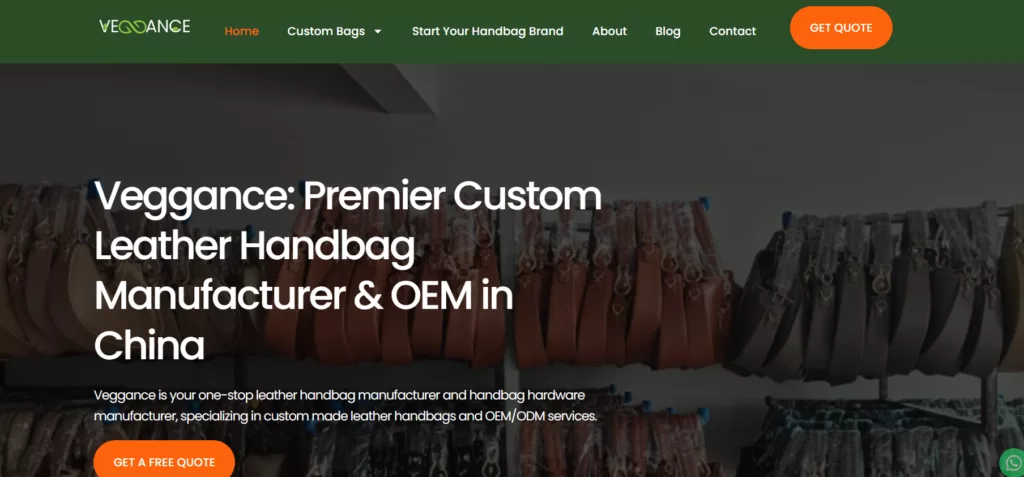
| 5. Veggance | Guangzhou, China | Custom/OEM designer and luxury‑style handbags, including vegan leather | Vegan leather and other materials, offers vegan and conventional options for handbags |
| 6. Florence Leather Market | Florence, Italy (online & local operations) | Wholesale leather bags and wallets, classic Tuscan styles at competitive prices | Genuine leather, Tuscan handcrafted techniques, multi‑generation craftsmanship tradition |
| 7. Bellini (Florence leather maker)* | Florence, Italy (leather goods area)* | Italian leather bags with focus on Florentine craftsmanship for fashion and tourism markets | Genuine Italian leather, artisanal production in Florence workshops |
Top 7 Best Handbag Manufacturers in the World
1. Italian Artisan (Italy)

You don’t choose Italy for speed. You choose it for the “Made in Italy” stamp and the tactile depth of Florentine cuoio tradition.
When visiting workshops in Santa Croce, I found the real differentiator wasn’t just the leather, but the edge finishing. Machines can’t replicate the organic, rounded feel of hand-painted edges. However, this artisan workflow creates operational drag. Sampling often hits 4-6 weeks, and hand-work introduces higher variance than automated lines.
Procurement Reality Check You must aggressively monitor QC pitfalls like edge paint peeling and handle symmetry. I’ve seen entire lots rejected because hardware alignment was off by two millimeters—a tolerance acceptable in fast fashion but fatal at the $800 price point.
Ask the Production Manager:
- Sample Iterations: Do you cap revisions? Most Tuscan artisans limit this to two rounds.
- Defect Taxonomy: How do you classify “minor” flaws? Get physical examples to align standards.
- Rework Policy: Who covers return shipping? (Crucial for expensive EU imports).
- Timeline: Does the clock start on deposit or material arrival?
- Sourcing: Is hardware cast locally or imported from Asia?
🛡️ LeelineBags’ Verdict: Italian sourcing is a branding play, not a volume play. We recommend this route only for your highest price-point SKUs. For volume collections, the 300% production markup rarely justifies the provenance.
2. Loipell (Europe)

Loipell offers a distinct advantage over the typical “chaotic artisan” workshop: systems discipline. They approach production with the rigor of a tech company, which I found critical for preventing spec drift—where bulk production slowly deviates from your approved “golden sample.”
They are the ideal fit for brands needing predictable seasonal drops and strict documentation (inspection reports, material traceability). While smaller ateliers offer flexibility, Loipell provides the ISO 9001-style consistency required for global retail compliance.
To qualify them quickly, audit their process, not just their showroom. I recommend asking:
- OEM vs. ODM Split: Do they have in-house development capacity, or just assembly lines?
- Customization Constraints: What won’t they customize (e.g., complex hardware molds)?
- QC Checkpoints: Ask to see their in-line inspection flow chart.
Treat these questions as negotiation hygiene. If a factory cannot document their quality control process before the contract, you are gambling on every shipment.
🛡️ LeelineBags’ Verdict: Loipell wins on repeatability. Their structured approach ensures your 1,000th unit looks exactly like your first. The trade-off is rigidity; they are less likely to accommodate last-minute design pivots than smaller, agile workshops.
🚀 Actionable Insight: Request a signed “Limit Sample” (a unit showing maximum acceptable defects) during the contract phase to lock in your quality standard.
3. Niccoli Bags (Italy)

“Made in Italy” is often a marketing crutch. Real quality comes from discipline in the finishing room, not geography. I found Niccoli Bags separates itself through obsessive edge control and lining fit—areas where mass manufacturers often cut corners.
They outperform competitors on finishing-heavy SKUs. Think structured top handles or rigid silhouettes where a single crooked stitch ruins the geometry. If your design relies on visible edge paint, you need this control. I’ve seen high-speed factories rush drying times, which causes edge cracking weeks later. Niccoli treats edge painting as a multi-day chemistry process.
This approach contrasts with volume-based models. (For more on regional trade-offs, see our guide on American vs. Chinese manufacturing standards).
📋 Production Interview Prompts Use these questions to validate their timeline:
- Sampling: “Do you require a separate ‘pre-production’ sample after the ‘golden’ sample approval?”
- Delays: “What is the current lead time for custom hardware plating?” (This is the #1 cause of delays).
- Failures: “What is your tolerance for stitch tension variance on thick leathers?”
🛡️ Our Verdict: Niccoli is for small-batch premium runs where QC is the brand identity. Don’t use them for basic totes. Reserve them for flagship, high-margin pieces.
4. Autron Industry

Autron represents the shift from art to engineering. You choose this partner when you need the predictability of an assembly line rather than the nuance of an artisan. In my experience, their main advantage is scheduling discipline—critical when coordinating regional inventory for the UK or US markets where retail chargebacks for late delivery are brutal.
However, industrial speed often sacrifices luxury “hand-feel.” I once audited a production run where the factory rushed the final packing phase, scratching 15% of the hardware because the tech pack didn’t explicitly require protective film. Industrial machines do not pause to check for softness or finish unless programmed to do so.
To prevent “mass-market tells” in your luxury product, you must contractualize these controls:
- AQL Targets: Set a strict Acceptable Quality Limit (e.g., AQL 1.5 for critical defects like broken zippers).
- Packaging Specs: Define tissue wrapping thickness and silica gel weight (e.g., 5g vs 2g) to prevent moisture damage during shipping.
- Hardware Protection: Mandate protective tape on all metal plates until the customer unboxes it.
5. Veggance
Treat sustainability as a compliance spec, not a marketing slogan. If you fail to verify claims, you will pay premium prices for standard plastic with a green sticker.
I see this constantly. Factories claim materials are “green,” but they cannot prove the origin. To verify a claim, you must demand the Transaction Certificate (TC). Do not accept a general facility certificate. You need the TC that tracks your specific batch from the recycler to the loom.
The Performance Trap Sustainable materials often trade durability for ethics. I have seen “apple leather” peel after just three months of humidity. Recycled cotton also frequently fails colorfastness checks.
To avoid returns, enforce these tests during custom handbag manufacturing:
- Bally Flex Test: Run 2,000 cycles to catch coating cracks.
- Crocking Test: Ensure natural dyes do not bleed onto white clothes.
- Smell Test: Recycled glues often carry strong chemical odors. Check this immediately.
🛡️ LeelineBags’ Verdict “Eco-friendly” builds require higher QC budgets. We reject about 30% of recycled PU batches because they fail basic durability tests. Traceability is the only thing that matters. If we cannot trace the material back to the source, we do not book the order.
6. Florence Leather Market (Italy)

Florence offers a powerful “Tuscan provenance” story, ideal for high-end capsule collections. However, sourcing here requires navigating a dangerous gap between market access and factory capability.
In my experience, many “manufacturers” here are actually aggregators. They finish imported semi-products just enough to legally claim “Made in Italy,” which destroys production consistency. To separate real workshops from tourist-trap resellers, you must demand production floor visibility.
Use this checklist to vet the source:
- The Cut: Ask to see the hide cutting area. If they cannot show you the clicker press or active cutting table, they are likely buying pre-cut kits.
- The Edge: Inspect the edge paint on three identical bags. Visible variance here proves they use different subcontractors (often home-workers) rather than a standardized production line.
- The Origin: Demand the tannery certificate. Real Tuscan workshops display their Vegetable Tanned Leather Consortium tags proudly.
Without these checks, you risk falling for reselling schemes disguised as artisan production.
7. Bellini

Bellini is the answer when you need a collection launched in weeks, not months.
I recommend their white-label (ODM) model specifically for market validation and influencer drops. You pick a pre-existing structure and customize the “skin,” bypassing the typical 90-day cycle for custom molds and tooling.
However, speed creates a risk: generic products. Since you don’t own the geometry, your competitor could sell the exact same silhouette. To differentiate, you must aggressively manage the Control Points:
- Hardware Plating: Standard catalog hardware often tarnishes. I always specify a minimum 0.1–0.2 micron plating thickness in the contract.
- Material Batches: Don’t assume the sample swatch matches the bulk. Request cutting clippings from the actual production hide to ensure batch consistency.
- Packaging: Custom dust bags and boxes are the easiest way to elevate a catalog item.
While a regional sourcing option offers faster logistics, Bellini provides the specific Italian aesthetic without the development headache. Just be wary of “sample looks great, bulk disappoints”—always mandate a pre-shipment inspection.
The Execution Plan: Models, Timelines, and QC

Select your model based on IP strategy, not just price. Managing the production cycle defines your success. We use this three-phase framework to move from concept to landed inventory without rework.
Phase 1: Define Your Model (Decision Rules)
Decide on intellectual property (IP) ownership before you contact a factory.
- ODM (Private Label): You select a catalog design and add your logo.
- Best for: Speed (30-day launch) and low budget.
- Risk: Zero differentiation. Competitors can sell the same bag.
- OEM (Custom Specs): You provide the tech pack. The factory creates unique molds.
- Best for: Brand equity and IP control.
- Risk: Higher startup costs and longer lead times (90+ days).
Author’s Verdict: Start with ODM to test market demand. Once you reach 500 units, pivot to custom handbag manufacturing to build a defensible asset.
Phase 2: The Realistic Timeline
Do not believe “30-day delivery” promises for custom orders. In our experience, real production follows this path:
- Tech Pack (Weeks 1-2): Define every zipper, lining, and stitch count.
- Prototyping (Weeks 3-6): Custom hardware molds often take 25 days to cast.
- Golden Sample (Week 7): Approve this final version. Keep it as your contract standard.
- Bulk Production (Weeks 8-12): Material cutting and assembly.
Operations Insight: Metal hardware is the #1 delay driver. Approve finishes early. Use these manufacturing negotiation tips to set penalty clauses for timeline slippage.
Phase 3: QC and Compliance Backbone
You cannot inspect quality into a finished product. You must build it in.
Use the ISO 2859-1 standard (AQL 2.5). This statistical method defines exactly how many minor defects you will accept before rejecting a shipment.
The Inspection Cycle:
- IQC (Input Quality Control): Check leather hides for scars before cutting.
- DUPRO (During Production): Inspect stitching when 20% of bags are finished.
- PSI (Pre-Shipment): Final random check.
Compliance Checklist: Paperwork protects you from Customs seizure. Demand these documents:
- USA: Verify total lead content matches CPSC standards and California Prop 65.
- EU: Require REACH regulation testing for chemical safety.
Whether you choose American or Chinese manufacturers, strict documentation is mandatory.
Ready to start your production run? Contact us today to discuss your project requirements.
Frequently Asked Questions for Best Handbag Manufacturers in the World
Q1. What is the difference between OEM, ODM, and White Label?
OEM (Original Equipment Manufacturer) means you design the product from scratch. You own the intellectual property, but you pay for the molds. This builds the highest brand value. ODM (Original Design Manufacturer) and White Label mean you select a factory’s existing design and add your logo. This saves upfront tooling costs.
Q2. What is a realistic timeline for custom handbag production?
Ignore promises of “30-day delivery” for custom orders. High-end production realistically takes 60 to 90 days. Hardware molds require 25 days to cast. Material sourcing takes another 15 days. Actual assembly takes 30 days. The Bottleneck: In our projects, custom metal hardware causes 90% of delays. We recommend you approve your zipper pulls and buckles first. This keeps your schedule safe.
Q3. What quality standards should I include in a Purchase Order?
Never use vague terms like “high quality.” You must specify technical tolerances to avoid common handbag factory scams. We rely on ISO 2859-1 (AQL 2.5). This statistical standard defines exactly how many minor defects you will accept before rejecting a shipment. You should also specify hardware plating thickness (minimum 0.1 microns) and edge paint layers (minimum 3 passes). If it is not in the contract, the factory will not do it.
Q4. How do I verify sustainability and “Made In” claims?
Do not trust a simple “Eco-Friendly” sticker. You must demand the Transaction Certificate (TC) for your specific batch of fabric. This tracks the material from the recycler to your factory. For origin claims, verify that the factory actually cuts the leather on-site. Many handbag manufacturers in the UK or Australia import finished shells and only attach handles locally. Request a live video call of the cutting floor to prove true origin.