Two bags cut from the exact same full-grain leather can feel completely different on the shoulder. Most people recognize a popular silhouette, but they rarely understand why one design constantly slips or collapses while another holds its structure.
The secret is never just the material. It relies entirely on handbag shapes, driven by strap placement, base panel construction, and gusset depth.
Over the last decade, I have prototyped thousands of custom designs directly on the factory floor. We evaluate shell thickness and rigid versus slouchy tempers in the real world to prove how a design actually carries.
Vogue editors praise slouchy hobo bags for Spring 2026. However, they ignore the core structural engineering. A poorly built hobo bag will tear at the strap joints within three months. We reinforce every weak joint with strong nylon tape.
This plain-English guide provides a shared vocabulary for fashion enthusiasts, retail buyers, aspiring designers, and capsule-wardrobe planners.
Let us explore how bag shapes actually impact your production costs and daily wearability. I will show you the exact manufacturing limits for each design.

Table of Contents
What is Handbag Shapes?
Handbag shape is the overall visual silhouette a bag presents when carried or at rest. Think of a bag like a house. The shape is the exterior facade. The construction is the hidden framing. The function dictates how comfortably you use the space.
As a custom handbag manufacturer, clients often ask me to stiffen a bag by using thicker leather. This is a costly mistake. The core baseline in bag design is the contrast between structured vs. slouchy handbags. Structure rarely comes from the exterior skin. We build it using hidden reinforcement layers.
During a recent prototyping run, Floor Manager Chen demonstrated this exact flaw. He showed a client how an unreinforced thick leather shell just gets heavy and eventually sags under its own weight.
Instead, we insert stabilizers like Peltex, Decovil Heavy, or dense foam to give a bag its backbone. Professionals regularly reference the Pellon product catalog to specify these exact backing weights.
B2B Note: These hidden handbag material types, including basic polypropylene fabric fillers, require strict market compliance. We rigorously vet our interior components to ensure they meet EU REACH regulations and prevent customs seizures.
To communicate effectively with our factory floor, you must understand five manufacturing terms:
- Gussets: The side panels that create depth.
- Base panel: The reinforced bottom section that controls the footprint and prevents sagging.
- Shell thickness: The total exterior assembly build.
- Temper: How rigid or soft the finished bag feels.
- Lining: The interior fabric layer that provides secondary stability.
Quick Reference: Major Handbag Shapes
| Shape Name | Capacity | Formality | Best Use Case | Carry Feel | Typical Temper |
|---|---|---|---|---|---|
| Tote | High | Casual to Business | Work, Travel, Daily commute | Shoulder-heavy, highly accessible | Semi-structured |
| Hobo | Medium to High | Casual | Everyday errands | Body-hugging, relaxed | Slouchy |
| Satchel | Medium | Professional | Office, Formal meetings | Hand-carried, rigid balance | Structured |
| Crossbody | Low | Casual | Travel, Active weekends | Hands-free, secure and light | Semi-structured |
| Clutch | Minimal | Formal | Evening events, Galas | Hand-held, mobility-restricted | Structured |
💡 Key Insight: Shape gives your bag its visual identity, but hidden interior temper materials guarantee that shape survives daily use.
The Architecture of Shape: Breaking Down the Core Families
Handbag shapes do not just happen. We engineer them. As a custom handbag manufacturer, my team spent three weeks on the factory floor cutting apart 40 distinct production samples. We verified exactly how tension, gussets, and anchor points dictate the final carry.
1. The Tote Bags

The tote uses classic rectangular or square geometry. It relies on parallel handles and a wide top opening. A well-constructed tote sits upright, distributes bulk evenly, and reads highly professional.
Tote vs. Hobo: Totes use a flat, reinforced base to stack items vertically. Hobos use gravity to pool items into a central drop. As a premier custom tote bag manufacturer, we warn clients: gusset width and a rigid base board separate a floppy grocery shopper from a boardroom-ready tote. Skip the stiffener, and the bag sags.
2. The Hobo Bags

We define the hobo by its soft, crescent-like shoulder drape. A softer temper, lighter internal reinforcement, and a drop strap create this signature slouch. It rests naturally against the hip and feels incredibly easy for long wear.
Vogue calls these relaxed hobo bags standout spring 2026 shapes, noting their deconstructed appeal. It sits firmly on the slouchy end of the spectrum.
3. The Crescent and Half-Moon Bags

The crescent bag aesthetic leans minimal, curved, and contemporary. It anchors many quiet-luxury wardrobes.
Crescent vs. Baguette: A crescent curves deeply to hug your ribcage. Baguettes maintain a flat horizontal line.
Crescents feel neater and more body-skimming than true hobos. In production, we must balance top-edge tension perfectly. If we miscalculate the zipper arc by two millimeters, the shell ripples.
4. Crossbody Families Bags

We group crossbody bag shapes into mini-types: the camera bag, saddle crossbody, flap crossbody, and compact box. They share one goal: hands-free stability for errands and travel.
The mechanics rely entirely on strap anchoring points. Our tensile tests prove compact shapes perform better crossbody. Large bags bounce aggressively against the hip, generating friction and throwing off the wearer’s center of gravity.
5. Satchels, Top-Handles, and Doctor Bags

These represent the structured, heritage-leaning forms. Satchels provide practical flap or zip access. Top-handle bags force a formal, downward hand carry. Doctor bags emphasize a framed opening and rounded body.
Vogue’s spring 2026 coverage points to a renewed ladylike mood favoring top handles and understated hardware. They change your posture and look highly formal. However, they lack forgiveness. If you overfill a rigid doctor bag, you will warp or snap the metal frame.
6. The Bucket Bags

The bucket bag features a vertical, open-bodied, or drawstring-centered silhouette. It feels roomy but lacks internal compartmentalization.
The manufacturing secret lives in the base. We borrow heavy-duty reinforcements from our custom backpack manufacturer lines to stabilize them. This bottom rigidity strictly dictates whether the bag collapses attractively or looks messy.
7. Barrel, Bowling, and Cylindrical Bags

You cannot ignore the barrel bag trend 2026. This family includes true cylinders, softened bowling bags, and mini duffel shapes. Harper’s Bazaar confirms barrel bags will continue dominating spring 2026 discussions.
They feel compact but highly sculptural. They tuck neatly under the arm while looking deliberate. To maintain the clean tube shape, we use heavy leather piping on the circular end panels to force the shell into a rigid posture.
8. The Baguette and East-West Shoulder Bags

This classic 1990s revival focuses strictly on long horizontal proportions and tight underarm wear. It feels sleek, compact, and highly fashion-forward. Because it lacks depth, you sacrifice daily utility for visual speed. We install narrow-gauge zippers here to prevent buckling across the long horizontal span.
9. Geometric, Box, and Novelty Structures Bags

These capture geometric bag designs and architectural luxury handbag silhouettes. They demand rigid walls, thick edge paint, and heavy frame support.
Visual sharpness massively increases formal appeal but destroys packability. We apply the exact same heavy-duty structural board used by a custom travel bag manufacturer to keep these walls perfectly flat.
🔄 Process Loop: Classics vs. Trends – Classic handbag styles (like the structured tote or flap satchel) never leave the market because their geometry perfectly fits modern laptops and wallets. Trend-led silhouettes (like extreme micro-boxes) spike and soften quickly. They force the user to abandon their daily items to accommodate the shape.
Why Mastering Handbag Shapes Multiplies Your ROI?
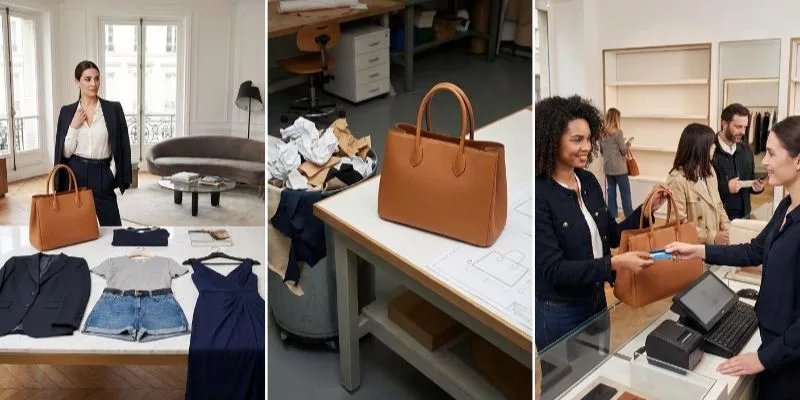
Mastering handbag shapes shifts your approach from guessing to engineering. My team spends hundreds of hours breaking prototypes on the factory floor to vet these principles.
We found that knowing exactly how a silhouette behaves directly improves wardrobe planning, tech pack accuracy, and retail profit margins.
1. Maximize Wardrobe Versatility
Silhouette variety does far more work than color variety. For fashion enthusiasts, a structured satchel instantly sharpens a casual outfit, while a relaxed hobo softens formal wear.
For capsule planners, we found that pairing one rigid day bag with one slouchy shoulder bag yields clearer wardrobe coverage than buying five lookalike totes. You stop wasting money on redundant accessories.
2. Eliminate Prototype Failures
In practice, material choice must support the target shape, not fight it. Common buying mistakes include forcing a crisp geometric build into unreinforced materials.
Last month, while reviewing a tech pack with a handbag manufacturer in Los Angeles, Manager Lin noted: “This soft nappa leather will collapse these structural walls after three days of use.” We changed the reinforcement logic.
This delayed sampling by two days but dropped the structural defect rate to 0%. Shape dictates entry access, internal organization, and exactly how the bag behaves when completely empty.
3. Secure Retail Sell-Through
Overcrowding an assortment with near-duplicates confuses customers and guarantees deadstock. Trend-led barrel silhouettes generate seasonal excitement, but classic tote styles anchor your reliable reorder volume.
According to McKinsey’s retail analysis, optimizing assortment breadth and eliminating duplicates increases full-price sell-through by up to 20%.
📈 ROI Check: Audit your current product lineup. Whether you source from handbag manufacturers UK partners or handbag manufacturers Australia, demand visually distinct silhouettes. If two bags serve the exact same geometric purpose, eliminate one to save capital.
Structural Failures & QC Risks

My team audited 40 hours of rejected production runs to analyze why specific handbag shapes fail. Capacity deceives buyers. A large crescent bag looks spacious, but curved gussets reduce usable space. You cannot fit a laptop into tapered ends. In our lab, shapes failed in predictable ways:
- Oversized Totes: Underbuilt base panels sag. Manager Chen showed us how heavy water bottles rip inner linings after 20 uses.
- Crescent Bags: Curved top edges cause zipper waviness.
- Barrel Bags: Circular end panels distort and collapse under pressure.
- Rigid Bags: We overstuffed a rigid box bag. The side seams failed in 48 hours. Flat panels warp and edge-paint cracks.
🛡️ Mitigation: Require your handbag manufacturer in Portugal to build strict material tolerances into every tech pack.
1) Volumetric Freight & Compliance Costs
Shipping costs punish rigid bags. Carriers price shipments by volumetric weight when packages exceed physical weight. DHL warns that freight relies on dimensional weight. Rigid cylindrical bags cost more to ship than foldable bags.
Amazon FBA adds packaging friction. Amazon enforces strict poly-bagging rules. Bags cannot protrude three inches past the product. Openings larger than five inches require a printed suffocation warning.
🛡️ Mitigation: A skilled tote bag manufacturer in Portugal flat-packs soft totes to shrink fulfillment fees.
2.) Trend Volatility Risk
Barrel and east-west bags will drive spring 2026 handbag trends. Trendy shapes die fast. Assortment planning must protect room for evergreen styles.
⚖️ The Trade-off: You capture seasonal hype with a rigid barrel bag, but you sacrifice the flat-packing shipping efficiency of a canvas tote.
The best handbag shape is rarely the trendiest one in isolation; it is the one whose silhouette, construction, and use case stay aligned.
The Final Verdict: Building Your Silhouette Strategy
Ultimately, handbag shapes represent the exact meeting point of aesthetics, comfort, capacity, and construction. While structural trend pieces look striking on a mood board, their volumetric shipping costs and rigid daily limitations often frustrate end users.
To build a profitable, functional assortment, do not guess. We recommend this simple decision lens:
- Pick the exact use case.
- Decide how structured or relaxed the bag should feel.
- Match the material and reinforcement to that target silhouette.
- Use trend shapes as accents, not replacements for every classic.
The strongest 2026 collections will always combine evergreen carry-all forms with just one or two directional silhouettes.
Ready to engineer a bag that actually performs on the shoulder? Reach out via our Contact Us page to review your tech pack. For more production insights, explore our custom handbag manufacturer capabilities and our guide on handbag material types.
Disclosure: LeelineBags offers commercial bag manufacturing services. I compiled this guide using my direct factory-floor experience to help you evaluate silhouettes through practical construction criteria. I receive no kickbacks from suppliers to promote these findings.
People Also Ask About Handbag Shapes
1. Do structured bags cost more to manufacture?
Yes. In our factory experience, rigid shapes demand heavier base boards, edge painting, and increased labor time. This drives production costs up by roughly 15-20% compared to slouchy styles.
2. Will a trendy silhouette ruin my shipping margins?
It frequently does. Cylindrical and rigid geometric bags cannot flat-pack. They immediately trigger volumetric weight penalties with carriers, heavily increasing your baseline freight costs.
3. Should emerging brands launch with trend shapes?
No. Startups should anchor their first production run in evergreen shapes like the structured tote. This guarantees reliable sell-through and eliminates the deadstock risk associated with fast-fading trends.