
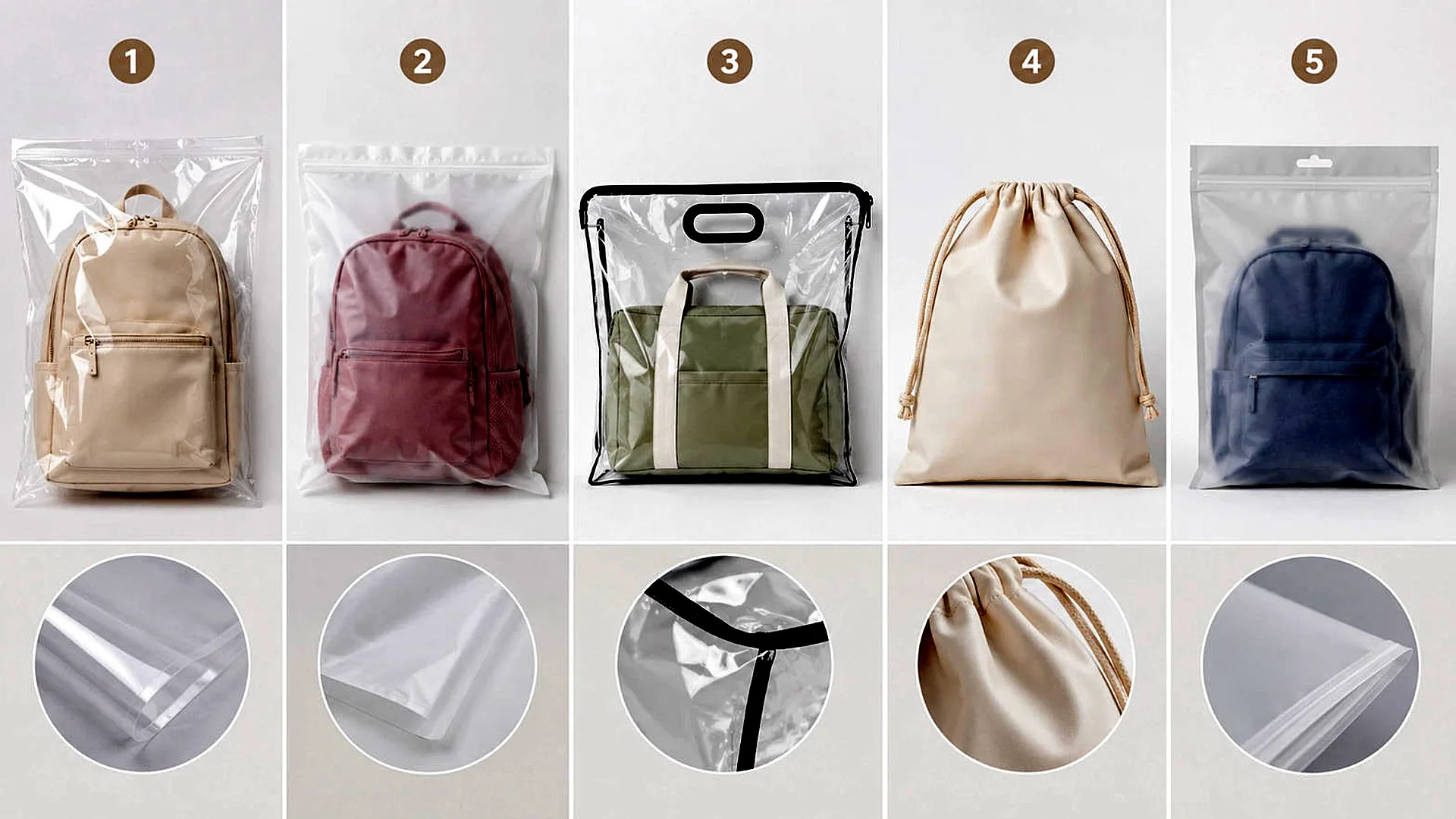
Amazon FBA Prep for Bags is where most sellers lose money. Not the product, but the prep line. This SOP covers backpacks, totes, cosmetic pouches, duffels, and handbags that ship to Amazon without relabeling, rebagging, or rejection.
It is for founders, private-label sellers, and supply-chain managers. I reviewed rejection and defect logs from 50+ FBA-bound bag shipments, watched LeelineBags’ prep line, and ran a Q&A with Leo Jiang, their Warehouse/Logistics Lead.
Three failures repeat: missing suffocation warnings, unscannable FNSKUs on curved surfaces, and poor moisture control in transit. A compliant unit has tight straps and flat film at arm’s length; a rejection shows loose straps, wrinkled film, or curved barcodes.
The sequence below carries photo callouts. Prep at origin first; US prep centers are the backup.
Prerequisites for Amazon FBA Prep for Bags
Time: 2 hours | Difficulty: Intermediate.
Lock inputs first: final ASIN/SKU list, FNSKU files, carton plan, bag dimensions, material type, destination country, pack-out SOP, and prep-owner confirmation.
Stage tools: 1.5 mil poly bags, mil gauge, thermal printer, blank labels, scanner, carton scale, tape, elastic ties, hardware film, desiccant.
Quality cues: true 1.5 mil film feels tight and smooth; cheap film feels chalky and tears at the seal.
⚠️ Safety First: Check suffocation-warning thresholds, permanent country-of-origin marks, and FNSKU scannability on curves. Add desiccant for humid transit; leather and fabric mold fast.
- Method: China factory prep is primary. A US prep center is the fallback when the supplier cannot follow the SOP.
- Accessibility: Describe tools and labels by function, not color alone.
🚀 Actionable Insight: Run one bag through the SOP and send the photo to the factory before bulk prep starts.
Read Official Amazon packaging and prep requirements and Official Amazon barcode requirements before starting.
How to Prep Bags for Amazon FBA?
Work the line top to bottom. Lock the rules in Seller Central first, then run protection, arrangement, sealing, labeling, and cartoning to the bag’s own shape, with the gate audit closing the lot.
Step 1: Lock Amazon Prep Rules Before Bulk Pack-Out
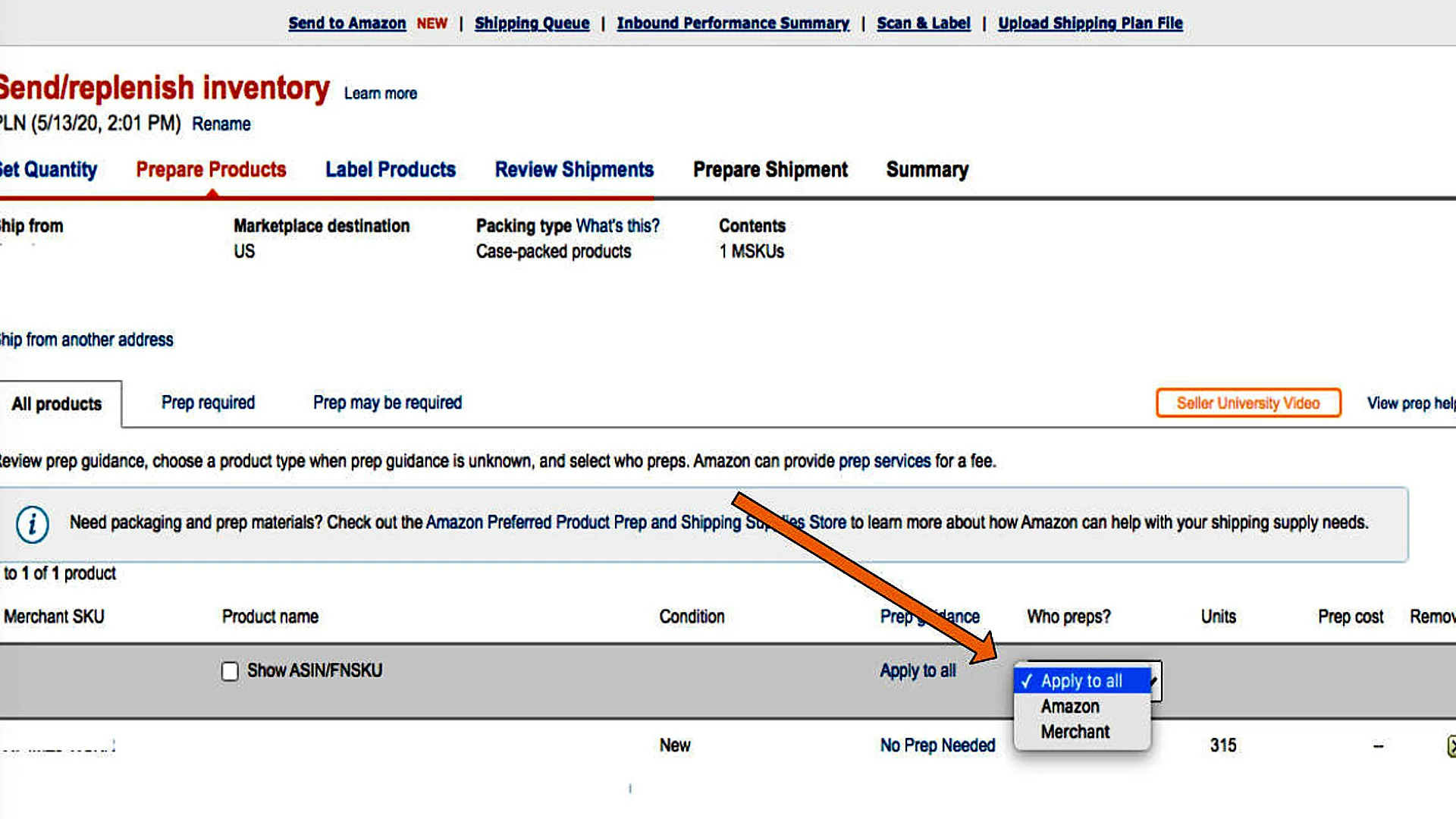
Compliant bag prep starts in Seller Central, not on the packing table. In a recent audit, a tote SKU lost two days because the team packed against an old label file.
Open Seller Central, then FBA > Prepare products for FBA. Review the prep page for each bag SKU and confirm the barcode type before printing.
Two policy changes reset the defaults for US FBA in 2026. Amazon stopped providing prep and item-labeling on shipments created after January 1, 2026, so prep now sits with the seller or a chosen provider.
From March 31, 2026 it ended commingling: resellers must label every new shipment with an FNSKU, while Brand Registry brand owners may use manufacturer barcodes without stickers. Read the commingling policy against your own account status.
Convert the rules into a one-page factory prep spec: poly-bag size, label location, desiccant requirement, set marking, and carton count. Floor teams tape it to the wall.
When the spec, barcode file, or prep diagram locks after packing starts, rework adds 3 to 5 days per SKU.
| Prep route | Cost | Speed | Defect risk | Who catches mistakes |
|---|---|---|---|---|
| Factory at origin | Lower unit cost, one handling touch | Fast, same line as QC | Low with early spec lock | Factory QC before carton seal |
| US prep center | Higher labor plus inbound freight | Slower, 3 to 7 days post-import | Medium, SKU mix-ups rise | Prep center after customs clearance |
Before bulk pack-out, pause the line. Scan one printed FNSKU label and twist one sample poly bag to confirm the warning sits flat, because every SKU must leave with one approved barcode file, one diagram, and one named owner.
Step 2: Match Protection Logic to Each Bag Family
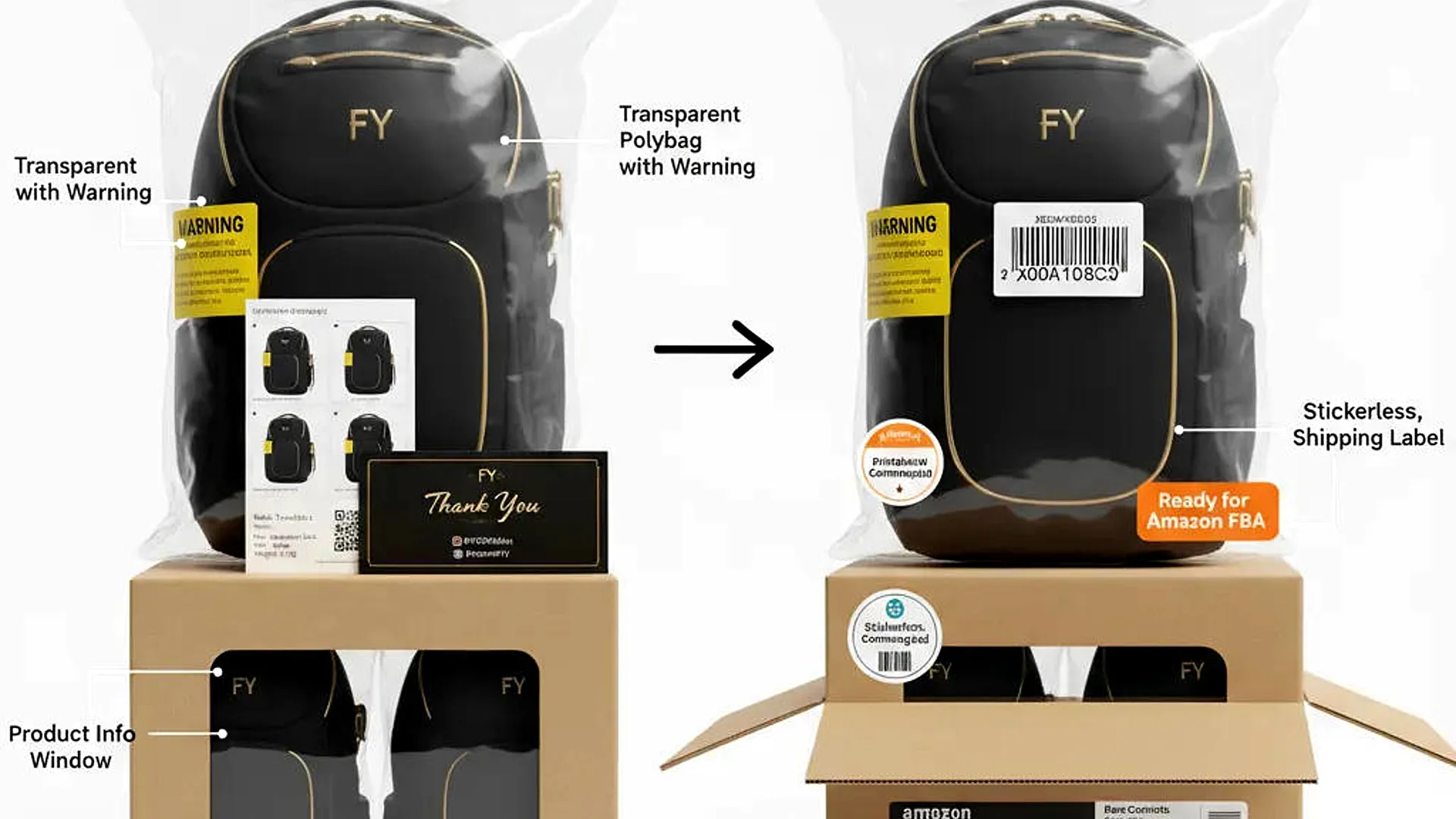
Group bags by failure mode, not material alone: a leather tote and a PU tote fail differently after humid transit. Durability levels decide how much compression a shell survives.
Leather and hardware. Seal the surface before the shape.
- Premium leather handbags: dust bag plus outer polybag, metal trims filmed, tissue or a shape insert. Leather goods manufacturing sets the pack sequence.
- PU handbags: film the hardware; skip sealed dust bags that trap moisture.
Fabric bodies. Fold, never crush.
- Nylon and polyester backpacks: flatten the body, fold along the base seam, tie straps with elastic. No vacuum press at the denier usually sourced.
- Cotton totes: anti-crease board and a flat fold, matched to custom tote bag manufacturing spec.
Small and structured formats. Support the base and the hardware.
- Cosmetic pouches: mirror protection and drop-test prep; custom cosmetic bag manufacturing changes the lining approach.
- Lunch bags: moisture barrier inside, zipper slightly open per custom lunch bag manufacturing pack-out.
- Duffels: handles strapped and a light stuff to avoid a center crease, as in custom duffle bag manufacturing.
- Garment, sports, gift, and tool bags: hanger or tissue, hardware wrapped, base supported. Hardware that survives film wrapping matters most here.
Bulky soft goods need a compression decision. Light compression cuts CBM 15% to 20% on duffels and backpacks, but treat that as a starting estimate and confirm it on a pilot carton.
Vacuum saves more space but crushes foam straps and coated fabric that holds a crease. Foam recovered within about 48 hours in the logs; coated nylon held the crease.
Leo Jiang described the desiccant split for humid sea freight: “Leather gets 10g silica and a breathable dust bag. PU gets 5g, no sealed film. Fabric gets 3g plus a 24-hour line dry.”
The mold logs agree: sealed PU sweated, leather dried. That comes from the logs, not a controlled test, so pair it with a pilot carton on each new route. Read the mold-control sequence for leather before the first humid-season lot.
Step 3: Run the Internal Arrangement Station
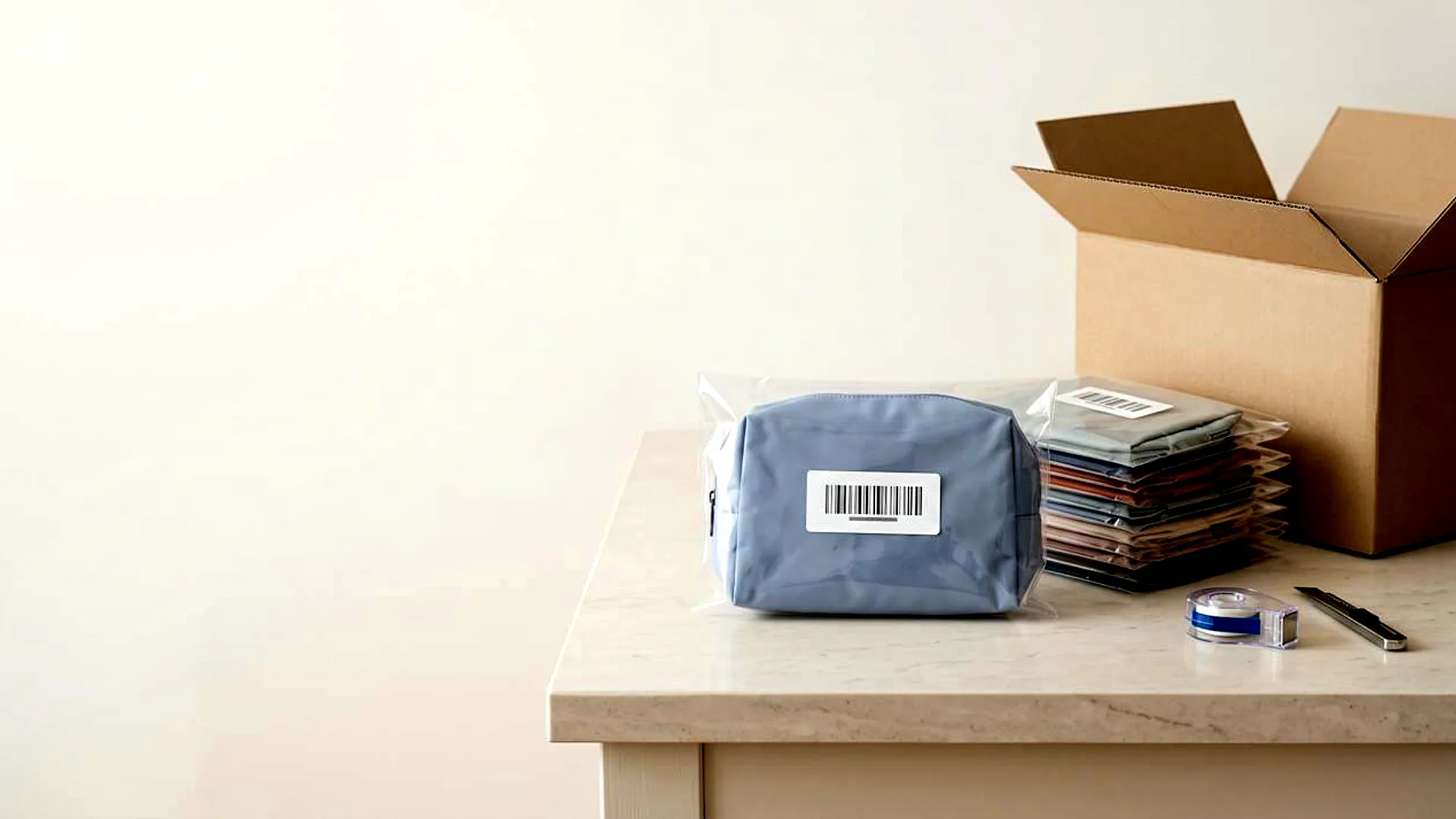
Work soft bags with loose components one at a time. Flatten the bag, tuck long straps down the back panel, fold webbing ends inside the base fold, then secure straps with removable elastic. Never tape straps to the outer face.
Protect buckles and zipper pulls with hardware film, then add a shape insert for structured leather or tissue for soft nylon. Keep silica in a corner pocket, never against the lining.
LeelineBags crosses backpack shoulder straps in an X on the back panel, secured with a 6-inch elastic loop through the haul handle. Loose webbing tucks into the back-panel pocket; the travel bag format sets how deep the base fold can go.
Run the sensory check: thumb under the elastic sits snug, the bag shakes with no hardware knock, and nothing presses sharply into the outer face.
Desiccant Rule: sea freight carries high humidity, so leather takes 10g silica with a breathable dust bag, fabric 3g after a 24-hour line dry, and PU 5g with no sealed film. Air freight runs lighter: 3g to 5g only for damp packs, and silica never touches the lining.
The shipment log carried 14 rework tickets: nine late spec changes, three arrangement or loose straps, two moisture.
⚠️ Experience Warning: On air shipments, teams still reuse ocean-freight desiccant loads. The bags arrive over-dry, and leather linings stiffen.
Step 4: Bag and Seal Each Unit to Amazon Spec
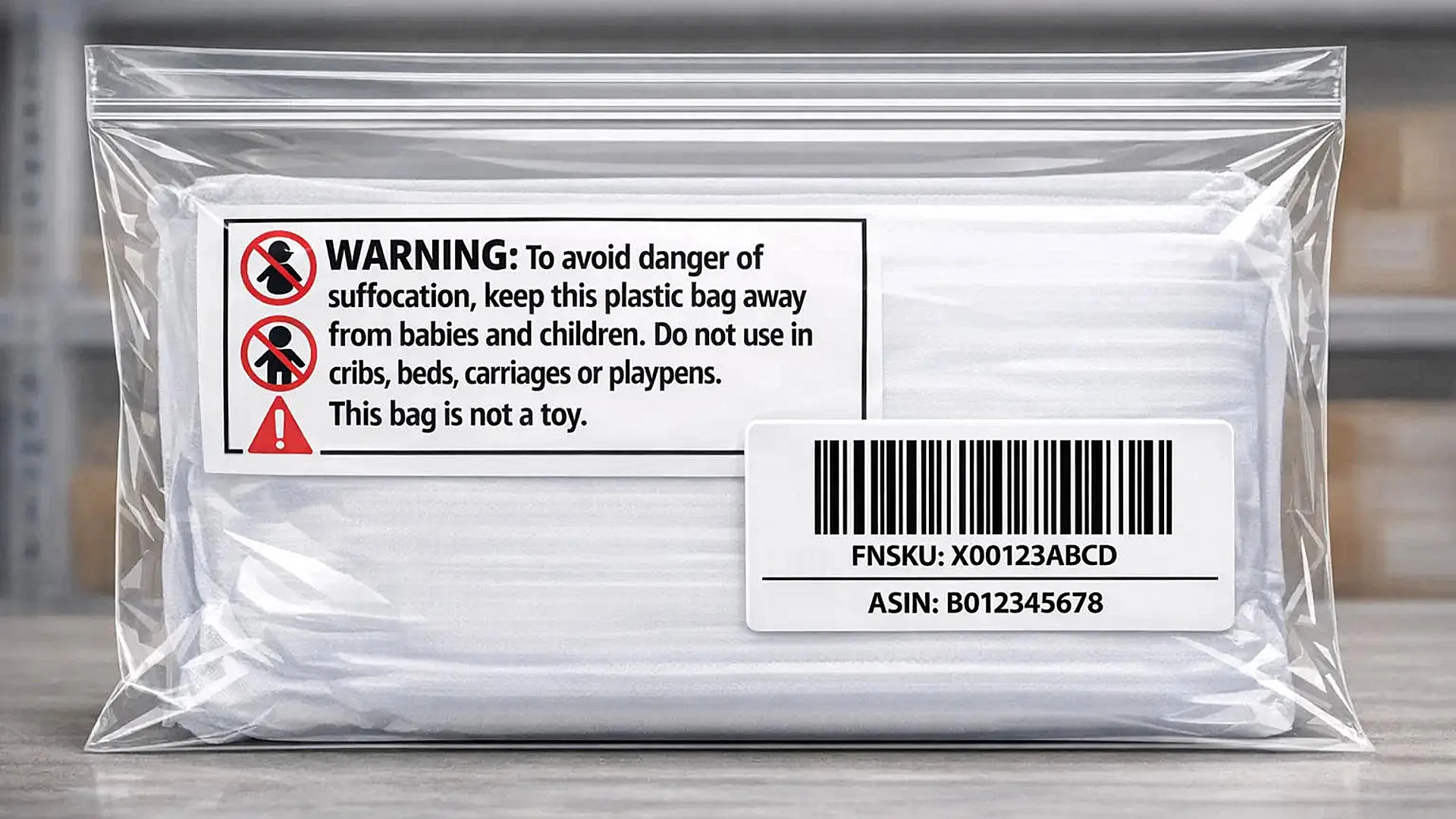
Start bagging only after the arrangement check passes. In our line audit, three packers grabbed the nearest bag off the roll: two sizes fit badly and the film bunched at the gusset.
Pick a transparent bag sized close to the product, so the film hugs the bag instead of ballooning. Gauge starts at extrusion, which is why polyethylene bag manufacturing explains tight film versus film that tears at the seal.
Slide the unit in without twisting, align the opening edges square, press out trapped air, seal the full width. Check handles, straps, and gussets: no film should fold back over a strap.
Run the pinch test. True 1.5 mil feels firm and smooth; thin film crackles under your thumb. At LeelineBags the QC lead checks the roll with a micrometer before sealing and again each morning, so ask your supplier for an unedited photo of the gauge reading on the film lot.
Suffocation warning is required when the opening is 5 inches or more, measured flat. Measure it and write the number down.
Self-adhesive bags are LeelineBags’ default. Heat-sealed bags suit high-volume runs with a trained operator; skip heat sealing if the seam wrinkles.
US FBA is the primary scope. EU and UK shipments may need different warning language, and one print file rarely works everywhere. See Official Amazon poly-bag prep requirements.
Confirm four things: warning legible, opening logged, film scans clean, seal holds under a firm pull.
⚠️ Experience Warning: Two shipments failed receiving because the warning label sat under a folded flap of film. Place it on the flat face, never on a seam or a fold.
Step 5: Place the FNSKU for First-Pass Scans
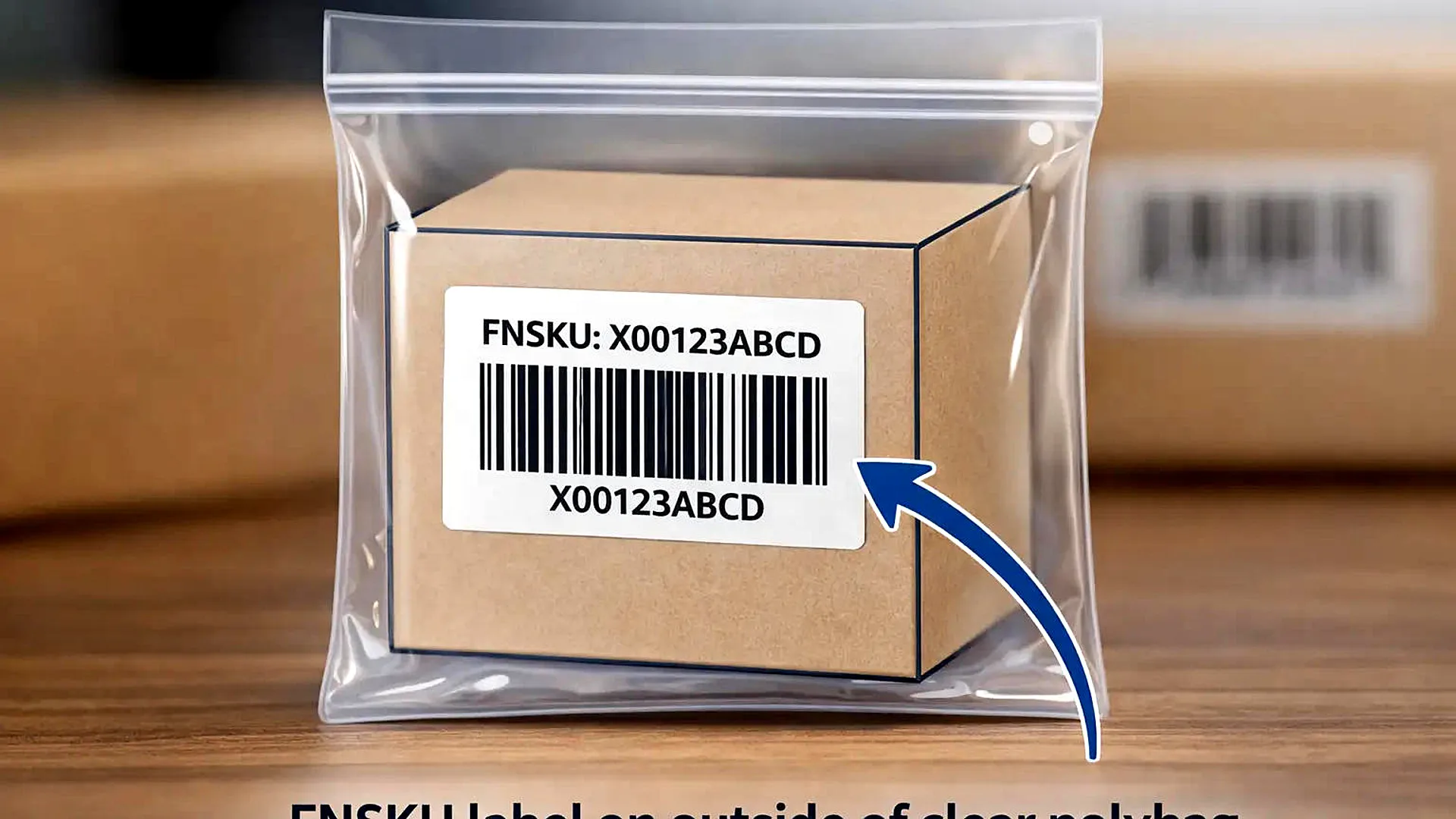
Curved-surface FNSKU failures ranked as a top rejection reason in the shipments we reviewed. A label bridging a seam or zipper edge lifts, and the scanner fails on first pass.
Lock the barcode hierarchy. Use one scannable outer code, cover conflicting retail barcodes, keep the FNSKU on the outermost layer. Resellers can check Brand Registry status to confirm which rules apply; allowed formats are in Official Amazon barcode requirements.
For soft goods, place the FNSKU on a flat outer poly panel, away from seals, gussets, folds, zippers, and handles. A flat panel gives full contact; a label bridged over a curve shows a hump at the seam and lifts at the edge.
If the product is a set, seal it as one unit, apply “Sold as set” and “Do not separate”, and leave only the set barcode visible.
Country-of-origin marking must be permanent and conspicuous. A sewn-in label beats a removable hangtag that can fall off in transit. See 19 CFR origin marking and CBP informed compliance.
Run a micro-test on the first article of each SKU: scan through the closed bag, then check after one day at room temperature. A label that scanned clean at seal and lifted overnight is the case you are testing for. Caption positions by surface name, such as “front outer poly panel.”
Step 6: Cartonize and Clear the Factory Gate Audit
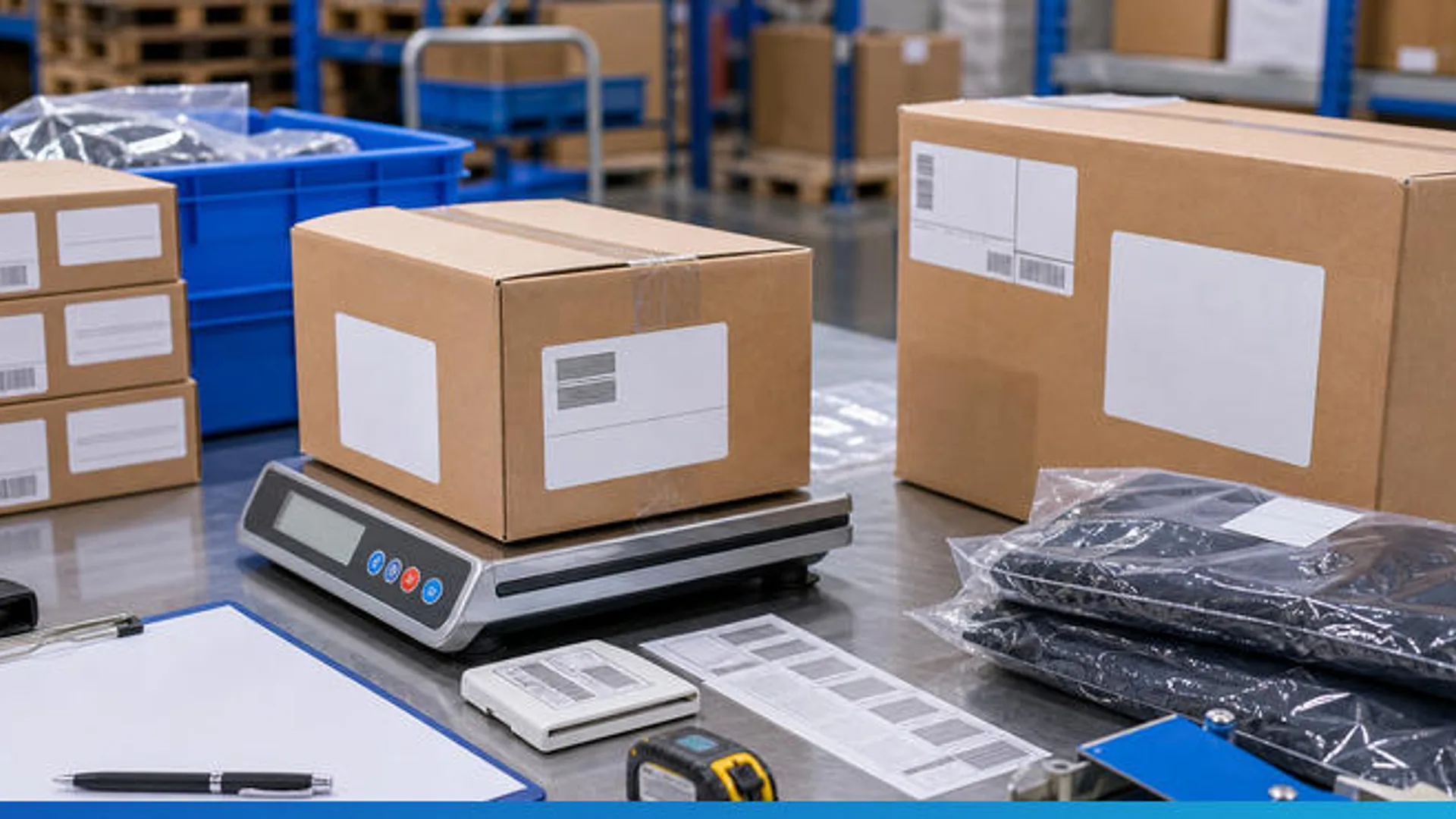
Cartonizing is where bags get crushed. In the line audit, a team stacked 14 duffels into a 22-inch carton and sealed it; the long side panel bulged and two units left permanent creases.
Batch the line: bag all units, then seal, label, and cartonize. Station batching cut touchpoints from four passes to one.
Pack-out sequence. Group units by SKU and hold one consistent count; mixed-SKU cartons caused most receiving discrepancies. Follow the six-gate packing sequence and keep each carton inside Amazon’s 50 lb ceiling, with a single item over that limit in its own carton.
Volumetric efficiency. Fold flat, not crushed: flatten along the base seam, loop straps loosely, never bend a frame or crease a stiff front panel. Foam strap memory shows a dent at delivery, so fill, weigh, and seal one pilot carton, then reopen it after 24 hours.
Master-carton checks. Labels must read at arm’s length and box-content data must match the units inside. Place outer labels on flat faces, top or long side; never let tape cover a barcode.
Factory gate audit. Reopen five cartons per lot: scan units, spot-check warnings and origin marks, count by hand, weigh cartons. Before carrier pickup, the shipment file, the carton file, and the physical cartons must match exactly.
⚠️ Experience Warning: Origin-side prep is cheaper once SKUs multiply, but only if you audit. I have seen factories cartonize beautifully and label the wrong SKU. The gate audit catches that in 20 minutes.
Troubleshooting FBA Bag Prep Failures
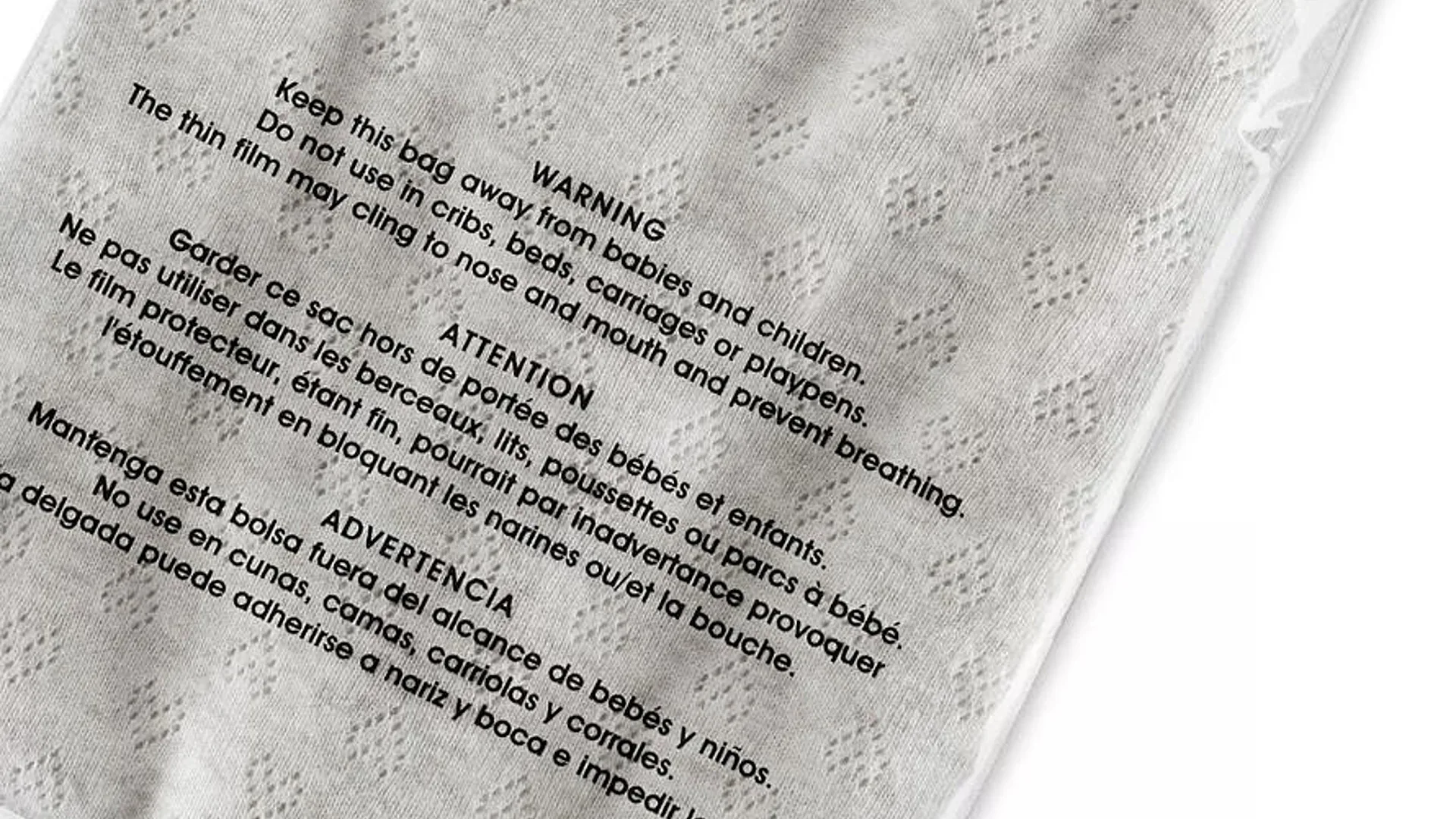
Missing or Misapplied Suffocation Warning
Problem: a warning hidden under film or tape, or missing on a 7-inch mouth.
Cause: a wrong flat measurement, or a label placed on a seam.
Fix: measure the mouth flat and, at 5 inches or more, place a legible warning on the lower third of the flat face.
Preventive control: the opening size goes into the SKU spec; no measurement means no seal.
Unscannable FNSKU on Curves, Zippers, or Wrinkled Film
Problem: a label bridges a zipper or film wrinkle, and the corner lifts before the first scan.
Cause: labeling the nearest surface instead of a flat panel.
Fix: move the FNSKU to a flat outer panel, press the edges, scan, recheck after 24 hours.
Preventive control: the diagram marks no seams, zippers, or gussets.
Mold, Hardware Marks, Strap Distortion, or Shape Collapse After Sea Freight
Problem: a musty lining, hardware rub, creased straps, or a collapsed base after transit.
Cause: weak moisture control and loose packing.
Fix: line-dry fabric 24 hours; use 10g silica for leather with a breathable dust bag, 5g for PU with no sealed film, 3g for fabric. Film the hardware, add a shape insert, and cross straps in an X inside the back-panel fold.
Preventive control: a pilot carton reopened after 24 to 48 hours, with strap rebound checked before sealing.
One defective sample carton means stop the line: pause, quarantine, audit the batch. Fix at origin before shipping, use a prep center for post-import cleanup, and a removal order only when rework costs more.
Caption failure photos by defect, as “warning under film flap” or “musty lining, collapsed base.” Rejections start as placement errors, not bad bags.
Final Thoughts
A finished unit looks almost boring: straps flat, film unwrinkled, the warning in the lower third, the FNSKU scanning at arm’s length, the origin mark sewn in, the carton weighing what its label claims. Protected, sealed, scannable, and legally marked, that is Amazon-ready in one photo.
Do not scale yet. Run one pilot shipment, photograph every station, and audit the second lot against those images; when they match, roll the SOP into repeat production.
Want a factory to build the bags and hand them over FBA-ready in one flow? Talk to the LeelineBags team here.
Moving into sourcing? Start with custom backpack manufacturing and custom handbag manufacturing. EU-bound lots can read the Portugal guide.
Lots crossing customs should price the landed-cost model first.
Methodology & Disclosure
This SOP rests on 50+ logged FBA bag shipments, one live prep-line audit, and a Q&A with Leo Jiang, LeelineBags’ Warehouse/Logistics Lead. The logs are Amazon-side receiving and rework records; the counts do not extend beyond that set.
LeelineBags is an OEM/ODM bag manufacturer and hosts this article: founded in Wuhan in 2015, a 50,000 m² plant, 500+ people, up to 500,000 units a month, ISO 9001, BSCI, OEKO-TEX, and GRS.
Those are published company facts; the prep checks come from shipment logs, not certification scope. The IQC/IPQC/FQC gate checklist covers the upstream checks.
Amazon’s prep and barcode pages were rechecked on 2026-11-17, so confirm the current version in Seller Central before you seal a lot. I receive no manufacturer kickbacks for these findings.
Frequently Asked Questions About Amazon FBA Prep for Bags
1. Is Amazon FBA Prep for Bags the same as standard FBA prep?
Mostly, but soft goods add two failure modes boxed products lack: bags compress, so strap memory and base creases need checking at pack-out and after transit, and the outer surface is rarely flat, which is where FNSKU labels lift.
2. Who is responsible for prepping bags before they reach an Amazon fulfillment center?
Since January 1, 2026, Amazon no longer offers prep and item-labeling on new US shipments. Prep and FNSKU labeling now sit with the seller or a chosen provider, whether that is the factory or a third-party prep center.
3. Do bags need a suffocation warning on the poly bag?
Yes, when the poly-bag opening measures 5 inches or more flat. Most bags exceed that, so plan for the warning by default and put it on the flat outer face in the lower third, never over a fold, seam, or zipper track.
4. Can I use the manufacturer barcode instead of an FNSKU?
It depends on whether the seller is a Brand Registry brand owner or a reseller, and the rules tightened on March 31, 2026 when Amazon ended commingling. Brand owners may use manufacturer barcodes in qualifying cases; resellers must label every new shipment.
5. Where should the FNSKU go on a bag’s poly bag?
On a flat outer panel, clear of seals, gussets, folds, zippers, and handles. A label that bridges a curve or seam lifts at the edge within about a day, and the scanner then fails on first pass.
6. How much desiccant does a leather or PU bag need for sea freight?
Leather takes 10g of silica with a breathable dust bag, PU about 5g with no sealed film, and fabric around 3g after a 24-hour line dry. Air freight carries less humidity, so the load is lighter. Never let silica sit against the lining.
7. Should FBA prep for bags happen at the factory or a US prep center?
At the factory when the supplier can follow the SOP: one handling touch and defects caught before freight. Use a US prep center for mixed-SKU cleanup after import.
8. What causes most FBA bag shipment rejections?
Placement errors, not poor bags. Across the 50+ sample, the repeat causes were suffocation warnings hidden under film, FNSKU labels lifting off curved or seamed surfaces, and moisture or strap distortion after sea freight.